

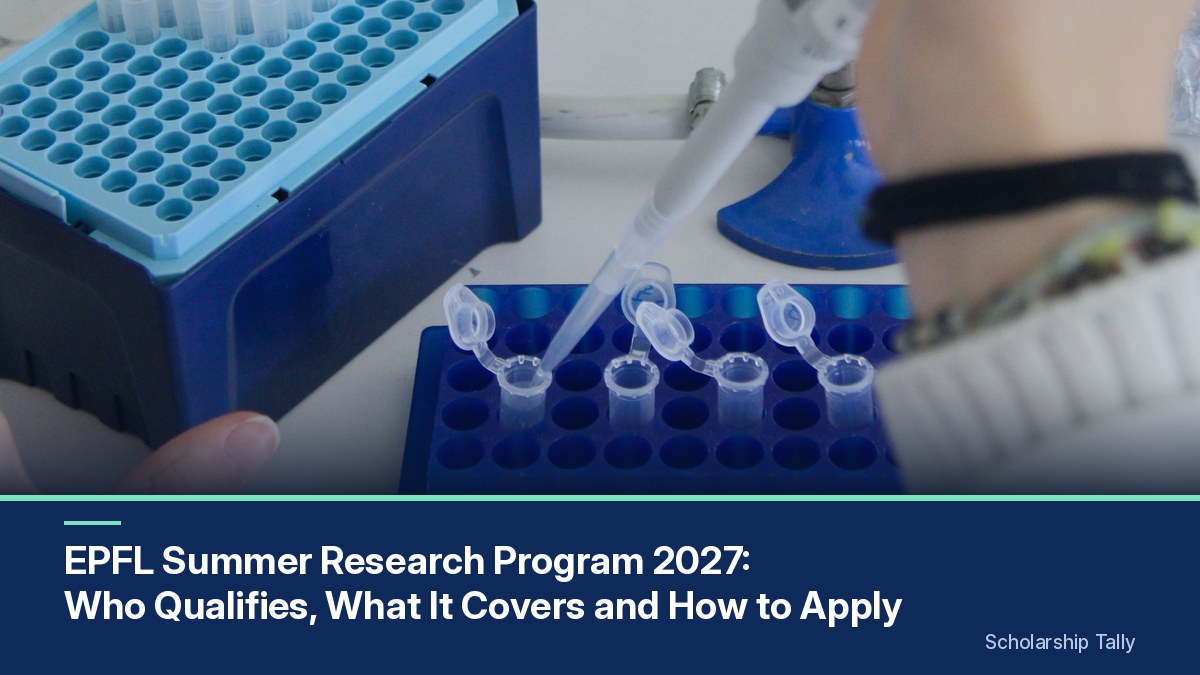
Applications for the 2027 Summer Research Program at the Ecole polytechnique federale de Lausanne (EPFL) School of Life Sciences close at 23:59 Central European Time (CET) on Sunday 15 November 2026. The eight-week program places bachelor and first-year master students in life sciences in an EPFL research lab in Switzerland from 5 July to 27 August 2027, with a stipend of 3,600 Swiss francs (CHF) from which housing and living costs are paid. The program’s frequently asked questions (FAQ) page says your referee receives the upload link only after you submit, and that the referee portal closes at the same deadline. Scholarship Tally’s view: submit by Sunday 8 November so your referee has a week to upload the letter.
This guide is a decision check for that application. It covers whether you sit inside the year-of-study and subject window, what the stipend really leaves after housing and how the travel money works, how to choose up to three labs, and how to finish an application that cannot be saved and has to be completed in one sitting. It does not replace EPFL’s pages; it turns them into checks and a plan you can act on.
By Derrick Ochieng for Scholarship Tally. Checked on 7 October 2026 against the program home page, the Program Description, How to Apply, FAQ, Program Committee, Our Supporters and Testimonials pages, and the program’s Impact Report 2025 (PDF). The EPFL pages show no last-updated date. Where they differ, we say so. Scholarship Tally is not part of EPFL, and we do not take applications.
Editorial note: A human editor used artificial intelligence (AI) to organise the material from the official pages and produce an initial draft, which helped structure a long set of program rules and application details. The editor then checked every date, rule and figure against those pages. Advice that is our own, rather than an official rule, is labelled as Scholarship Tally’s view.
EPFL Summer Research Program 2027 at a glance
| Item | Official position (checked 7 October 2026) | EPFL source |
|---|---|---|
| Program | EPFL School of Life Sciences Summer Research Program (SRP), running since 2006 | Program home page; Impact Report 2025 |
| Dates | 5 July to 27 August 2027; you must be on site for the whole period | Program home page; Program Description; FAQ |
| What you do | Eight weeks in one School of Life Sciences research group, about 40 hours a week, in English | Program home page; FAQ |
| Places | About 25 (the FAQ cites 25 places for 2026; the Program Description says 20 to 25 each summer) | FAQ; Program Description; Program Committee |
| Competition | Over 1,300 applications in 2026 | FAQ |
| Who | Students worldwide in a life-sciences-related degree who have completed at least two undergraduate years, up to the first master’s year, by the start; no Doctor of Philosophy (PhD) students | How to Apply; FAQ |
| Grades | Grade point average (GPA) equivalent to 3.75/4.0 or higher, or top 5% of your class | How to Apply |
| Stipend | CHF 3,600 for the two months; housing is booked and paid from it in advance, leaving approximately CHF 1,700 | Program Description; FAQ |
| Travel | Up to CHF 1,000 for overseas flights or CHF 500 for shorter distances, reimbursed after the program ends | Program Description; FAQ |
| Not stated | Visa fees, health or accident insurance | None of the reviewed pages |
| Deadline | 15 November 2026, 23:59 CET; the referee portal closes at the same time | How to Apply; Program Description; FAQ |
| Results | By email: before 20 December (FAQ) or about six weeks after the deadline (How to Apply) | FAQ; How to Apply |
What the program is, and what this guide adds
EPFL describes the Summer Research Program as eight weeks of lab immersion for international bachelor or first-year master students in life sciences. You join ongoing research in one lab of the School of Life Sciences, with mentoring by faculty and scientific staff. Around the lab work are scientific seminars, Friday afternoon workshops, lab visits and personal development activities. Every participant must also present a poster at the closing symposium on the last day. The workshops and poster are compulsory.
This is a standing program, not a one-off 2027 offer. The Impact Report 2025 says more than 420 international students have taken part since 2006, and that 16% of participants return to EPFL to continue their studies in some capacity. EPFL’s Our Supporters page lists the program’s donors and institutional supporters. There is one online application, and the program pages mention no separate donor application.
The year-of-study rule is on How to Apply, the essay limits and money mechanics are in the FAQ, and the referee timing is split between the Program Description and the FAQ. This guide puts those checks in the order you need them.
The FAQ also points to other EPFL summer options with their own eligibility rules: Summer@EPFL in computer and communication sciences, the E3 program in engineering, and EPFL research internships. None of them is covered here.
A 60-second eligibility check
Every check below is measured at the start of the program, 5 July 2027. Scholarship Tally’s view: treat each one as pass or stop, because strong essays cannot fix a failed rule.
Year of study: two undergraduate years done, no more than one master’s year
You must have completed at least two years of undergraduate work, up to the first year of a master’s degree, before the program starts. The FAQ is blunt: outside that window you are not eligible. PhD students are not eligible at all.
Enrolled for the whole program
You must be enrolled in a degree program during the entire SRP, from 5 July to 27 August 2027. If you finish your bachelor’s degree before the summer and are not yet in a master’s program, the FAQ says you can still apply if you have been accepted into, and confirmed your place in, a master’s program in a life-sciences subject by the program start date, and you plan a life-sciences career.
Subject: human-based life sciences
You must be currently enrolled in biology, biophysics, chemistry, bioengineering, bioinformatics, quantitative biology, genetics, a medical program or another life-sciences-related program, and show a strong interest in a life-sciences career. Related backgrounds are welcome, but you should have at least a few mainstream life-science courses on your transcript, such as cell biology or biotechnology. EPFL calls it a human-based life science program and says it does not select students whose background is animal science (veterinary) or plant science.
Grades: 3.75/4.0 or top 5%
How to Apply asks for a GPA equivalent to 3.75/4.0 or higher, or a place in the top 5% of your class. The FAQ says an application slightly below 3.75 will still be evaluated, but that chances are low because the program is very competitive. If your university uses another scale, the top 5% test is EPFL’s own suggested way to judge whether you qualify.
Full attendance
The FAQ says you must be on site for the entire time between the program dates, and it accepts that these dates do not suit some countries’ academic calendars.
English and lab experience
No proof of English is required, and there is no formal curriculum vitae (CV) or motivation letter. EPFL may invite you to a Zoom call during evaluation to check your English. Lab experience is a plus, not a requirement; the FAQ notes that most participants already have some, and How to Apply calls basic life-sciences understanding essential.
Who it fits, and who should not apply
The program fits a strong second-, third- or final-year bachelor student, or a first-year master student, in a human life-sciences field who wants a research career, can work in English for about 40 hours a week, sometimes including weekends (the FAQ gives cell culture as an example), and can stay in Switzerland for all eight weeks.
It does not fit PhD students, students who will not have finished two undergraduate years by July 2027, students who will no longer be enrolled during the summer, veterinary or plant science backgrounds, or anyone who cannot attend the full dates. Scholarship Tally’s view: it is also a hard fit if you cannot pay for your flight up front, for the reasons in the money section below.
Be realistic about the odds. The FAQ says EPFL received over 1,300 applications for 25 places in 2026, and the Impact Report 2025 says 26 students from 20 countries were selected in 2025. The committee, drawn from the five institutes of the School of Life Sciences, says its job is to assemble a diverse group. A careful application is worth the effort, but no one should plan their summer around it until a result arrives.
What the CHF 3,600 really covers
The Program Description says each student receives CHF 3,600 for the two-month period, covering housing and living costs. The official pages do not describe the program as fully funded, and you should not read it that way.
- Housing comes out first. EPFL books your room and pays for it from your stipend before you arrive. You then have approximately CHF 1,700 left to live on. Scholarship Tally’s view: treat that amount as the whole remainder for food, local transport and everything else. No weekly budget is published.
- Rooms are in Lausanne. The Program Description says near the EPFL campus; the FAQ says a short metro ride away. Rooms are usually single, with a kitchen and bathroom shared with other participants. EPFL says it cannot make special housing arrangements.
- Living on the remainder is possible but tight. The FAQ says students who are careful, for example by eating picnic lunches and eating in, can live on what is left, and that you need your own money for weekend travel and tourism.
- Travel is reimbursed, not prepaid. EPFL says the majority of travel costs to and from Switzerland is covered, up to CHF 1,000 for overseas flights and CHF 500 for shorter distances. The FAQ says this is reimbursed after the program is finished, so you buy the ticket yourself and get the money back later, up to the cap.
- Geneva labs pay more. Three listed labs are at Campus Biotech in Geneva, about 1 hour 15 minutes each way from Lausanne, where all students are housed. Students in Geneva labs receive a larger stipend to cover most of their travel to and from the program plus the commute. The amount is not published.
- Not stated: visa fees, and health or accident insurance. Do not assume either is covered. If that decides whether you can go, email [email protected] after reading the FAQ.
Scholarship Tally’s view: if your return flight is likely to cost more than the reimbursement cap, or you cannot carry the fare for several months, sort out the cash flow with your family or university before you apply rather than after you are selected.
How to choose up to three labs
You name up to three labs from the participating list (34 labs on How to Apply and the Program Description as checked). EPFL evaluates your application with input from those labs and finalises your lab assignment at the final selection. The FAQ adds a point that changes strategy: your chances depend partly on how many applicants choose the same top three labs, because popular labs have more applications to choose from. EPFL does not publish which labs are most popular.
For each lab choice, the application asks three questions of up to 800 characters each, including spaces:
- What specific aspects of the research in the lab do you find interesting?
- Which specific skills or techniques would you like to acquire from this lab?
- Is there a particular project you would like to pursue in the lab? Provide justifications and cite relevant papers.
Scholarship Tally’s view on choosing:
- Start from the lab websites linked on How to Apply and read recent work before you pick, because the third question asks you to cite papers and justify a project.
- Choose labs you can write about specifically. Three generic answers copied across three labs will read as generic.
- Do not choose by name recognition alone. Since crowded labs are harder, it is reasonable to include at least one lab whose work you know well even if it is less famous.
- Dry-lab projects exist. The list includes computational groups such as the Schrimpf Lab (NeuroAI), the Dal Peraro Lab (Biomolecular Modeling) and the A Mathis Lab (Computational Neuroscience & AI), and one testimonial describes a dry-lab genomics project done on computers.
- Check location. The list marks the Hummel, A Mathis and Van de Ville labs as Geneva, and the FAQ tells you to confirm a lab’s location on its website. A Geneva lab means daily commuting while you live in Lausanne.
If you only want one or two labs, the FAQ says to choose “none” in the menu for the remaining slot and write n/a, or a short sentence explaining why you chose fewer than three.
The one-sitting application and the short answers
How to Apply says it plainly: once you begin, you must finish in one sitting, and you cannot save and come back. Only complete applications are considered, and the online form is the only accepted format. Before you open it, have these ready:
- your transcript or transcripts, plus any translation and grading explanation;
- all six personal answers and the per-lab answers, already cut to length;
- your referee’s name and a working email address, with their agreement already given.
The personal questions replace the CV and motivation letter. Limits include spaces:
- your top three accomplishments or awards (1,000 characters);
- internship programs you have taken part in (800);
- relevant professional experience (800);
- an introduction: the key strengths you will bring to the program (800);
- what motivates you to pursue science, with specifics (800);
- your hobbies and interests (800).
With three labs, that is six personal answers plus nine lab answers (Scholarship Tally’s count). The FAQ also says you will be asked how you used AI to prepare your application. Scholarship Tally’s view: decide now how you will use any AI tool, keep a short note of it, and answer that question honestly; the specificity EPFL asks for, such as cited papers and particular techniques, has to come from your own reading.
Practical tip from us: 800 characters including spaces is a short paragraph, so draft in a document that counts characters with spaces, then paste. Do not write the answers inside the form.
Transcripts and grading scales
Selection uses your bachelor transcript (and your master’s transcript if you have started a master’s), or your school’s official list of classes and grades. The FAQ covers most edge cases:
- Language: transcripts in English, Spanish, French, German, Portuguese or Italian are accepted as they are. Otherwise translate into English; you may do it yourself, ideally with a faculty member signing that it is a true translation, and you must include the original.
- Official or not: official transcripts if possible and not too expensive; otherwise unofficial transcripts or screenshots from your student portal.
- First-semester master’s students: upload your bachelor transcript and a list of the courses you are taking now, if master’s grades will not arrive before 15 November.
- Missing or late transcripts: list your classes and grades received, plus classes still awaiting grades, and explain on the document why the full transcript is unavailable.
- Unusual grading scales: enter your result in another short format, such as 12.3/15, or write “Please see transcript” and add an explanation of the grading system, including how difficult each grade is to achieve.
Your referee: why the timing matters
You need one letter of recommendation. The FAQ suggests someone who can judge your academics, research potential and ability to work in a group, ideally a lab head or professor.
The timing is the trap. You cannot upload the letter yourself. Your referee only receives an automatic invitation with an upload link when you submit your application, and their portal closes at the same moment as yours: 15 November 2026, 23:59 CET. After you submit, you receive a link to a referee management portal where you can see when the letter arrives and send reminders. If your referee gets nothing, the FAQ says to check the address, then contact the program administrator with a confirmed address so they can resend.
Ask before you enter their details; EPFL says the same. The FAQ lists what the referee should cover in about 500 words:
- how many students are in your peer group and roughly where they would rank you (1 = first);
- how they know you;
- your academic excellence, creativity and aptitude for research;
- comments on how you would fit into an international program with group activities.
Scholarship Tally’s view: send your referee that list in October so they can draft early, and submit your application about a week before the deadline so they have time to upload.
A dated plan to submit by Sunday 8 November
This is Scholarship Tally’s planning aid, not an official timetable. It assumes you start this week and fit the work around full-time study.
- 7 to 11 October: run the eligibility check above. Ask your referee, share the 500-word brief, and confirm the email address they will use. Request your transcript.
- 12 to 18 October: read the participating lab websites and shortlist up to three labs. Note one or two recent papers per lab that you understand well enough to cite.
- 19 to 25 October: draft the six personal answers. Collect evidence for the accomplishments and internships answers.
- 26 October to 1 November: draft the three answers for each lab, including a project idea with cited papers.
- 2 to 7 November: cut every answer to its character limit, prepare any translation or grading explanation, and write down how you used AI.
- Sunday 8 November: complete the form in one sitting and submit. Your referee’s link goes out with a week to spare.
- 9 to 15 November: watch the referee management portal and send a polite reminder if nothing has arrived midweek.
Why not submit on 15 November? Because your referee would then have hours, not days. The time zone matters too. CET is one hour ahead of Coordinated Universal Time (UTC), so 23:59 CET on Sunday 15 November is 22:59 UTC. That is our own conversion from the CET time EPFL publishes; convert from UTC to your local time.
What happens after you submit
- Evaluation: the FAQ says applications are evaluated with input from your top three labs, and that you may be invited to a Zoom call to check your English.
- Results: the FAQ says results will be sent by email before 20 December, while How to Apply says about six weeks after the deadline. Scholarship Tally’s count puts six weeks at around 27 December. Treat the two official dates as a conflict.
- Lab assignment: the FAQ says lab assignments are finalised when the final selection is made.
- Visa, if you need one: EPFL says it will help, with an invitation letter and directions. The process can take more than three months, so do not start before EPFL’s instructions arrive, and act quickly when they do.
- The summer: you arrive for 5 July 2027 and stay until 27 August 2027, ending with the poster and closing symposium on the last day. Travel is reimbursed after that.
Where the official pages differ
Five small inconsistencies are worth knowing about. None changes the deadline.
- Results date: before 20 December (FAQ) versus about six weeks after the deadline (How to Apply).
- Number of places: 20 to 25 participants each summer (Program Description), 25 places in 2026 (FAQ) and a group of 25 (Program Committee), while 26 were selected in 2025 (Impact Report). We say about 25.
- Eligibility wording: the home page says international bachelor or first-year master students; How to Apply and the FAQ give the more exact two-years-done, up-to-first-master’s-year rule. Follow the exact rule.
- Housing location: near the campus (Program Description) versus a short metro ride from it (FAQ).
- Deadline wording: How to Apply calls 15 November “the new application deadline”, without saying what it replaced. Use 15 November 2026, 23:59 CET.
Common mistakes
- Opening the application before your essays, transcripts and referee details are ready, because the form cannot be saved.
- Choosing labs without reading their research, especially when popular labs may receive more applicants.
- Assuming the full CHF 3,600 is available for living costs after arrival, rather than accounting for the housing deduction.
- Leaving the submission and referee upload until the final hours.
Frequently asked questions
Is the EPFL Summer Research Program fully funded?
EPFL’s official pages do not describe the program as “fully funded”. The Program Description and FAQ say students receive a CHF 3,600 stipend from which housing is paid, leaving approximately CHF 1,700. The FAQ says travel is reimbursed after the program, up to CHF 1,000 for overseas flights or CHF 500 for shorter distances. Visa fees and health or accident insurance are not stated.
Can students from Africa, Asia or Latin America apply?
Yes. The FAQ says the program selects students from the entire world, and no country list or nationality rule is published. The 2025 cohort came from 20 countries.
Can a first-year bachelor student apply for 2027?
The How to Apply page and FAQ say you must have completed at least two years of undergraduate work by 5 July 2027. If your second year will not be finished by then, you are outside the program’s eligibility window.
I will have finished my bachelor’s degree by July 2027. Am I still eligible?
Yes, if you have been accepted into a life-sciences master’s program and confirmed your place by the program start date, and you plan a life-sciences career.
When does my referee get the upload link?
Only when you submit your application. The link is sent automatically, and the referee portal closes at 23:59 CET on 15 November 2026, the same time as the application.
What if my university does not use a 4.0 scale?
The FAQ says you can enter a grade in a format such as 12.3/15, or write “Please see transcript” and explain the grading system. How to Apply gives a GPA equivalent to 3.75/4.0 or higher, or top 5% of the class, as the grade rule.
Can I arrive late or leave early?
No. The FAQ says you must be on site for the whole program, from 5 July to 27 August 2027.
Who do I contact with questions?
Email [email protected], but only after reading the program site and the FAQ, as EPFL asks. Write in full sentences and explain your question clearly.
Official sources
- EPFL School of Life Sciences Summer Research Program home page (2027 dates, deadline and contact)
- Program Description (activities, stipend, housing, travel and the lab list)
- How to Apply and Participating Labs (eligibility, selection criteria, the lab list and the link to the online application)
- Frequently asked questions (eligibility edge cases, essay questions, transcripts, reference letter, money and visa)
- Program Committee (who selects participants)
- Our Supporters (program donors)
- Testimonials (former participants’ accounts)
- SRP Impact Report 2025 (PDF) (2025 cohort and program history)
Facts in this guide were checked on 7 October 2026. Dates and rules can change between cycles; if this guide and EPFL’s pages disagree, follow EPFL.