The MIT Summer Research Program (MSRP) brings undergraduates to the Massachusetts Institute of Technology (MIT) in Cambridge, Massachusetts, for nine weeks of paid research with an MIT faculty member. For 2027 the programme runs from June 7 to August 7, 2027, and the application closes on Tuesday, January 19, 2027 at 11:59 PM ET, with both recommendation letters due by the same moment, according to the MSRP Eligibility and Application page.
The MIT Summer Research Program is not open to every student. You must already be studying full-time at a college or university in the United States (not MIT), and international students on an F-1 visa also need work permission called CPT or OPT before the programme starts. This guide explains who fits, what MIT pays for, how to pick research mentors, what to submit, and the mistakes that end applications early. Facts were checked on 2 November 2026 against the MIT Office of Graduate Education pages listed at the end.
Quick facts
| Item | Details | Source |
|---|---|---|
| Run by | MIT Office of Graduate Education (MSRP General) | MSRP home page |
| Who | Undergraduates studying full-time at a U.S. college or university (not MIT) | Eligibility and Application |
| Year of study | Sophomores, juniors and non-graduating seniors with two academic years of college completed | Eligibility and Application |
| Programme dates | June 7 to August 7, 2027 (nine weeks, on site) | MSRP home page and FAQs |
| Application opened | September 29, 2026 | Eligibility and Application |
| Deadline | Tuesday, January 19, 2027 at 11:59 PM ET (letters too) | Eligibility and Application |
| Support | Weekly stipend, round-trip travel, university housing and a food subsidy | Overview and FAQs |
| Stipend amount | Not published on the MSRP pages | Checked 2 November 2026 |
| Cost to you | MIT says there is no cost to take part; food is not fully covered (you get a food subsidy) | FAQs |
| GPA | Minimum 3.5 overall or in your major (4.0 scale); MIT still considers applicants below 3.5 who show strong potential | Eligibility and Application and FAQs |
| Not in MSRP General | Biology and Brain and Cognitive Sciences (they use MSRP Biology/BCS) | Eligibility and Application |
| Decision | By March 31 | FAQs |
| Contact | [email protected], (617) 324-8453 | FAQs |
Who the MIT Summer Research Program is for
MIT describes MSRP as a way to “promote the value of graduate education” and to prepare undergraduates for graduate study at MIT and other universities. It started in 1986. The programme is a strong fit if you:
- Study full-time at a degree-granting college or university located in the United States or its territories.
- Will have finished at least two academic years of college by the start of the programme.
- Are interested in a graduate degree in one of MIT’s graduate programmes, and have a genuine interest in a career in academic research and/or teaching.
- Come from a background MIT encourages to apply. MIT says MSRP “prioritizes access for students with demonstrated need” and encourages applicants from rural, urban or under-resourced schools, first-generation students, and students who have overcome economic, social or educational barriers. MIT also says it “does not consider race, ethnicity, sex, or other protected characteristics in its admission processes”.
It is not for you if:
- You study at a university outside the United States, even if you are a U.S. citizen. MIT’s FAQs say these applicants, and exchange students, are not eligible.
- You are an MIT student, a graduate student, or a first-year student (first-year students at some colleges can look at the Leadership Alliance FYRE programme that MIT mentions instead).
- You want to work in Biology or Brain and Cognitive Sciences. Those departments run their own programme, MSRP Biology/BCS, and MSRP General does not take applications for them.
- You are aiming for an MBA or another Sloan professional degree. MIT says these do not count as the graduate interest MSRP looks for, although the MIT Sloan PhD Program does take part.
- You cannot be at MIT for all nine weeks. MSRP General is on site for the whole programme, and you may not take classes at MIT or elsewhere while it runs.
If you are a student in Africa, Asia or elsewhere who studies at a home university, this programme will not fit. Our guide to the EPFL Summer Research Program 2027 covers a different summer research programme with its own rules.
What you get, and what MIT does not say
The MSRP Overview lists the financial support as a “weekly stipend, round-trip travel to MIT, meal subsidy, and housing”. The FAQs add that there is no cost to take part, that housing is university housing for the full nine weeks, and that food is not fully covered: you get a food subsidy and several meals a week during programme activities.
Beyond the money, MSRP gives you:
- Research under the guidance of MIT faculty members, postdoctoral fellows and advanced graduate students, with a direct research supervisor (such as an advanced graduate student or a postdoc) assigned by your faculty mentor to oversee your project.
- Weekly faculty research talks and professional development seminars.
- The chance to write an abstract, a research paper and a graduate school statement of purpose.
- A final poster presentation at the Research Forum and Luncheon.
- A community service day and group outings such as barbecues, a Boston Harbor boat cruise and visits to local attractions.
- Access to MIT’s libraries, athletic facilities and health services.
What the MSRP pages do not say, as of 2 November 2026:
- How much the weekly stipend is. Do not trust a figure you see elsewhere unless MIT gives it to you.
- How many students are chosen, or what share of applicants get in.
- Whether there is an application fee. None is mentioned.
Also note that a place in MSRP does not guarantee admission to an MIT graduate programme. The FAQs say so directly.
The eligibility rules in plain words
These are the MSRP General rules from the Eligibility and Application page:
| Rule | What it means for you | Source |
|---|---|---|
| GPA | At least 3.5 overall or in your major, on a 4.0 scale | Eligibility and Application |
| Where you study | Full-time, degree-granting, at a U.S. institution in the U.S. or its territories, not MIT | Eligibility and Application |
| Year | Sophomore, junior or non-graduating senior, with two academic years of college done (credits from high school do not count) | Eligibility and Application |
| Graduation | You should not graduate before December 2027 | Eligibility and Application |
| Goal | Interest in an MIT graduate programme and a research or teaching career | Eligibility and Application |
| Status | U.S. citizen, permanent resident, DACA recipient, or international student with the right visa and work permission | Eligibility and Application |
Two details are worth reading twice:
- The GPA rule is not a wall. The FAQs say a 3.5 or higher is typical among admitted students, but applicants below 3.5 who show strong potential, such as grades that rise over time or real challenges explained in the statement, will still be considered.
- The graduation date is printed two ways. The application page says you should not graduate before December 2027, while one FAQ answer says students graduating before December 2026 are not eligible. If you graduate during 2027, email [email protected] and ask before you apply.
International students: the CPT or OPT step
International students can apply if they are studying full-time at a U.S. institution inside the United States. If you hold an F-1 visa, MIT says you must get work permission through Curricular Practical Training (CPT) or Optional Practical Training (OPT) from your own college before the programme begins, and you must have that approval by May 15, 2027.
MIT also warns that CPT guidance “significantly changed in August 2026”, and asks international applicants to contact their International Students Office immediately to check whether MSRP can count as CPT under the current rules. In practice, talk to that office before you put hours into the essays.
Studying at a U.S. university’s campus abroad, on a study abroad programme, in a hybrid programme, or in any arrangement with teaching outside the United States does not meet the rule.
Choosing your research area and mentors
The application asks for your top three research choices, each with a department, a faculty member and a research area. The Faculty Mentors and Research Groups page explains how this works:
- MIT publishes an Interested Faculty Mentor List of professors who want to host an MSRP student. On 2 November 2026 the page said the list is “Launching November, 2026”. The FAQs say it is updated weekly through the application deadline, and that it is not complete, so you do not have to choose from it.
- MIT says about 70% of a cohort is usually placed with a mentor from that list, but you may name any MIT faculty member.
- Naming a professor does not guarantee a place in that lab. The FAQs say MIT does its best to place admitted applicants “in their top choice or a closely related lab”.
- Do not email professors about admission or placement. The FAQs say contacting faculty can complicate admissions and limit MIT’s ability to match students with mentors fairly.
MSRP General takes students in many fields, not only engineering. The Overview lists 28 participating departments, including Economics, Linguistics, Philosophy, Political Science, Urban Studies and Planning, Mathematics, Physics and Electrical Engineering and Computer Science. The FAQs add that faculty from all five MIT schools and the Schwarzman College of Computing can host MSRP General students.
What you submit
| Part | What MIT asks for | Source |
|---|---|---|
| Essays | Answers to all questions: your academic journey, barriers you faced, research interests, and how MSRP will help your path to graduate school | Eligibility and Application |
| CV | One to two pages: education, research, skills, any publications, activities and leadership | Eligibility and Application |
| Transcript | Unofficial transcript from every institution attended; it must be unlocked | Eligibility and Application and FAQs |
| Letters | Exactly two recommendation letters, sent online by your recommenders | Eligibility and Application |
| Research choices | Top three: department, faculty member and research area | FAQs |
Rules for the letters, from the FAQs:
- At least one letter must come from a faculty member at a school where you took classes or did research.
- If you have done research before, one letter must come from your research supervisor.
- If you did MSRP before, one letter must come from your MIT research mentor.
- Only two letters are read. If more arrive, MIT reads the first two it receives.
- Your recommenders get an email with a link to upload their letter, so ask them to check their spam folder. You can resend the link at any time before the deadline, even after you submit.
How to make your application stronger
These are practical suggestions based on what MIT says it looks for. They are not published selection criteria.
- Answer the “why you” question honestly. MIT says it wants to understand your journey, the support you have had, and how MSRP can speed up your growth. Specific moments work better than general claims.
- Link your research interests to real MIT work. Read the department pages and name three faculty choices whose current research matches what you want to learn, and say why.
- Pick recommenders who know your work well. A professor who supervised a project usually has more to say than a famous name who barely knows you.
- Keep your CV to two pages and put research, lab skills and leadership near the top.
- Apply to more than one programme. MIT’s own Office of Graduate Education encourages this, and links to other summer research programmes at MIT.
Step-by-step application
- Check that you meet every rule above, including the CPT or OPT step if you are on an F-1 visa.
- Decide between MSRP General and MSRP Biology/BCS. Biology and Brain and Cognitive Sciences applicants go to the separate programme.
- Ask your registrar for an unlocked unofficial transcript from every college you have attended.
- Choose two recommenders and ask them early. Tell them the letters are due by January 19, 2027.
- Browse the Interested Faculty Mentor List and MIT department websites, and choose your top three research options.
- Start from MIT’s Eligibility and Application page and use its Apply Here button. It opens MIT’s Program Connect Application Management page, where you can log in or create an account. Once signed in, enter your recommenders’ details early, so they get the upload link in good time.
- Write and upload your essays and your CV.
- Submit before Tuesday, January 19, 2027 at 11:59 PM ET, then check that both letters have arrived.
- Watch your email. MIT says decisions go out by March 31.
Timeline for 2027
| Date | What happens | Source |
|---|---|---|
| September 29, 2026 | Application opened | Eligibility and Application |
| November 2026 | Interested Faculty Mentor List launches | Faculty Mentors page |
| December 2, 2026 | Online information session at 4:00 pm ET | Eligibility and Application |
| January 19, 2027 | Deadline at 11:59 PM ET for the application and both letters | Eligibility and Application |
| By March 31 | Admission decisions | FAQs |
| May 15, 2027 | F-1 students must have CPT or OPT approval | Eligibility and Application |
| June 7 to August 7, 2027 | Programme on site at MIT | MSRP home page and FAQs |
The FAQs write the deadline as “11:59 PM EST”, which is the same moment as 11:59 PM ET in January. One note on the start date: the programme dates say June 7, while the note for F-1 students mentions beginning the programme on June 8, 2027. Plan to be available from June 7, and ask MSRP if your travel depends on it.
Mistakes to avoid
- Applying from a university outside the United States. Only students at U.S. institutions inside the United States qualify, and that includes U.S. citizens.
- A locked transcript. MIT says a locked or password-protected transcript means your application will not be considered.
- A missing letter. If both letters are not in by the deadline, the application is incomplete and is not reviewed. MIT cannot extend the deadline for missing letters.
- Extra letters. A third letter is not read and does not help.
- Emailing professors. Use the application to name your choices instead.
- Applying to MSRP General for Biology or Brain and Cognitive Sciences. Use MSRP Biology/BCS.
- Leaving CPT or OPT to the last minute. F-1 students need approval by May 15, 2027.
- Planning summer classes or exams during the programme. You cannot take classes during MSRP, and you must be on site for all nine weeks, so arrange early exams if needed.
- Treating MSRP as a route into MIT. A place does not guarantee admission to an MIT graduate programme.
Contacts
- MSRP email: [email protected]
- MSRP phone: (617) 324-8453
- Application technical help: [email protected] (copy [email protected], as the FAQs suggest)
- Information session registration (December 2, 2026): MIT Zoom registration page
FAQ
Is the MIT Summer Research Program paid?
Yes. MIT provides a weekly stipend, round-trip travel to MIT, university housing and a food subsidy, and says there is no cost to take part. The MSRP pages do not publish the stipend amount.
When is the MSRP 2027 deadline?
Tuesday, January 19, 2027 at 11:59 PM ET. Both recommendation letters must also arrive by then.
Can international students apply?
Yes, if they study full-time at a U.S. institution inside the United States. F-1 students need CPT or OPT approval by May 15, 2027. Students at universities outside the United States, and exchange students, are not eligible.
Can I apply with a GPA below 3.5?
MIT will still consider you if you show strong academic potential, for example rising grades or challenges you explain in your statement.
Can first-year students apply?
Not to MSRP General. MIT points first-year students at some colleges to the Leadership Alliance FYRE programme.
Do I need to contact a professor first?
No. MIT asks you not to contact faculty about admission or placement. List your top three choices in the application.
Which subjects can I research?
Fields across MIT’s five schools and the Schwarzman College of Computing, except Biology and Brain and Cognitive Sciences, which use MSRP Biology/BCS.
Does MSRP guarantee a place in an MIT graduate programme?
No. The FAQs say acceptance does not guarantee admission to MIT graduate programmes.
Can I take summer classes while in MSRP?
No. MSRP is full-time, and interns may not enroll in classes at MIT or elsewhere during the programme.
What happens if one of my letters is late?
Your application is incomplete and will not be reviewed, and MIT cannot extend the deadline for missing letters. Check early that both have arrived.
What if I graduate during 2027?
Check with MIT first. Its application page gives December 2027 as the earliest graduation date, but one FAQ answer gives December 2026. If you graduate between those two dates, email [email protected] before you apply.
When will I hear back?
MIT says applicants are told their decision by March 31.
Official sources
- MIT Summer Research Program home page, MIT Office of Graduate Education
- MSRP Overview
- MSRP Eligibility and Application
- MSRP FAQs
- MSRP Faculty Mentors and Research Groups
- MIT Program Connect Application Management page, opened by the Apply Here button on the Eligibility and Application page
Facts were checked on 2 November 2026. If anything differs, follow MIT’s official pages. Scholarship Tally is not affiliated with the Massachusetts Institute of Technology.
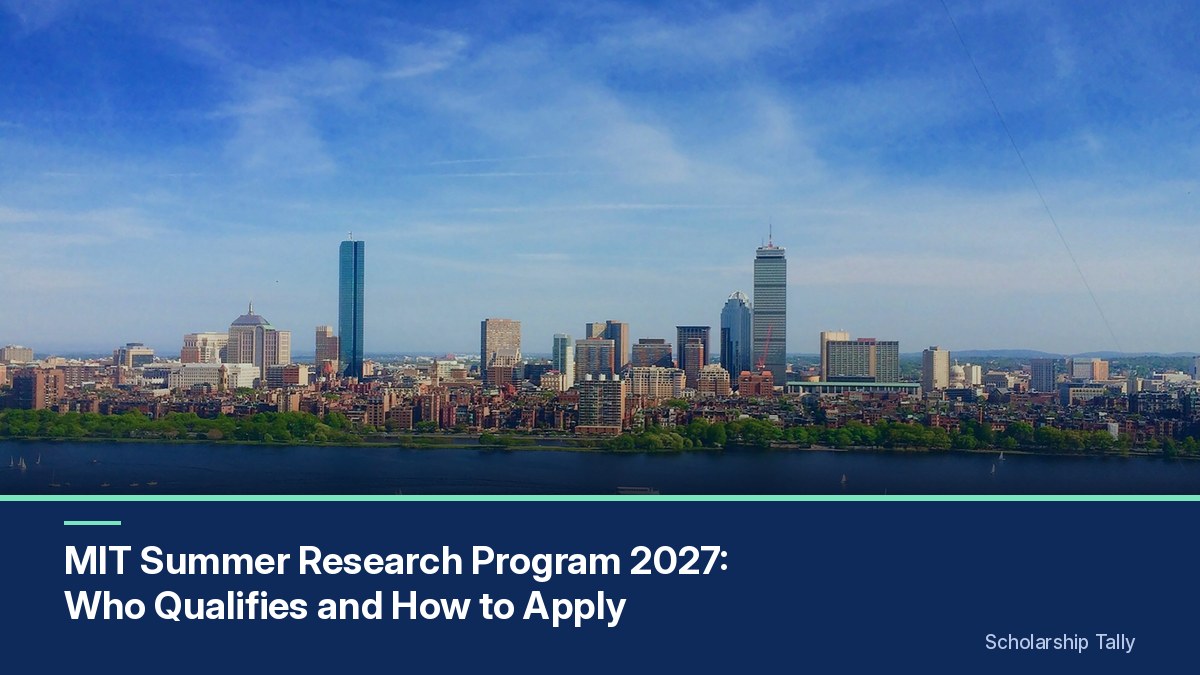
Photo by jacob Licht on Unsplash; cropped, tinted and title bar added.