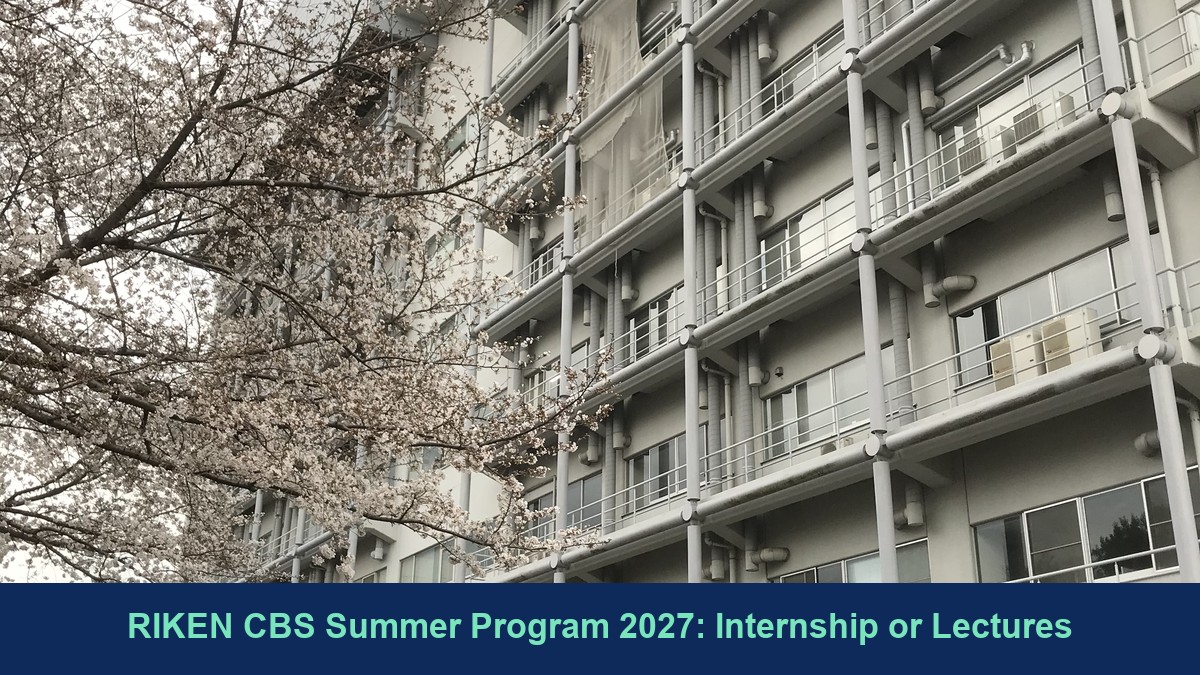
The RIKEN Center for Brain Science (RIKEN CBS) runs a summer program at its Wako campus in Saitama, which the program page describes as just outside Tokyo. It is not a degree, and it is not a monthly stipend. You apply for a two-month laboratory internship (Plan A), a five-day lecture course (Plan B), or both. Selecting both on the form is the application choice. It is not a promise that the laboratory will free you for every lecture. The program page says an intern may attend the lectures only if the lab schedule allows. Lectures, discussions, and poster sessions are in English. The program page says the program is sponsored by the International Brain Research Organization (IBRO).
Facts were checked on 12 November 2026 against the RIKEN CBS Summer Program page, its Apply page and its Before Applying page. If anything differs, follow the official pages.
Plan A runs from 8 June to 5 August 2027. Orientation is on 8 June. The final presentation and closing ceremony are on 5 August. Plan B runs from 5 July to 9 July 2027. The Apply page says the form opened at 9:00 a.m. Japan Standard Time (JST) on Monday 9 November 2026 and closes at 9:00 a.m. JST on Friday 8 January 2027. The same line prints the opening as “9:00 a.m. (JST)” and the close as “9:00 AM (JST)”. That is one clock time, not two. It is not the end of the day.
There is no registration fee. Meals and other daily living costs are yours. Airfare and a room are not automatic. The program page says RIKEN provides those only if you ask for financial support and the request is approved. Before Applying adds that people who receive a salary or other financial support are not eligible for that help, and it prints regional caps. The short money list on the program page does not repeat the salary bar or the caps. Read both.
Derrick Ochieng for Scholarship Tally checked this guide against the RIKEN Center for Brain Science’s Summer Program page, its Apply page and its Before Applying page on 10 November 2026. It was drafted with AI assistance from that reading.
Scholarship Tally is independent of RIKEN and the International Brain Research Organization and cannot assess your application.
At a glance
| Item | What the official pages say |
|---|---|
| Program | Plan A, a two-month lab internship. Plan B, a five-day lecture course. You may apply for both. Not a degree |
| Where | RIKEN Wako Campus, 2-1 Hirosawa, Wako, Saitama. The program page says just outside Tokyo. Lectures and posters are on the 2nd floor of the Administrative Headquarters (C00) |
| Who | Beyond high school, and enrolled at a school or a company from application through the program. Usually graduate students or new postdocs. Other positions are encouraged. High school students cannot apply |
| Money | No registration fee. Meals are not paid. Airfare and accommodation only if a support request is approved, and not if you already have a salary or other funding |
| Apply | One form. Opens 9:00 a.m. JST on 9 November 2026. Closes 9:00 a.m. JST on 8 January 2027. You cannot save a draft before you submit |
| Decision | By email, usually around mid-February. No day is printed. No appeal is published |
| After a yes | Acceptance does not guarantee you can attend. A visa may not arrive in time |
Who can apply
The program page, Before Applying, and the Apply page use the same eligibility list. High school students cannot apply. You must be beyond high school. You must attend the whole program on site. A shorter stay is not allowed. You must be enrolled in an academic institution or a company when you apply, and you must stay enrolled through the program. If you are on a gap year, or not yet enrolled when you apply, you must provide a certificate of enrollment from the institution or company you will be enrolled in during the summer program.
The program page also says participants are usually enrolled in graduate programs or have recently begun postdoctoral research, and that applicants in other positions are encouraged to apply. Those are two sentences, not one rule. The pages do not print the word undergraduate. They do not ban an enrolled undergraduate, and they do not say a graduate place is required. They do ban high school students.
If you are not a Japanese national, you need a valid passport. If your nationality needs a visa for Japan, getting the visa is your job. The pages link Japan’s Ministry of Foreign Affairs visa list and a visa flowchart. They say a visa that does not arrive in time can stop you attending even after you are accepted. They do not say Japanese nationals must hold a passport to apply.
The two plans
Plan A is two months in one RIKEN CBS laboratory, from 8 June to 5 August 2027. The dates cannot be moved for your convenience. You take part in the lab’s work. You may also attend the lecture course if the lab schedule allows. You must attend the Neuroethics workshop in the lecture schedule, present a poster during the lecture-course week, give a presentation on the internship at the end, and send the course survey. If you miss these, Before Applying says financial support can be refused and a certificate of attendance may not be issued.
The program page lists these 2027 host laboratories. It calls them potential host laboratories.
| PI | Laboratory |
|---|---|
| Adrian Moore | Neurodiversity |
| Aya Takeoka | Motor Circuit Plasticity |
| Hokto Kazama | Circuit Mechanisms of Sensory Perception |
| Jun Nagai | Glia-Neuron Circuit Dynamics |
| Kazuhisa Shibata | Human Cognition and Learning |
| Kentaro Miyamoto | Imagination and Executive Functions Team |
| Louis Kang | Neural Circuits and Computations Unit |
| Lukas Ian Schmitt | Distributed Cognitive Processing |
| Masako Tamaki | Cognitive Somnology RIKEN Hakubi Research Team |
| Nobutaka Hattori | Neurodegenerative Disorders Collaboration Laboratory |
| Takuya Isomura | Brain Intelligence Theory Unit |
| Taro Toyoizumi | Neural Computation and Adaptation |
| Thomas McHugh | Circuit & Behavioral Physiology |
The Apply page encourages you to contact the lab head in advance with a proposal for the internship. It also says the program office cannot take further questions about project proposals.
Plan B is the lecture course, 5 July to 9 July 2027, on site. The Apply page says partial attendance is not permitted. You present a poster and you submit the course survey. The same warning applies: missing a requirement can cost the financial support and the certificate.
Every participant presents a poster on research at their current institution, past, present, or future. Before Applying sets the board at 876 mm wide by 1643 mm high, A0, portrait. The Apply page says you print it before you travel. No printer is available during the program.
What it pays, and what it does not
The three pages do not print a monthly stipend. Do not budget as if one exists.
Before Applying says there is no registration fee to apply. It also says you pay for meals and other daily living costs. It also says that if you do not receive financial support, you arrange and pay for your own airfare, travel inside Japan, and accommodation.
Financial support is a request, not a prize that comes with a place. You submit a letter asking for it when you apply. Before Applying says it may be provided if that request is approved when you are accepted. Approved support can cover a round-trip airfare, or a bullet-train fare if you are travelling inside Japan, plus accommodation during the program. You buy the ticket yourself. RIKEN reimburses you after you go home and after you file the documents it asks for. People who receive a salary or other financial support are not eligible. If you do not submit the letter, or the request is not approved, nothing is reimbursed.
The caps are on Before Applying, not in the short list on the program page. The page says the full fare may not be reimbursed, and that the amount can change with exchange rates. It prints these maximums: 300,000JPY for Europe, the Middle East, Africa, and North&Latin America; 150,000JPY for India and Oceania; 100,000JPY for Asia. The page prints “North&Latin America” and “300,000JPY” in that form. People on approved support must follow RIKEN’s travel itinerary. Extra costs from a personal routing are yours. The page says more detail goes to successful applicants. It does not print that later date here.
Housing is assigned for everyone who does not live within commuting distance. That assignment is not the same as a free room. The program page says only people whose financial support is approved are exempt from accommodation expenses. Plan A housing is named as RIKEN I-House. Plan B housing is named as Hotel Toyoko Inn in front of Wako-Shi Station. Before Applying says the office assigns the room type. In principle the room is single, but it may be shared, and you cannot choose. You cannot bring family or friends who are not in the summer program. If you want to stay with them, you arrange a room off campus.
Plan A has two further costs the January form does not collect. Before Applying says every internship participant must buy accident insurance, at their own expense. Check whether your school or employer already covers it. A physician must complete a medical examination within six months before you leave for Japan, in English or Japanese. That exam is not on the Apply page’s document list for 9:00 a.m. JST on 8 January 2027.
How to apply
Use the 2027 application form linked from the Apply page. The page says applications are open. Documents must be in English. An incomplete file is not reviewed. A late file is not accepted, for any reason.
Two rules on that page have to be read together. If you want Plan A and Plan B, select “Both” in the one form. Do not send a separate application for each plan. The same page also says more than one application from the same person is allowed, and that only the most recent submission counts. An earlier form does not stay in the review if you send another one.
You cannot save the form as a draft. Prepare the answers and the files before you open it. After you submit, confirmation emails go to you and to your recommender. You can change the submitted form with the link in your confirmation email, until 9:00 a.m. JST on 8 January 2027. That edit link is not the same thing as a draft save. Use that link. The page does not tell you to email the file.
Questions that Before Applying does not answer go through the Summer Program inquiry form. The three pages do not print an email address for applications. Do not invent one, and do not send the file to a RIKEN address you found somewhere else.
Documents to upload
The Apply page splits the file by plan. Everything in the list, including the recommendation, must be in by 9:00 a.m. JST on 8 January 2027. The medical exam and the accident insurance are not in this list. They are internship requirements before you travel, described above. Do not treat them as part of the January file, and do not treat the January list as the last document you will ever need if you are on Plan A.
Plan A asks for five items if you want financial support, or four if you do not:
- A CV in any format. Include education, starting with the most recent degree, your current affiliation, the highest degree, and the years. Also include research experience and publications. The page links a sample CV.
- A motivation letter of approximately 500 words. Cover why you want to attend, your research background, and how you will use what you learn.
- An internship project description. No set format and no word limit. Be specific, say whether you already know the methods you plan to use, and set goals that fit inside the two months.
- One letter of recommendation. Your academic supervisor uploads it. The letter is not a file you attach yourself.
- A letter requesting financial support, only if you need it. No set format and no word limit. Say why you need the support. People with a salary or other funding are not eligible for the support.
Plan B asks for the CV, the motivation letter, the recommendation, and the financial-support letter if you need it. It does not ask for the project description.
The recommendation steps on the Apply page are: ask your supervisor to write the letter before you submit; after you submit, the office emails them a link; they upload it; you and they get a notice when that is done. You can see the letter’s status on the application site. You are still responsible for the letter arriving by the deadline. A late letter is not accepted. One letter covers Plan A and Plan B. The page does not ask for a second referee.
Dates
| When | What is printed |
|---|---|
| 9 November 2026, 9:00 a.m. JST | The Apply page says the form opens. No second opening time is printed |
| 8 January 2027, 9:00 a.m. JST | The form closes. The recommendation must be in by then. Late files are not accepted |
| Around mid-February | Results by email. No calendar day is printed. Individual feedback is not provided |
| 8 June 2027 | Plan A starts, with orientation. The internship dates cannot be shifted |
| 5 July to 9 July 2027 | Plan B, on site. Partial attendance is not permitted |
| 5 August 2027 | Plan A final presentation and closing ceremony |
| Before departure | Plan A only: accident insurance, and a medical exam within six months of travel. Not part of the file due at 9:00 a.m. JST on 8 January 2027 |
The program page, the Apply page, and Before Applying do not publish an appeal. Before Applying says individual feedback on selection results will not be provided. The inquiry form is for a question the Before Applying page does not answer. It is not described as an appeal. Acceptance is not the last step. The Apply page says a visa may still stop you attending.
Application mistakes to avoid
- Budgeting a stipend or free meals. The pages do not print a stipend. Meals are your cost.
- Treating a place as a paid ticket. Airfare and the room are reimbursed only if you request support and RIKEN approves it, and not if you already have a salary or other funding.
- Assuming the regional cap is the fare you will get. Before Applying says the full amount may not be reimbursed.
- Sending two forms, one for each plan. The page says to select Both. If you do send more than one form, only the latest is reviewed.
- Opening the form before the CV, the letter, and the project description are ready. You cannot save a draft.
- Leaving the recommendation late. Your supervisor uploads it, and it still has to arrive by 9:00 a.m. JST on 8 January 2027.
- Planning a shorter visit, or skipping the poster, the Neuroethics workshop, or the final talk. The pages say that can cost the money and the certificate.
- Arriving without a printed poster. No printer is provided.
- Reading an acceptance email as a promise that you will enter the program. The visa is your responsibility, and the pages say it can fail in time.
FAQ
Is this a scholarship with a stipend?
No. The program page, the Apply page, and Before Applying do not print a stipend. There is no registration fee. You pay for meals. A round-trip fare and accommodation can be reimbursed if you request support, the request is approved, and you do not already receive a salary or other financial support. You buy the ticket first. The caps differ by region.
Can an undergraduate apply?
The pages do not use the word undergraduate. They say you must be beyond high school, and that participants are usually graduate students or people who have recently started postdoctoral research. The same paragraph encourages applicants in other positions. You must also be enrolled at a school or a company, including a future enrollment certificate if you are on a gap year. High school students cannot apply. The pages do not add a separate undergraduate ban.
Does the medical exam have to be in by 9:00 a.m. JST on 8 January 2027?
No. The list due at 9:00 a.m. JST on 8 January 2027 is the CV, the motivation letter, the project description if you want the internship, the supervisor’s recommendation, and the financial-support letter if you are asking for help. The medical exam and accident insurance are Plan A rules for the months before you fly. Before Applying says the exam is within six months before departure, in English or Japanese, and that you buy the insurance yourself. Those are not on the Apply page’s upload list.
Can I do the internship and the lecture course?
Yes, if you select Both on the one form. Do not send two applications for that. The program page also says an intern may attend the lectures only if the laboratory schedule permits. Selecting Both is the application rule. The lab schedule is a separate limit on actually sitting in the lectures. Only your latest submission is reviewed if you send the form more than once.
What if I am not selected, or the visa is late?
Results usually come by email around mid-February. No day is printed. The pages do not publish an appeal, and they say you will not get individual feedback. An acceptance email is not a guarantee. The Apply page says a visa may not be granted in time, and that this can keep you out of the program. Questions that are not answered on Before Applying go to the inquiry form, not to an application inbox. The pages do not print one.
Official sources
- RIKEN CBS Summer Program 2027, RIKEN Center for Brain Science. The two plans, dates, eligibility, the host-lab list, the short financial-support list, and where the lectures are held.
- Apply 2027. The 9:00 a.m. JST window, the document list, the draft-save rule, the edit-after-submit rule, and the “Both” option.
- Before Applying. The salary bar, the yen caps, meals, insurance, the medical exam, poster size, and the statement that feedback is not provided.
- 2027 application form. The form the Apply page links.
- Summer Program inquiry form. The contact path on Before Applying and on the Apply page. Not an application address.