The AfOx Graduate Scholarships can cover the full course fee for up to three African applicants joining the University of Oxford’s 2027–28 MBA, plus a grant for living costs of at least £21,805. The application route is the MBA itself: Saïd Business School says there is no separate scholarship form, but your MBA application must be submitted by 6 January 2027.
Derrick Ochieng for Scholarship Tally checked on 17 November 2026 against the Saïd Business School AfOx Graduate Scholarships page, its MBA application guidance and Oxford’s living-cost estimates. Scholarship Tally is independent of Oxford; this article was drafted with AI assistance and cannot assess your application.
The award can make a substantial difference, but you still need a plan for costs and payment timing. The school lists a £75 MBA application fee and a £9,800 deposit for offer holders. Its scholarship page does not say whether either is waived or reimbursed for an AfOx recipient. Ask the MBA admissions and scholarship team before relying on a waiver.
At a glance
| Question | Official information |
|---|---|
| Award | AfOx Graduate Scholarships, including up to three for the 2027–28 Oxford MBA |
| Degree | One-year, full-time MBA at Saïd Business School, University of Oxford |
| Who | African citizens ordinarily resident in Africa, without an earlier master’s degree, who demonstrate commitment to Africa’s development |
| Funding | Full course fees and a living grant of at least £21,805 |
| Apply | Submit the MBA application; no separate scholarship application is required |
| Deadline | 6 January 2027; the scholarship page does not state a clock time or time zone |
| Course start | September 2027; the precise start day is not stated on the pages checked |
| MBA outcome | Stage 4 decisions are scheduled for 5 March 2027; this is not a published scholarship result date |
Is the MBA scholarship right for you?
This particular page is about the AfOx awards offered with Saïd Business School for the 2027–28 MBA. Its criteria require you to be an African citizen ordinarily resident in Africa, not to have already taken a master’s degree, and to demonstrate a commitment to the continent’s development. These are scholarship requirements; you must also satisfy the MBA admission requirements.
The school says MBA applicants should have at least two years of full-time work experience and a recognised undergraduate degree. It asks for a one-page CV showing your experience. Applicants need a GMAT or GRE result regardless of their previous work experience, studies or qualifications. Those requirements mean this is not a shortcut around the MBA admissions process.
The school does not publish an age limit or a universal minimum undergraduate grade on the scholarship page. That does not remove the MBA admissions committee’s assessment of your academic record, test scores, career progression and fit. If your qualification, residency circumstances or earlier study history is unusual, ask the school how it will assess them before paying for an application.
Scope matters: Oxford’s general scholarship listing says that details for some 2027–28 AfOx awards are still to be confirmed. The Saïd page specifically confirms up to three awards for the MBA. Do not assume that the conditions or process described here apply unchanged to every other Oxford master’s course.
What does the money cover?
The award pays the full MBA course fees and provides a living-cost grant of at least £21,805. The school also describes tailored training, networking and support before, during and after the time at Oxford. It does not publish a total cash value or a payment schedule on the MBA scholarship page.
Oxford lists the 2027–28 MBA course fee as £94,120. For an eligible recipient whose full course fee is covered, the worked tuition calculation is:
£94,120 course fee − £94,120 scholarship coverage = £0 remaining course fee.
That example addresses the stated MBA course fee only. It does not prove that every cost of applying, moving or living in the UK is covered, or that a recipient can avoid making an upfront payment. The living grant is a separate part of the award, not a reduction to the fee figure in this calculation. Ask the school how the grant is paid and when it becomes available.
The school’s scholarship page does not spell out whether the award pays for flights, visa charges, the UK immigration health surcharge, dependants or every personal expense. Do not assume either coverage or exclusion from silence; ask the school for the offer terms. Oxford’s general living-cost guidance says these costs may need additional provision and are outside its standard living-cost table.
What is left to pay for living in Oxford?
Oxford estimates that one full-time student without dependants will need £1,475–£2,175 per month in 2027–28. Its published 12-month range is £17,700–£26,100. The figures include estimated accommodation, food, personal items, social activities, study costs and other spending. They are planning estimates, not a quote for your own circumstances.
Compare those figures with the scholarship’s stated minimum grant, without assuming that every recipient receives exactly the minimum:
| Twelve-month comparison | Calculation | Result |
|---|---|---|
| Lower official living-cost estimate | £21,805 − £17,700 | £4,105 left in this simple comparison |
| Upper official living-cost estimate | £26,100 − £21,805 | £4,295 potential shortfall |
These are comparisons, not promises about your bank balance. Your actual grant could be higher than £21,805 and your expenses could differ. The table does not include visa or immigration health surcharge, travel, dependants or other costs outside Oxford’s standard estimate. It also does not account for when grant instalments arrive. A grant paid later will not necessarily solve a payment required before departure.
Before accepting an offer, make a personal budget for the months you will spend in Oxford and ask for written scholarship terms. Check what you must pay before the award begins, how the grant is scheduled, and whether you need extra funds to bridge an early payment. Oxford’s cost range is for one student; it should not be presented as a family budget.
Application fee and the £9,800 deposit
The MBA application page lists a £75 application fee. The MBA FAQ allows applicants who live in a listed low-income country and cannot afford the fee to request a waiver within the online form. The AfOx page does not promise a separate scholarship-specific waiver or refund. The eligible-country list and the applicant’s residence matter; a waiver is not automatic.
The MBA admissions page says an offer holder must pay a £9,800 deposit to secure a place and confirm a college preference. The MBA FAQ says the deposit is non-refundable, is offset against the course fee, and is normally due within 30 days of an offer; later-stage candidates may have less time. The AfOx page promises full course fees but does not explain whether a scholar’s deposit is waived, deferred or reimbursed. Full course-fee funding alone does not answer that timing question. Ask admissions and the scholarship team how the deposit applies to your offer before deciding whether you can accept it.
The school’s published information should also be checked for your offer’s payment deadline and any conditions. The dates and amounts above do not establish a deadline for your individual deposit. If the school changes a policy or your offer contains specific terms, rely on the written terms it provides and seek clarification where necessary.
Dates: scholarship deadline versus MBA rounds
The scholarship page gives 6 January 2027 as its deadline and says the MBA application must be submitted by then. That is the MBA’s Stage 4 deadline. The school does not state a clock time or time zone on the scholarship page, so do not treat an assumed midnight as an official deadline. Submit early enough to deal with references, scores and the online assessment.
The MBA has a later Stage 5 deadline of 15 March 2027. It is later than the stated AfOx deadline; do not assume a Stage 5 application qualifies for this award. The earlier 2027–28 MBA rounds were 2 September, 5 October and 4 November 2026.
For applicants in Stage 4, the school lists 5 March 2027 as the MBA final decision date. The AfOx page says shortlisted candidates will be contacted for interview, but it does not publish a separate scholarship decision date. Do not confuse an MBA decision with a confirmed scholarship result. The full-time MBA begins in September 2027 and lasts one year; confirm the precise induction and start dates with the school.
Documents and tests to prepare
The application requires full university transcripts or mark sheets, a one-page CV, a GMAT or GRE score report, two professional or academic references, a supporting statement, an online assessment and the completed application form. English-test evidence may also be required. If transcripts are not in English, the school asks for an official translation.
Your CV should show at least two years of relevant full-time work experience. The school looks for career progression, international exposure and leadership potential. You will also describe your post-MBA career plans and how the course helps you pursue them. For the AfOx award, make sure the evidence you provide honestly supports your commitment to Africa’s development.
The school requires either GMAT or GRE for every applicant, regardless of previous qualifications or experience. It says it does not set a minimum GMAT score, but considers 595 or above competitive on the current test, or 650 on the previous version. It describes GRE verbal and quantitative scores of 160 as competitive and says it accepts all scores. These are indicators of competitiveness, not guaranteed admission thresholds. Scores must meet the school’s validity and reporting rules.
Take every section of your chosen test and ensure admissions can access your official online score. GMAT and GRE scores must not be older than five years on your application deadline. The school’s GMAT reporting code is Q0G-4B-59 and its GRE institution code is 0807. Transcripts must show the subjects and grades for each academic year.
Choose two referees who can comment on your professional or academic work. The school prefers professional references and sends referees instructions through the online system. It accepts valid work, professional or institutional email addresses, rather than Gmail or Hotmail addresses. Give your referees enough time to respond before your application stage closes.
The supporting statement has a maximum of 500 words and asks for something not covered elsewhere in your application that you want the admissions committee to know. The online assessment has three competency-based questions. The school says the assessment link can take up to 24 hours to appear after you upload your CV and add both referees. Leave time for that delay and complete the assessment by your application deadline.
The assessment questions are randomised; preparation time and practice sessions are provided. The school says the assessment takes up to 30 minutes and requires a desktop or laptop with a working webcam, microphone and internet connection.
English-language evidence
If you must demonstrate English proficiency, the school lists several routes. For IELTS, it requires the Academic test with at least 7.5 overall and 7.0 in each component; IELTS General Training and IELTS Online are not accepted. Scores must be less than two years old at the start of the course.
The published page also accepts Cambridge C1 Advanced and C2 Proficiency, each with at least 191 overall and 185 in each component, taken less than two years before the course begins. Its current TOEFL wording says tests taken on or after 21 January 2026 are not accepted while Oxford reviews the revised test. Eligible older TOEFL results must be less than two years old at course start and meet a minimum of 110 overall, with 22 listening, 24 reading, 24 writing and 25 speaking. Check the official requirements before booking a test because the policy may change.
An English-test waiver may be possible at the admissions committee’s discretion for qualifying English-taught degree study or specified professional experience. Meeting the published conditions lets you request consideration; it does not guarantee approval. The school’s application form asks relevant waiver questions, so provide the requested evidence rather than leaving the requirement unaddressed.
How to apply, step by step
- Read the AfOx MBA scholarship eligibility and decide whether you meet the African citizenship, ordinary residence, prior-degree and development-commitment criteria.
- Review the MBA admission requirements and plan for the £75 application fee, any test costs, certified or translated documents and possible deposit.
- Prepare your transcript, one-page CV, valid GMAT or GRE result, English evidence if needed and supporting statement. Contact two referees with work or institutional email addresses.
- Create an account in the Oxford Saïd admissions portal. Complete the MBA form and provide the required materials. There is no separate AfOx MBA scholarship form.
- Allow up to 24 hours for the online assessment link after adding your CV and referee details. Finish the three-question assessment by your MBA stage deadline.
- Submit your MBA application by 6 January 2027 for the scholarship. The school does not state a deadline clock time on the scholarship page.
- Watch the application portal and your email for admissions updates. Oxford says it will contact scholarship candidates who are shortlisted for interview.
The school says MBA decisions are communicated through the application portal, with an email prompting you to log in. If you receive an unexpected payment request or offer letter through another channel, the school advises checking its authenticity with its admissions team. Do not treat an unsolicited payment request as proof of an award.
After an offer: what to establish before committing
If you receive a scholarship offer, read its conditions and acceptance deadline. The MBA FAQ says scholarship recipients must accept or decline by the date provided in the offer. The AfOx page does not specify a standard payment schedule, conditions for continuing the award, repayment rules or the effect of deferring. Ask the school for those terms before relying on the funding.
The same is true of holding another award. The specific MBA scholarship page does not say whether it can be combined with other funding. Rules may differ across awards, so obtain written confirmation from both funders rather than assuming that two offers can be stacked. Ask whether travel, visa and health charges are covered and whether any restrictions or return-home obligations apply; the specific page does not publish those details.
An MBA offer may itself contain conditions that must be met before admission. The school says offer holders secure their place with the deposit and then select a college preference; membership of a college is guaranteed, but a first-choice college is not. Keep the admissions and scholarship decisions distinct until you have both in writing.
MBA interviews last approximately 30–40 minutes and may be held in Oxford, overseas where available, or by video. The school may place a candidate on a waitlist if it wishes to make an offer but the class is full. Being interviewed or waitlisted for the MBA is not confirmation of a scholarship.
Oxford’s financial declaration process requires students to confirm they can fund living costs at least at the lower published estimate. The specific AfOx page does not explain how the grant will be documented for that declaration; ask the school rather than assuming the paperwork is automatic.
Other official funding routes
Saïd’s AfOx page names the Saïd Business School Foundation Scholarships and the Weidenfeld-Hoffmann Scholarships and Leadership Programme as other routes that may interest African MBA candidates. They are separate opportunities with their own eligibility, deadlines and selection rules. Check the current official pages for your course and entry year; a mention here does not mean you qualify or can combine them with AfOx.
Oxford’s graduate scholarship search is another official route for finding awards relevant to your course. Some schemes require earlier applications or separate steps. Prioritise scholarships whose current terms explicitly include your MBA and circumstances, and do not assume last year’s details carry forward.
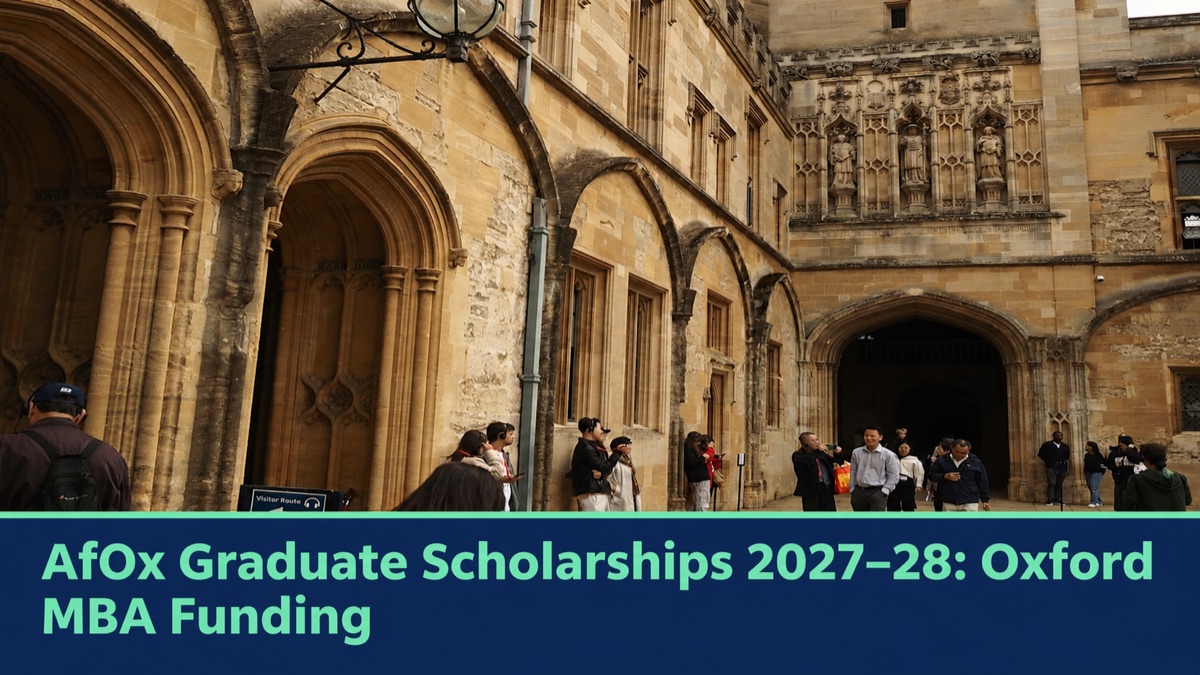
Featured image: Oxford courtyard, photographed by MChe Lee on Unsplash.
Official sources
- AfOx Graduate Scholarships at Saïd Business School
- Oxford MBA: how to apply and application requirements
- Oxford MBA programme and fee and Oxford graduate living costs
Frequently asked questions
Is there a separate AfOx scholarship application?
No. For this MBA award, Saïd says no separate scholarship application is needed. Submit the MBA application by the scholarship’s 6 January 2027 deadline.
Can I apply to the MBA in March and still receive this award?
Do not assume so. The MBA’s Stage 5 deadline is 15 March 2027, after the scholarship page’s 6 January deadline. Ask the school if you have an exceptional situation.
Is the £9,800 deposit covered?
The AfOx MBA page does not say whether the deposit is waived, deferred, reimbursed or otherwise covered for recipients. Ask the school about your offer before committing money.
Does the living grant cover every expense?
Not necessarily. The grant is at least £21,805. Oxford’s 12-month living-cost estimate ranges from £17,700 to £26,100 for one student without dependants, and excludes some possible additional costs. The actual grant and your spending may differ.
Can I apply if I already have a master’s degree?
The MBA scholarship page says applicants must not already have taken a master’s degree. If you are unsure how your qualification is classified, ask the school before applying.
Can I combine the award with another scholarship?
The specific AfOx MBA page does not state a combination rule. Ask the school and the other funder for written confirmation.
When will scholarship results be announced?
The AfOx page does not give a scholarship result date. Stage 4 MBA decisions are scheduled for 5 March 2027, but that date should not be presented as a confirmed scholarship result date.
Do I have to take an English test?
It depends on the MBA’s English-language requirements and any waiver approved for you. IELTS Academic requires 7.5 overall and at least 7.0 in each component; other listed routes and current TOEFL restrictions appear on the school’s requirements page.