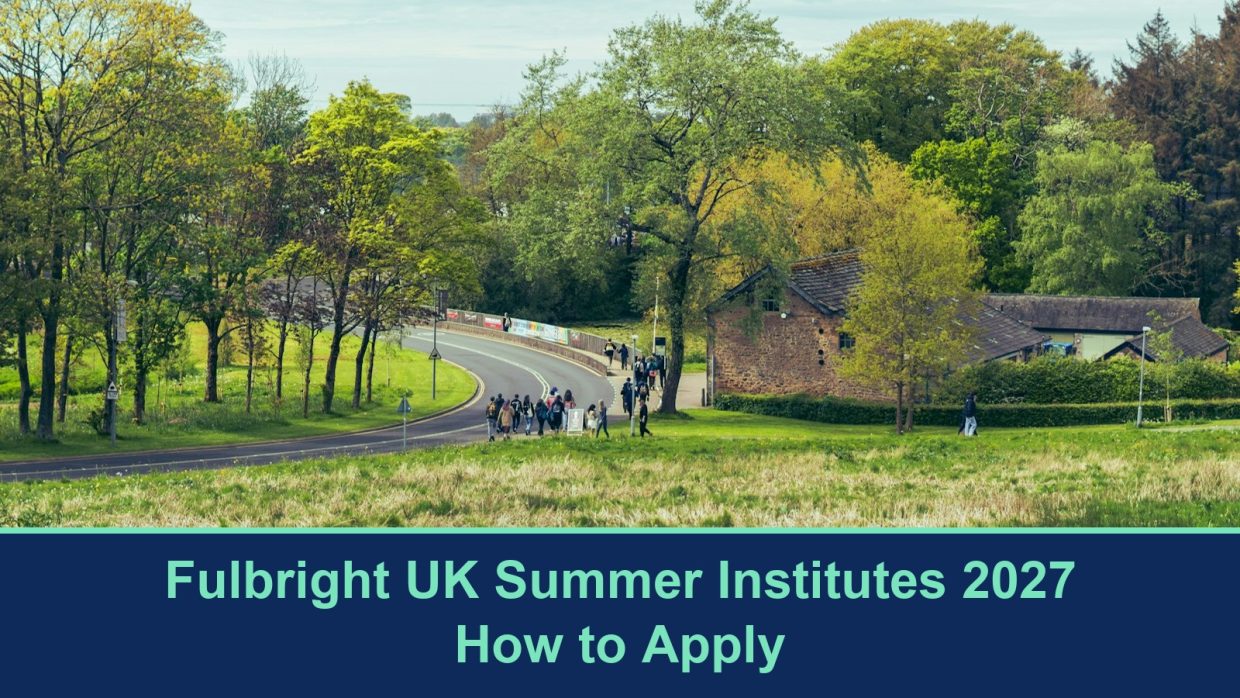
The Fulbright UK Summer Institutes give US undergraduates with limited international travel experience a chance to study and explore the United Kingdom for two to four weeks. In 2027, five host universities offer programmes ranging from Scottish history and Northern Ireland to creative writing, film and intercultural learning.
The award covers major programme costs, including airfare and accommodation. You must still arrange and pay for your own travel, health and accident insurance. Applications and the required reference are due 2 February 2027 at 11:59 p.m. The application form does not state a time zone, so submit well before that time.
At a glance
| Question | Official information |
|---|---|
| What is the programme? | A two-to-four-week UK summer institute for eligible US undergraduates. |
| Who can apply? | US citizens living outside the UK who will have a US passport by the programme start, at least a 3.6 GPA and at least two years of undergraduate study remaining after the institute; further conditions apply. |
| Where can I go? | Lancaster, Queen’s Belfast, St Andrews, East Anglia or Stirling in the UK. |
| What is covered? | Round-trip airfare, UK airport transfers, tuition, accommodation, some meals and specified activities. |
| What must I pay? | Travel, health and accident insurance; plan for costs the award does not promise to cover. |
| When is the deadline? | 2 February 2027, 11:59 p.m. The application form does not specify a time zone. |
| How do I apply? | Choose one institute and complete the online form, transcript and one reference. |
Who is this opportunity for?
The US–UK Fulbright Commission designed these institutes for US students who have had little opportunity to experience a different culture. Participants study at a UK university, take part in cultural activities and represent their communities while learning from people with different perspectives.
The official eligibility conditions are specific. You must be a US citizen and have a US passport by the programme start, have a GPA of at least 3.6, be at least 18 by the start of the programme, and have at least two years of undergraduate study left after the institute. You must be able to attend the whole programme and cannot participate in another study-abroad programme in summer 2027. US residence alone is not enough if you are not a US citizen. The programme terms also exclude applicants currently living in the UK, even if they are US citizens.
Fulbright seeks applicants with no or very little study or travel experience outside North America. Its FAQ says applicants who spent more than four weeks outside the US/North America in the previous five years are ineligible, while noting exceptions for refugees and students from different cultural backgrounds who travelled because of family emergencies. The Commission also says veterans deployed abroad may apply and should explain their circumstances, including any limits on cultural exposure during service.
The FAQ describes the intended applicants as current first- or second-year university students. Community-college students can apply if they will still have the required two years of undergraduate education after the institute. For example, if you plan to transfer to a four-year university, explain that plan in the application and name the receiving institution if possible. A student graduating in May or June 2028 would not have the required two years remaining after summer 2027.
The form asks whether you expect to graduate in spring 2029 or later and provides space to explain an earlier graduation plan. That question does not remove the published requirement to have two years of undergraduate study remaining. If your academic standing looks unusual because of credits earned in high school, Fulbright says the time remaining after the institute is what matters.
Which of the five institutes should you choose?
You may apply to one institute only. Choose the programme whose subject genuinely connects with your interests and whose full schedule you can attend. The Commission says an extensive background in a topic is generally unnecessary unless a particular institute specifies otherwise.
- Lancaster University – International Cultural Experience: a three-week programme focused on intercultural experience and global competencies.
- Queen’s University Belfast – Understanding Northern Ireland: a three-week introduction to Northern Ireland’s history, culture, politics and society.
- University of St Andrews – Scotland’s History: Kingdom, Nation, People: a three-week exploration of Scotland’s history and national identity.
- University of East Anglia – Fiction in all its Forms: a two-week creative-writing summer school using narrative and storytelling to explore how stories shape understanding.
- University of Stirling – Crafting Stories Through Film: a four-week video-editing programme exploring storytelling through film and digital media.
Fulbright explicitly prioritises applicants who have never left the US and are unlikely to travel without its support. It also looks for academic ability, leadership, intercultural sensitivity, adaptability and ambassadorial qualities. Applicants should be prepared to share accommodation and engage respectfully with people from different backgrounds.
The subject matters for your application. One of the short answers asks you to explain why the specific institute appeals to you and how it relates to your academic interests and personal goals. A history applicant might discuss a question they hope to explore at St Andrews, while someone interested in storytelling might explain what they would bring to East Anglia or Stirling. Those are ways to think about the prompt, not additional eligibility criteria.
What does the award cover?
The Fulbright Commission and host institutions say the programme covers:
- Round-trip airfare from the US and transfer between the UK arrival or departure airport and accommodation.
- Tuition and fees at the host institution.
- Accommodation and some meals.
- A social and cultural programme with free activities.
- A small daily meal allowance at institutes where meals are not provided.
This is substantial support, but it is not a promise that every expense is paid. Participants must pay for their own travel, health and accident insurance, including health coverage for the UK. The terms also exclude passport and any necessary visa expenses, taxis, tips and baggage shipment. The official page does not give a price for insurance or a specific daily meal allowance, so a reader cannot calculate a precise remaining balance from the published figures alone.
Consider the practical difference: if accommodation and a meal allowance are provided, those benefits reduce the amount you need for the stay. You still need to budget separately for the insurance policies and any personal spending that is not specifically listed as covered. An allowance described as small should not be treated as an unlimited food budget. The amount and what meals are provided may depend on the institute.
The Commission will not arrange flights from a destination other than the US. Fulbright says the return tickets are booked around the institute dates and cannot be altered. Its FAQ also explains that a participant wishing to stay in the UK after the programme must make their own arrangements and pay the associated costs, including purchasing their own flight back to the US. The host and Commission do not assume responsibility after the institute ends. Family members, partners and friends may not accompany or join participants during the programme.
Passport, timing and travel history
A valid US passport is necessary to participate. The form asks applicants to confirm that their passport will remain valid for six months after their return, which it identifies as the end of February 2028. It also allows an applicant to indicate that they are in the process of applying for a passport. Start early enough to have the document available when needed; the form mentions that passport processing can take time, but a processing estimate is not a guaranteed delivery date.
The form says passport processing can take eight to eleven weeks; that is an estimate, not a guaranteed delivery date.
The form asks whether you have travelled outside North America and, if so, asks for each trip’s dates, country, length and reason. It also asks about previous international academic summer programmes. Prepare an accurate list rather than assuming that one trip automatically decides your eligibility. Read the four-week rule together with the stated exceptions for refugees, family emergencies and veterans’ deployment circumstances.
You must be able to take part in the entire institute. The Commission says programme dates cannot be changed to accommodate a family holiday and participants cannot leave early. Consider your summer work, family and academic commitments before selecting an institute.
Application timeline
Applications opened on 12 November 2026. The form states that complete applications must be received by 11:59 p.m. on Tuesday, 2 February 2027. The reference must also be received by that time. The form does not identify the deadline time zone, so do not rely on a last-minute conversion or wait until the final hour.
The published timeline expects finalists to be announced in April 2027, a virtual pre-arrival orientation in May 2027, and the institutes in June or July 2027. These are programme milestones, not a guarantee that every institute has the same exact start date. Check the full dates of the institute you choose before committing.
The Commission says it cannot provide individual feedback on applications. If you are waiting for an outcome, monitor the email account you used to apply, including its spam folder, and keep your contact details current.
Prepare the application and essays
The online form asks for your personal and academic details, including your university, intended or current major, GPA, expected graduation date and travel history. It also asks whether you are a first-generation college student. The Commission defines that term here as having parents who did not complete a four-year college or university degree, regardless of other family members’ education.
Prepare a PDF transcript. The form asks for the most recent official transcript, but says an unofficial copy may be uploaded if an official one has not yet been received. The programme page says official transcripts are preferred. Obtain yours early enough to correct problems before the deadline.
The form includes these written responses:
- List activities from the last four years, such as extracurricular activities, employment, family responsibilities or community service, then explain why one is meaningful and how it connects to your goals or values. The explanation is limited to 200 words.
- Explain your interest in the Fulbright UK Summer Institute programme, what attracts you to your chosen institute and how it relates to your goals and academic interests. Limit: 300 words.
- Describe a leadership experience or position with significant responsibility and how it will help you navigate the institute. Limit: 200 words.
- Describe a challenge local to where you grew up or study and how you hope to address it through your future career or studies. Limit: 300 words.
- Explain the main reasons you should be selected for a funded programme. Limit: 150 words.
- Write a personal statement about your experiences, perspectives and interests, why you want to study in the UK, and what you hope to gain from the institute. Limit: 700 words.
The prompts invite personal detail, but they do not require you to invent international experience. The activities list can include family responsibilities, employment and hobbies as well as formal student organisations. Use the space to explain what you did and what it taught you, then connect that experience to the question asked.
Arrange one reference
You need one reference, ideally from a recent professor, academic instructor or adviser who can discuss your academic potential and ability to handle the programme. If you are a first-year student and your professors do not know you well enough, Fulbright allows someone such as a high-school teacher, coach, youth-group leader or employer. Family members and friends are not accepted as referees.
The reference is a separate step. Enter your primary email on the application and use the Reference Request Form on page 3 to provide your referee’s details. The referee receives a link to upload the letter. The primary email on page 1 reveals the request link, and the request status can be revisited. After submitting the application, use the emailed link to monitor or replace the request if needed. For reference problems, contact [email protected]. The applicant receives a confirmation email once the reference has been submitted; the form says the referee will not receive a confirmation email.
Ask your referee well before 2 February, provide the correct email address and follow up. If the request does not arrive, ask the referee to check spam or junk mail. You can make a new reference request if you need to change your referee. A complete application requires both your form and the reference by the deadline.
How to apply
- Confirm your US citizenship, passport position, GPA, age, travel history and remaining undergraduate study against the requirements above.
- Choose one of the five institutes and make sure you can attend it in full.
- Gather your passport and academic details, PDF transcript, travel history and referee’s contact information. Draft the short answers and personal statement within the stated limits.
- Open the official online application form. Save every time you leave using the form’s save-and-resume option, enter an email address and create a password. Return through the emailed link rather than starting again from the website.
- On page 3, complete the separate reference request so your referee receives the submission link. Keep track of the request and ensure the letter arrives by the deadline.
- Review and submit the application and transcript by 2 February 2027 at 11:59 p.m., remembering that the form does not specify a time zone. The referee’s letter is also due by then.
Frequently asked questions
Can an international student living in the US apply?
US residence alone does not satisfy the citizenship rule. The Commission requires US citizenship and a valid US passport, and its terms exclude US citizens currently resident in the UK.
Can community-college students apply?
Yes. Community-college students can apply if they will have at least two years of undergraduate study remaining after the institute. Fulbright suggests explaining an intended transfer to a university, and naming that university if possible.
Does the award include insurance?
No. Participants must arrange and pay for their own travel, health and accident insurance. The programme covers the listed airfare, transfers, tuition, accommodation and meal support, but does not publish a general cash amount for insurance.
Can I apply to more than one institute?
No. The Commission says applicants may apply to only one. Choose based on the programme’s focus and your ability to attend the entire institute.
Will I receive academic credit?
Credit may be possible on most summer programmes, but it is not guaranteed by the general programme page. The host university contact can explain the arrangements for the institute and any credit transfer.
Official sources
Checked on 23 November 2026 against the US–UK Fulbright Commission’s UK Summer Institutes page the 2027 application form and the programme terms and conditions. Scholarship Tally is independent of the Fulbright Commission.