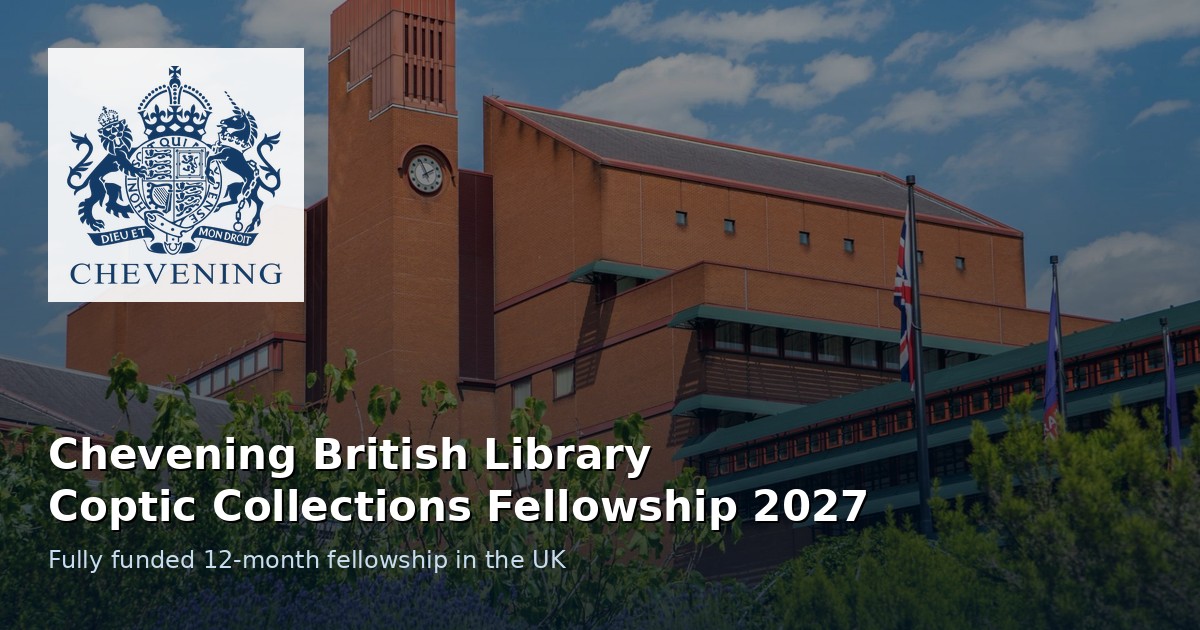
The Chevening British Library Coptic Collections Fellowship is a 12-month, project-based fellowship at the British Library in London, United Kingdom, for mid-career professionals from Egypt, Palestine and Sudan with a strong interest in Coptic manuscript heritage and cultural collections. It is co-funded by the British Library and the UK Foreign, Commonwealth and Development Office (FCDO), and it runs from September 2027 to September 2028. Applications close on 27 October 2026 at 12:00 Coordinated Universal Time (UTC).
Facts were checked on 12 November 2026 against the Chevening British Library Coptic Collections Fellowship page and Chevening’s fellowships eligibility page. If anything differs, follow the official pages.
This guide is for deciding whether you are a realistic candidate before you spend time on the form. It sets out who the fellowship fits, the eligibility requirements, what the funding does and does not include, and how to show evidence for the work the British Library describes. Scholarship Tally checked the official Chevening pages on 15 October 2026. Recheck them before you submit.
At a glance
| Item | Detail |
|---|---|
| Host | British Library, London, United Kingdom |
| Funders | British Library and the UK Foreign, Commonwealth and Development Office (FCDO) |
| Length | 12 months, September 2027 to September 2028 |
| Citizenship | Egypt, Sudan or Palestine |
| Residence | Egypt, Sudan or Palestine, or a listed Middle East and North Africa country (see below) |
| Core skill | Excellent Coptic (Sahidic or Bohairic) |
| Experience | At least five years, professional and/or academic research |
| Funding | Living expenses, return economy airfare, activity allowance, up to £1,000 project expenses |
| Deadline | 27 October 2026, 12:00 UTC |
Who this fellowship fits (and who it does not)
This is not a master’s scholarship or a general research grant. It is a defined project at one institution: you lead a research project at the British Library, working closely with Dr Michael Erdman, Head of Asian and African Studies (interim), on the Library’s Coptic manuscripts. The collection includes hundreds of complete and fragmentary codices and papyrus, parchment and paper fragments covering more than 1,500 years of Coptic history, theology and literary culture. Chevening notes that a comprehensive overview of the holdings has never been produced and that many parts remain difficult to discover. The fellowship involves surveying the collections and enhancing catalogue records.
It fits you if all of these are true (each one is a programme requirement, listed in full under Eligibility requirements below):
- You read Coptic at an excellent level in Sahidic or Bohairic (Arabic and/or Greek are desirable extras).
- You have catalogued and handled manuscript collections and know manuscript description standards.
- You have done provenance research and documentation, or can show a demonstrable interest in it.
- You have worked with heritage communities or delivered engagement activities around cultural heritage collections.
- You are mid-career, with at least five years of professional and/or academic research experience.
It is probably not for you if you are early in your career, if your Coptic is at reading-course level, or if your work is in Coptic history or theology without hands-on manuscript or catalogue work.
Citizenship and residence
You must be a citizen of Egypt, Sudan or Palestine and normally resident in one of these countries. Citizens of those countries who are resident elsewhere in the Middle East and North Africa region, in a country that is Chevening-eligible and eligible for Official Development Assistance (ODA), may also apply. The listed countries are Iran, Iraq, Jordan, Lebanon, Libya, Morocco, Syria, Tunisia and Yemen. The programme page does not describe a route for citizens resident outside that list.
The return commitment
You must show a clear intention to return to and contribute to your country of citizenship, and you must return there for at least one year after the fellowship ends. This is both a programme rule and a standard Chevening rule, so build your application around what you will do at home afterwards.
Eligibility requirements to check before applying
Check each requirement against the official criteria before applying. A strong professional profile does not replace the need to meet every one of them.
- Coptic level. “Excellent knowledge” of Sahidic or Bohairic is required. Arabic and Greek are listed only as desirable.
- Five years of experience. You need significant professional and/or academic research experience of at least five years.
- Postgraduate level. You need a postgraduate qualification, or equivalent professional training or experience in a relevant area, at the time you apply.
- Current status. You must be currently employed or enrolled as a PhD candidate. If you are enrolled as a PhD candidate, the PhD must not be with a UK, European Union (EU) or United States of America (USA) university.
- English. You need good written and spoken English and the ability to communicate research findings.
- Manuscript experience. You need experience cataloguing and handling manuscript collections and knowledge of manuscript description standards.
- Provenance. You need experience of provenance research and documentation, or a demonstrable interest in it.
- Heritage engagement. You need experience working with heritage communities or delivering engagement activities related to cultural heritage collections.
- Leadership potential. Chevening’s standard criteria require you to show potential to rise to a position of leadership and influence.
- Standard Chevening exclusions. You cannot hold British or dual British citizenship (unless you are a citizen of a British Overseas Territory). You cannot have received UK Government scholarship funding, including Chevening, in the last five years. You cannot be an employee, former employee or relative of an employee of His Majesty’s Government, the British Council or a sponsoring UK university, or have been one within the two years before Chevening applications opened. People contracted to work on any British Council programme or project, and their relatives, are also ineligible. Employees and relatives of employees of Chevening partner organisations may apply, but cannot receive a partner award from that organisation if the employment was within the last two years.
What the funding covers, and what it does not
Chevening lists the following for each fellowship:
- A 12-month period of project-based activity at the British Library
- Living expenses for the duration of the fellowship
- A return economy airfare
- An allowance package for fellowship-related activities
- Up to £1,000 for approved project-related expenses
Chevening does not publish the amount of the living expenses or of the allowance package, so do not plan around a figure you have seen elsewhere. Ask Chevening if you need one for a decision such as leave from your employer.
The programme page also says the FCDO cannot help arrange or facilitate travel to the UK, including from Palestine. Successful fellows must arrange their own travel, which may mean going through a third country. If you live in Palestine or anywhere with restricted travel, think through that route early.
What the 12 months involve
The British Library describes six strands of work. Each one is also a hint about the evidence your application should contain. The examples in the last column are suggestions for showing relevant experience, not an official document list.
| Work strand | What it means | Evidence to show |
|---|---|---|
| Collection survey | Surveying the Coptic holdings and finding gaps in cataloguing and documentation | A survey, audit or inventory you led or contributed to |
| Cataloguing | Creating and improving catalogue records from manuscript evidence and existing metadata | Catalogue records or descriptions you wrote (even a small sample), the standards or templates you followed, and how you handled fragmentary or incomplete material |
| Provenance | Researching, documenting and analysing how the manuscripts were acquired | Provenance work, or a specific question you want to investigate |
| Community events | Organising events with Coptic community members and researchers | Events, workshops or programmes you ran with heritage communities |
| Writing | Producing blogs, reports and other outputs about the collections | Published or public-facing writing for non-specialists |
| Public engagement | Widening access to and understanding of Coptic heritage | Outreach that reached people beyond academia |
The fellowship also supports the British Library’s work with the London Diocese of the Coptic Orthodox Church. If you have worked with Coptic church communities, archives or libraries, say so directly.
Chevening says fellows gain specialist experience in manuscript cataloguing, provenance research and collections documentation, practical experience of community and public engagement, and a higher international academic and professional profile. Use your application to explain how that experience will be used once you return home.
Planning your application before 27 October 2026
Applications go through the Chevening online application system. Start from the official programme page so you are sure you are applying to the right fellowship.
- Confirm the hard filters first: citizenship and normal residence (or the listed Middle East and North Africa exception), excellent Coptic (Sahidic or Bohairic), at least five years of experience, current employment or eligible PhD status, and the standard Chevening exclusions (British citizenship, a recent UK Government scholarship, UK Government or British Council links).
- Collect specific examples for each work strand in the table above: names of collections, number and type of manuscripts handled, catalogue standards, provenance findings and events you ran.
- Draft a short project idea that matches the survey, cataloguing and provenance goals, and that names what you would hand over at the end.
- Write your return plan: the role you will go back to and how the work will help your institution or community.
- Complete the online form and submit before 27 October 2026, 12:00 UTC. Do not leave it to the final hour.
FAQ
Can I apply if I live outside Egypt, Sudan or Palestine?
Only if you are a citizen of one of those three countries and live in one of the listed Chevening-eligible, ODA-eligible countries in the Middle East and North Africa region: Iran, Iraq, Jordan, Lebanon, Libya, Morocco, Syria, Tunisia or Yemen.
Is basic Coptic enough?
No. The programme page asks for excellent knowledge of Coptic in Sahidic or Bohairic. Arabic and Greek are desirable extras, not substitutes.
My PhD is at a European university. Can I apply?
The programme page requires that you are currently employed or enrolled as a PhD candidate, and that any PhD is not with a UK, EU or USA university. A PhD at a European Union university does not meet the PhD route. If you are currently employed and otherwise eligible, the employment route remains open. Confirm the exact wording on the official page.
How much is the living allowance?
Chevening does not publish an amount. It lists living expenses, a return economy airfare, an activity allowance and up to £1,000 for approved project expenses.
Will the FCDO help me travel from Palestine?
No. The programme page says the FCDO is unable to assist with arranging or facilitating travel to the UK, including from Palestine, and fellows must arrange their own travel, possibly through third countries.
I had a Chevening Scholarship before. Am I eligible?
Only if at least five years have passed since you completed that UK Government-funded scholarship.
When does the fellowship start and end?
It starts in September 2027 and ends in September 2028. Chevening gives months, not exact dates.