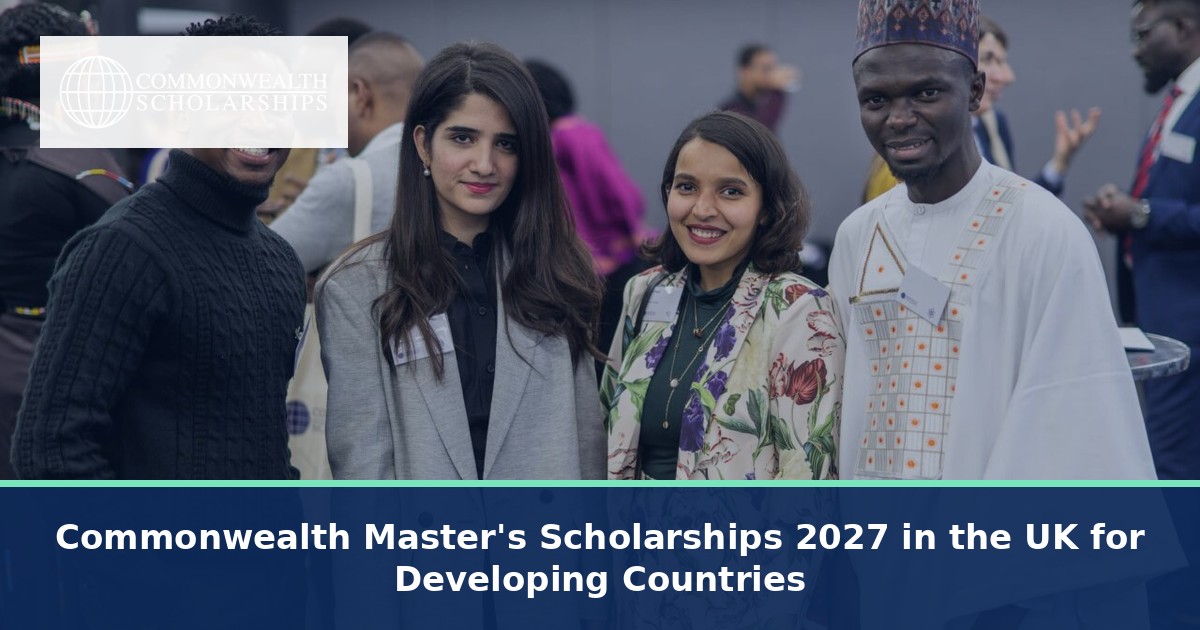
Commonwealth Master’s Scholarships pay for a one-year, full-time taught Master’s degree at a UK university for people from 43 eligible low and middle income Commonwealth countries who could not otherwise afford to study in the UK. They are run by the Commonwealth Scholarship Commission in the UK (CSC) and funded by the UK Foreign, Commonwealth and Development Office (FCDO). The scholarship provides approved tuition fees in full, a return airfare and a monthly stipend of £1,712, or £2,000 in the London metropolitan area.
The timing is the part you need first. When we checked the official pages on 23 October 2026, applications for the 2027/28 round, for study starting in September/October 2027, were closed. The CSC deadline was 16:00 British Summer Time (BST) on Tuesday 20 October 2026, and nominating agencies could set earlier closing dates of their own. Dates for the 2028/29 round have not been announced. If you missed this round, the useful steps now are to check whether you can apply for Commonwealth Shared Scholarships, which open on 10 November 2026, and to start preparing a complete application for the next agency-nominated round.
At a glance
| Item | What the CSC says | Source |
|---|---|---|
| Programme | Agency-nominated Commonwealth Master’s Scholarships, one of three CSC Master’s programmes | Programme page |
| Study | One-year taught Master’s, full time, at a UK university with a CSC agreement | Programme page |
| Who | Citizens of, or people granted refugee status by, 43 eligible Commonwealth countries, or British Protected Persons; permanently resident in an eligible country | Programme page |
| Pays | Tuition fees in full, return airfare, £1,712 a month (£2,000 in the London metropolitan area) | Programme page |
| Route | Apply to a nominator and on CSC Central; no direct applications | Programme page |
| Status | 2027/28 round closed at 16:00 BST on 20 October 2026 | Checked 23 October 2026 |
| Next round | 2028/29 dates not announced | Checked 23 October 2026 |
Where the 2027/28 round stands
The official programme page now says: “Applications for Commonwealth Master’s Scholarships for the 2027/28 academic year are now closed.” The round opened on 8 September 2026, according to a CSC news item published on 18 August 2026.
| Stage | Official date or wording | Status on 23 October 2026 |
|---|---|---|
| Opening | Tuesday 8 September 2026 | Passed |
| CSC deadline | 16:00 BST, Tuesday 20 October 2026 | Closed |
| Nominations | Nominators “will nominate candidates to the CSC by December 2026” | Due by December 2026 |
| Outcomes | Applicants “can expect to hear the outcome of their applications by July 2027” | Expected by July 2027 |
| Study start | September/October 2027 | Not started |
| 2028/29 round | No dates published | Not announced |
What this means for you:
- If you applied, your nominator decides whether to put you forward, and selections are then made from the pool of nominations. The CSC says “a nomination is no guarantee of selection.”
- The programme page says: “We will contact all applicants by email.” Watch every folder, including junk and spam, because “A scholarship offer may be withdrawn if a candidate is emailed but does not respond within a specified time.”
- If you did not apply, you cannot join the 2027/28 round now. The CSC applicant FAQs say that when a scholarship is not open, you should wait until the website is updated. Do not rely on any website that gives a 2028/29 date before the CSC does.
What the scholarship pays, and what it does not
Each scholarship provides the items below. The programme page prints the stipend as “rates quoted at current levels”, so it can change for a later round.
| Item | What the CSC provides |
|---|---|
| Tuition | Approved fees covered in full by agreement with the university; you are not liable to pay any part of the tuition fee |
| Airfare | Approved return airfare between your home country and the UK |
| Stipend | £1,712 a month, or £2,000 a month at universities in the London metropolitan area |
| Study travel | A study travel grant towards study-related travel in the UK or overseas (no amount printed) |
| Children | For widowed, divorced or single parent Scholars: £622 a month for the first child and £154 a month for the second and third child under 16, living with you at the same UK address |
| Disability | A full assessment of your needs and of eligibility for additional financial support |
| Visa costs | Student visa fee waived when you apply from outside the UK |
| Health surcharge | Immigration Health Surcharge (IHS) paid by the FCDO for applications made outside the UK |
The CSC FAQs for Scholars describe a Commonwealth Scholarship as “a full award (covering all costs)”. Read that alongside the limits the CSC itself sets out:
- The CSC “will not reimburse the cost of fares for dependants, nor the cost of journeys made before the award is confirmed.”
- Family allowances “are intended to be only a contribution”. The programme page adds: “The true costs are likely to be considerably higher, and Scholars must be able to supplement these allowances to support any family members who accompany them to the UK.”
- The CSC does not provide health insurance. The IHS gives you access to the National Health Service in the same way as UK residents.
- If your visa needs a tuberculosis test, you pay for it first and the CSC contributes later, in a stipend payment after you arrive.
- Flights must be booked through the CSC travel provider. The CSC will not reimburse flights booked any other way.
- You cannot hold another scholarship, award or bursary that covers the same costs at the same time.
The programme page itself does not use the label “fully funded”, and we do not either. Its general conditions say a Commonwealth Scholarship “covers fees, approved fares, and personal maintenance”. Family support is limited: child allowances apply only to widowed, divorced or single parent Scholars, dependants’ fares are not paid, and family allowances are only a contribution. If you plan to bring dependants, budget for the costs these allowances do not cover.
Who can apply
To be considered, the programme page says you must:
- Be a citizen of, or have been granted refugee status by, an eligible Commonwealth country, or be a British Protected Person.
- Be permanently resident in an eligible Commonwealth country.
- Be available to start studies in the UK by the start of the UK academic year in September 2027 (for the round that has just closed).
- By that September, hold a first degree of at least upper second-class (2:1) honours standard, or a lower second-class degree and a relevant postgraduate qualification (usually a Master’s degree).
- Be unable to afford to study in the UK without this scholarship.
- Provide all supporting documents in the required format.
Other rules that decide many cases:
- There is no age limit, and the applicant FAQs say work experience is not required.
- The CSC “would not normally fund a second Master’s degree”, and a second Master’s needs a justification. If you have already studied at Master’s level at a UK institution, or already received a Commonwealth Scholarship at Master’s level, you are not eligible.
- If you are still finishing your first degree, you can apply as long as it is completed by September of the start year, and you upload to-date transcripts.
- Disabled applicants who do not hold a 2:1 but can show their potential to contribute to international development may be considered for a contextualised nomination through the Commonwealth Disabled People’s Forum (CDPF).
- Employees and relatives of employees of the UK Government, former employees who left within the last three years, staff of the Association of Commonwealth Universities (ACU) or the British Council, and CSC Commissioners and their relatives are not eligible.
- You do not need a university offer letter to apply for the scholarship, but you should apply for admission early (see the next section).
The 43 eligible countries on the programme page are: Bangladesh, Belize, Botswana, Dominica, Eswatini, Fiji, Gabon, The Gambia, Ghana, Grenada, Guyana, India, Jamaica, Kenya, Kiribati, Lesotho, Malawi, Malaysia, Maldives, Mauritius, Montserrat, Mozambique, Namibia, Nauru, Nigeria, Pakistan, Papua New Guinea, Rwanda, Saint Helena, Saint Lucia, Saint Vincent and The Grenadines, Samoa, Sierra Leone, Solomon Islands, South Africa, Sri Lanka, Tanzania, Togo, Tonga, Tuvalu, Uganda, Vanuatu and Zambia. The CSC applicant FAQs are blunt: if your country is not on the programme’s list, you cannot apply for that programme. In line with the commitments made at the Commonwealth Heads of Government Meeting (CHOGM) 2024, the Commission particularly welcomes applications from Small Island Developing States (SIDS), and its news item says it is ringfencing funding for SIDS applicants in 2026 and 2027 through this programme.
What you can study: the CSC funds one-year taught Master’s programmes only. It does not fund Master of Business Administration (MBA) degrees, and the applicant FAQs add that it does not fund research Master’s programmes. There is no restriction of subject as long as your study relates to the six CSC development themes: science and technology for development; improving population health, health systems and capacity; promoting innovation and entrepreneurship; strengthening peace, security and governance; strengthening resilience and response to crises; and access, inclusion and opportunity. You also link your study to one of the 17 UN Sustainable Development Goals (SDGs). The CSC does not provide new direct support for the fossil fuel energy sector overseas.
Your three university choices
You do not apply to “the UK” in general. Scholars are only placed at UK universities that have signed a Memorandum of Understanding (MOU) with the CSC. Under that agreement the university contributes 20% of the overseas tuition fee and pays any tuition fees above the CSC fee cap. The programme page says full fees are covered by agreement between the CSC and the university.
The application asks you to list three universities and courses in order of preference and to explain your reasons. This matters more than it looks:
- The programme page warns: “If three choices are not included and the CSC are not able to place an applicant at the institutions included, the scholarship will not be able to proceed.”
- The CSC makes the final decision on where you study and “reserves the right to overrule any preferences”, considering the suitability of the course and its value for money.
- After selection, the CSC will not change your university, course or order of preference unless exceptional information appears that could not have been foreseen.
- You apply for admission yourself, early. The programme page warns that “Many courses have strict admission deadlines”, and that if you are selected but have not applied and been accepted for a course, “it may not be possible to proceed with the scholarship.”
How the application works: a nominator plus CSC Central
“The CSC does not accept direct applications for these scholarships.” As well as applying to the CSC, you must apply to a nominator, so you run two tracks at the same time. In practice the steps look like this:
- Choose your three MOU universities and one-year taught courses, and apply for admission to them.
- Find your nominator. National nominating agencies are “the main route of application”. Each agency runs its own selection, may add its own eligibility criteria and may set its own closing date, which can be earlier than the CSC deadline. The applicant FAQs say you must meet both the agency’s rules and deadline and the CSC’s.
- Check whether a non-governmental organisation or charitable body nominator fits you better. Each has its own country list. The routes listed are: the Canon Collins Educational and Legal Assistance Trust, for southern African countries; the CDPF, for disabled candidates whose studies will improve the position of disabled people in their country; The Commonwealth Equality Network (TCEN), for studies that will improve the position of LGBTI+ people; the Forum for African Women Educationalists (FAWE), for female candidates from listed African countries; and Windle Trust International, for Master’s candidates from Kenya and Uganda with refugee status or otherwise affected by conflict, who must also apply separately to Windle Trust. The CSC says ineligible applicants to these nominators will not receive a reply.
- Complete the CSC application on CSC Central, the CSC’s online system. The CSC “is unable to accept any applications or documentation not submitted via CSC Central”, applications cannot be edited after you submit, and late applications are not accepted. The CSC does not charge an application fee.
- Upload your documents by the CSC deadline: a passport or national ID card proving citizenship or refugee status; full transcripts for all higher education qualifications, including to-date transcripts for any current course, with certified translations if they are not in English; and references from at least two people, signed, in PDF format, on institutional letterhead or as an email that clearly shows the sender’s details. Missing transcript pages make an application ineligible, and if to-date transcripts are not available you must explain why.
- Write the form itself: your qualifications, up to 10 publications and prizes, employment history, three named referees (one must be your current employer, if you have one), a Development Impact statement in four parts, award objectives, five-year and long-term career plans, a detailed plan of study, a personal statement, and your voluntary work and leadership.
You do not need an International English Language Testing System (IELTS) score for the CSC application itself, but your universities may ask for an English test for admission.
How applications are judged
The CSC applicant FAQs say Commonwealth Scholarships are graded for academic merit and development impact, and that Master’s applications are also graded for quality of study plans. The CSC selection criteria page explains what “quality of study plans” means: a statement of what you want to learn and how it relates to your objectives, and how well you have researched the course and institution. An existing offer of admission and clear presentation count as secondary indicators. The programme page lists its criteria as candidate merit, “Quality of research proposal” and potential impact on the development of your home country, and asks you to link your answers to each point.
The CSC’s advice for applicants is direct about the competition:
- “All of the CSC’s scholarship schemes are highly competitive.”
- “Every year many strong candidates are disqualified due to incomplete applications.”
- “There are no quotas for people from different countries.”
- Many successful applicants have a first-class honours degree or a distinction at Master’s level. Applicants with a 2:1 do win, but their plan of study and development impact statements must be exceptional.
- Applicants who are unclear or vague about what they intend to do, or who use overly technical language, are likely to score poorly.
- Cutting and pasting text about a course or institution from a website or brochure is insufficient and may be considered plagiarism.
In your application, make the link between your study plan, your Development Impact statement and your career plans explicit.
If you are selected: offer, conditions and going home
The programme page sets out the steps. You are first provisionally selected, subject to the CSC agreeing your terms of admission with a university. When admission is agreed, the CSC sends a Notification of Award, which is the formal offer. You submit a Health and Disability Form, and once all conditions are met the CSC sends a Confirmation of Award. You also sign an undertaking to return to your home country before your student visa expires, and you are expected to start on the date in your Notification of Award. The FAQs for Scholars say the CSC cannot normally agree to deferral.
The return rule is strict:
- All Commonwealth Scholars commit to returning home after the scholarship. “Switching to a graduate or other visa to remain in the UK is not permitted.”
- Scholars must leave the UK within one month of the end of their scholarship tenure or one month after the end of their programme, whichever is earlier, and the CSC does not support Scholars remaining in the UK under the Graduate Immigration Route (often called the Graduate route).
- The only exception is a Master’s Scholar who receives an offer of a UK PhD with full funding for tuition fees and maintenance, under the CSC policy on further study.
What to do now: Shared Scholarships and the next round
The closest option this season is the CSC’s other published Master’s route, Commonwealth Shared Scholarships. For 2027/28, the Shared page says applications “will open on Tuesday 10 November 2026”, and the closing date is 16:00 Greenwich Mean Time (GMT) on Tuesday 8 December 2026. On 23 October 2026 the Shared page listed the same 43 eligible countries as the Master’s page.
| Point | Agency-nominated Master’s | Shared Scholarships |
|---|---|---|
| Status | 2027/28 closed on 20 October 2026 | 10 November to 8 December 2026 |
| Who selects first | Your nominator, then the CSC | The UK university, then the CSC approves |
| Where you study | Up to three MOU universities you choose; the CSC decides | An approved Master’s course at a participating university |
| Extra rule | Nominators may add their own criteria | Not studied or worked for more than one academic year in a high income country |
Key Shared Scholarships rules from the official page:
- You must apply for an approved Master’s course at a participating UK university. The list for 2027 “will be published in advance of the opening date”, so check it before 10 November.
- You apply on CSC Central and must also apply for and secure admission to the course yourself.
- You can apply for more than one course and to more than one university, but you can accept only one Shared Scholarship offer.
- You must not have studied or worked for more than one academic year in a high income country. Distance learning with a university in a high income country while living at home is allowed.
If you are aiming for the next agency-nominated round instead, use the months before the CSC posts new dates:
- Find your national nominating agency on the CSC list and ask how and when it runs its own process, since its deadline may be earlier than the CSC’s.
- Shortlist three one-year taught courses at MOU universities, and plan your admission applications around their deadlines.
- Request complete transcripts for every higher education qualification now, including certified translations if needed.
- Line up referees. The form asks you to name three referees who can comment on both your capacity to benefit from the scholarship in the UK and your ability to deliver development impact afterwards, and at least two signed references must be uploaded by the deadline.
- Draft your Development Impact statement and plan of study, tied to one CSC development theme, in plain language.
Who should skip it, and common mistakes
This scholarship is not for you if:
- Your country is not on the 43-country list (see Who can apply), or you are not permanently resident in an eligible country.
- By September of the start year you will meet neither qualification route: a first degree of at least upper second-class (2:1) honours standard, or a lower second-class degree plus a relevant postgraduate qualification (usually a Master’s degree). The exception is a CDPF contextualised nomination for disabled applicants (see Who can apply).
- You already studied at Master’s level at a UK institution or already held a Commonwealth Scholarship at Master’s level.
- You want an MBA, a research Master’s or a programme longer than one year.
- You can afford to study in the UK without the scholarship.
- You plan to stay and work in the UK after your course.
Common application and financial-planning mistakes:
- Applying on CSC Central without a nominator, or missing the nominator’s earlier deadline.
- Listing fewer than three choices, or not applying for admission to them.
- Leaving out a transcript page, a translation or a reference, which makes the application ineligible.
- Copying course descriptions into the plan of study instead of explaining what you want to learn and why.
- Treating the stipend as enough for a family. The CSC says family allowances are only a contribution.
FAQ
Is the 2027/28 Commonwealth Master’s Scholarships round still open?
No. The CSC deadline was 16:00 BST on Tuesday 20 October 2026, and the programme page now says the 2027/28 round is closed. The CSC has not yet published any dates for the 2028/29 round.
What does the scholarship cover?
Approved tuition fees in full, an approved return airfare, a stipend of £1,712 a month (£2,000 in the London metropolitan area) at current levels, a study travel grant, child allowance for widowed, divorced or single parent Scholars, and a disability needs assessment, plus the Student visa fee waiver and the Immigration Health Surcharge for applications from outside the UK. The money section above lists the CSC’s own limits.
Is it fully funded?
The CSC calls a Commonwealth Scholarship “a full award (covering all costs)”, but it does not pay dependants’ fares or health insurance, and family allowances are only a contribution. Plan your own money for anything beyond your own study and living costs.
Can I apply directly to the CSC?
No. You must apply to a national nominating agency or a listed non-governmental nominator and also complete the CSC application on CSC Central.
Do I need an offer letter or IELTS to apply?
You do not need an offer letter or an IELTS score for the CSC application. You should still apply for admission to your three courses early, and your universities may require an English test.
What if my nominating agency’s deadline is earlier than the CSC’s?
You must meet both. Agencies set their own closing dates and criteria, and the CSC applicant FAQs say you have to meet the agency’s requirements as well as the CSC’s.
What is the difference from Commonwealth Shared Scholarships?
The agency-nominated route goes through a nominator and lets you choose up to three MOU universities. Shared Scholarships are for approved courses at participating universities, which make the first selection, and you must not have studied or worked for more than one academic year in a high income country. The 2027/28 Shared round runs from 10 November 2026 to 16:00 GMT on 8 December 2026.
When will I hear, and can I defer?
The CSC says applicants can expect to hear the outcome by July 2027. Deferral cannot normally be agreed.
Must I return home after the scholarship?
Yes. You sign an undertaking to return home, must leave the UK within one month of the end of your scholarship or programme (whichever is earlier), and cannot switch to the Graduate route or another visa to stay.
Where do I ask questions?
Read the CSC applicant FAQs first, then use the form on the CSC contact us page for general questions. Questions about a nominator’s process go to that nominating agency. Disability questions can go to [email protected], the address the CSC gives in its FAQs for Scholars.
Official sources
All details above were checked against these Commonwealth Scholarship Commission pages on 23 October 2026. The CSC updates its pages, so check them again before you act.
- Commonwealth Master’s Scholarships programme page
- CSC news, 18 August 2026: SIDS Master’s Scholars and the 2027/28 dates
- National nominating agencies
- Non-governmental organisations and charitable body nominators
- Selection criteria for assessment of applications
- CSC development themes
- UK universities with a CSC agreement
- Advice for applicants
- Commonwealth Scholarships frequently asked questions (applicants)
- FAQs for Commonwealth Scholars (accurate as of May 2026)
- CSC disability support statement
- Commonwealth Shared Scholarships
- CSC contact us
The 2027/28 round is closed; the button below opens the official programme page, which shows the closed notice now and is where the CSC will post the next round.