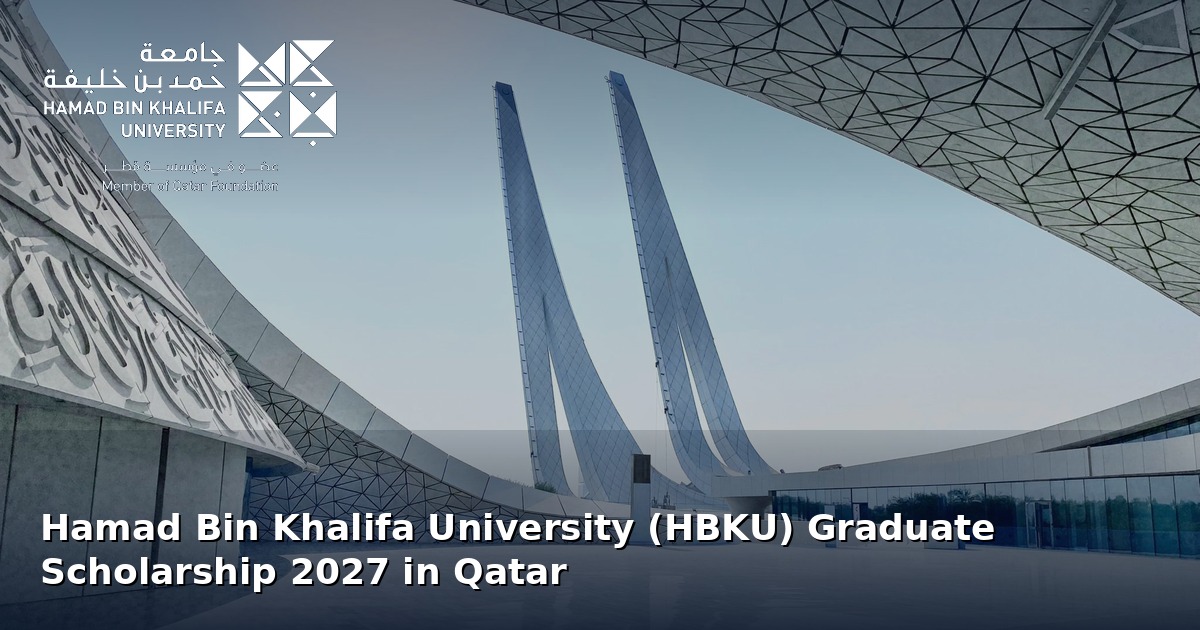
Hamad Bin Khalifa University (HBKU) in Doha, Qatar, does not run a single scholarship competition. Its graduate funding is a tuition waiver, and for selected full-time students a monthly stipend, decided during graduate admission. HBKU says “no separate application is needed”: you apply for a master’s or doctoral place, and the university considers you for funding at the same time. Awards depend on merit or need and on available funds, and they are not automatic.
Facts were checked on 12 November 2026 against HBKU’s Scholarship page, its graduate admissions page and its student financial information page. If anything differs, follow the official pages.
The timing comes first. When we checked the official HBKU pages on 27 October 2026, the online graduate application had been open since Thursday 1 October 2026. The admission deadline for international graduate applicants is Monday 1 February 2027, 97 days after our check. Qatari and resident applicants who want funding have until Monday 15 March 2027. HBKU prints these as dates only, with no time of day, so plan to submit well before the day. There is no late deadline in the 2026-2027 calendar.
All amounts below are in Qatari riyals (QAR), exactly as HBKU prints them. We do not convert them or add them up.
At a glance
| Item | What HBKU says | Source |
|---|---|---|
| What it is | A tuition waiver, plus a monthly stipend for selected full-time students | Scholarship Guidelines |
| How you apply | Through graduate admission; no separate scholarship application | Scholarship Guidelines FAQ |
| Waiver | 100% for the listed PhD and Doctor of Juridical Science (S.J.D.) categories; 75% or 60% for the listed master’s and Juris Doctor (J.D.) categories; 0% for some programmes | Scholarship Guidelines |
| Stipend | QAR 9,000 a month for an international PhD student; QAR 7,000 for an international master’s student | Scholarship Guidelines |
| Basis | Merit or need, and the availability of funds; not guaranteed | Scholarship Guidelines |
| Deadline | International graduate applicants: Monday 1 February 2027 | Admissions pages |
| Funding deadline | Qatari and resident applicants who wish to apply for funding: Monday 15 March 2027 | Admissions pages |
| Application fee | QAR 250, non-refundable | College admission pages |
| Start | Fall 2027 semester; exact dates not yet published | Academic calendar |
In short, HBKU lists full tuition waivers for the PhD and S.J.D. categories shown in its waiver table, alongside partial or zero waivers for other programme types. Stipends are selective, depend on available funds and carry a research assistant commitment of 10 hours per week. Neither a waiver nor a stipend is guaranteed.
Where the 2026-27 admission cycle stands
| Date | What happens | Status on 27 October 2026 |
|---|---|---|
| Thursday 1 October 2026 | Online graduate admission application opens to the public | Opened; applications open now |
| Monday 1 February 2027 | Admission deadline for international graduate applicants | Open |
| Monday 15 March 2027 | Admission deadline for Qatari and resident applicants who wish to apply for funding | Open |
| Fall 2027 | Start of study | Dates not yet published |
What the dates mean for you:
- If you are an international applicant, 1 February 2027 is your deadline for both admission and funding consideration, because funding is decided inside the admission process.
- The 15 March 2027 date is only for Qatari nationals and Qatar residents who want funding. It is not a second chance for international applicants.
- No late deadline appears in the 2026-2027 academic calendar, so do not plan around one.
- HBKU has not yet published a 2027-2028 academic calendar, so the Fall 2027 start dates are not out. For context only, last year’s orientation for new graduate students was on 20 August 2026 and Fall classes began on 23 August 2026. Do not treat those as 2027 dates.
- HBKU does not publish decision dates or the number of awards.
How HBKU graduate funding works
HBKU, founded in 2010, is a member of Qatar Foundation for Education, Science, and Community Development and is located within Education City in Doha. Its graduate funding may combine a tuition waiver with a stipend for selected students; students who receive a stipend generally also receive a waiver. Funding is assessed during admission, needs no separate scholarship form and depends on merit or need and on available funds.
The waiver rates are for “HBKU-sponsored graduate students”. Students funded by external sources follow their sponsor’s rules instead. Self-sponsored graduate students are “only eligible for a discounted tuition rate of 2,000 QAR per credit hour based on financial need.” No nationality is excluded on the pages we checked, and HBKU’s student financial information page says “Full-time enrollment is required for fall and spring semesters.” Bachelor’s funding is not covered by these guidelines; HBKU sends those questions to [email protected].
HBKU’s Admissions Overview lists seven colleges and schools: the College of Islamic Studies (CIS), the College of Science and Engineering (CSE), the College of Health and Life Sciences (CHLS), the School of Economics and Management (SEM), the College of Humanities and Social Sciences (CHSS), the College of Law (CL) and the College of Public Policy (CPP). The waiver rate depends on which of them runs your programme and on the type of degree.
Tuition waivers by programme type
The waiver reduces tuition, which HBKU charges per credit hour. The table uses HBKU’s own programme labels: programmes in science, technology, engineering and mathematics appear as STEM, and HBKU does not spell out “SHAPE”, so we leave it as printed. Degree names: Master of Science (MS), Master of Arts (MA) and Master of Laws (LL.M.).
| Programme type | Waiver | Fee per credit |
|---|---|---|
| PhD STEM (CSE and CHLS) | 100% | QAR 4,000 |
| PhD SHAPE and S.J.D. (CIS, CHSS and CL) | 100% | QAR 2,500 |
| STEM MS programmes (CSE and CHLS) | 75% | QAR 4,000 |
| SHAPE MS and MA (CIS, CHSS and CPP) | 60% | QAR 2,500 |
| J.D. (CL) | 60% | QAR 2,500 |
| LL.M. programmes (CL) | 0% | QAR 2,000 |
| MS Economics (SEM) | 0% | QAR 2,500 |
| Certificate programmes | 0% | QAR 2,000 |
Examples of total programme fees printed on HBKU’s Tuition Fees page:
| Programme | Total programme fee | Length |
|---|---|---|
| PhD, CSE or CHLS | QAR 240,000 (60 credit hours) | 3.5 years |
| PhD in Islamic Studies | QAR 180,000 (72 credit hours) | 4 years |
| PhD in Humanities and Social Sciences | QAR 150,000 (60 credit hours) | 3.5 years |
| S.J.D. | QAR 150,000 (60 credit hours) | 3.5 years |
| MS, CSE or CHLS | QAR 132,000 (33 credit hours) | 2 years |
| Most MA programmes | QAR 90,000 (36 credit hours) | 2 years |
| J.D. | QAR 212,500 (85 credit hours) | 3 years |
| LL.M. | QAR 64,000 (32 credit hours) | 1 year |
A 75% or 60% waiver leaves part of the tuition for you to pay. Work out your own figure from the fee page for your exact programme, because some MA programmes cost more than QAR 90,000.
Programmes with little or no HBKU funding
Check this section before you build a plan around a waiver:
- 0% in the waiver table: LL.M. programmes, MS Economics and certificate programmes.
- School of Economics and Management: it “does not provide tuition waivers for the MS Economics program; students must fully self-fund their studies.”
- College of Islamic Studies certificates: “There are no scholarships available to international students for any of the CIS graduate certificate programs. All applicants need to be self-funded.”
- College of Humanities and Social Sciences: “Applicants are expected to fund their studies. However, there is a limited number of scholarships on a competitive basis. Scholarships are granted to applicants on an overall evaluation of the documents and interviews.”
- Other colleges: the College of Science and Engineering, College of Health and Life Sciences, College of Islamic Studies, College of Law and College of Public Policy each say they provide “a limited number of tuition waivers on a competitive basis.”
- Not in the table: the Master of Science in Sport and Entertainment Management (QAR 4,000 per credit on the fees page) and the School of Education’s Master of Arts in Comparative Education are not listed in the waiver table. Ask the college before you apply.
Stipends: rates, duties and conditions
HBKU lists “the stipends awarded to selected graduate students”:
| Category | Monthly rate | Annual rate | Duration |
|---|---|---|---|
| Qatari PhD | QAR 11,000 | QAR 132,000 | 45 months |
| International PhD | QAR 9,000 | QAR 108,000 | 45 months |
| Local PhD | QAR 5,000 | QAR 60,000 | 45 months |
| Qatari Master’s | QAR 9,000 | QAR 108,000 | 21 months |
| International Master’s | QAR 7,000 | QAR 84,000 | 21 months |
| Local Master’s | QAR 4,000 | QAR 48,000 | 21 months |
HBKU does not define “Local” on the page, and it says “Stipends for local students are limited.” If you are unsure which row applies to you, ask your college.
The stipend comes with work and conditions:
- Who gets it: full-time graduate students serving at the university as research assistants (RAs) and/or teaching assistants (TAs), “depending on the availability of funds.”
- Research duty: students receiving a stipend work as RAs with their primary supervisors for 10 hours per week.
- Hours cap: a maximum of 20 hours per week in total, which means 10 hours beyond the research assistant commitment.
- Teaching: stipend holders may serve as TAs for 10 hours per week at an hourly rate of 50 QAR for the semester in which they teach.
- Extra work: stipend holders can also take paid work through the Student Employment Program (SEP) for up to 10 additional hours per week.
- Workers: “Full-time working professionals and part-time workers who exceed 40% of full-time hours are not eligible for stipends.” HBKU adds that discounted tuition may be available to them based on need.
- Family: “Stipend awards do not depend on the student’s marital status or the number of family dependents.”
- Travel: international students receive “a single round-trip airfare during their candidature”: one inbound ticket at the start of the programme and one outbound ticket on graduation.
- External money: stipends funded from external sources, including research grants, are excluded from the rates in the table.
- Exceptions: these can be considered case by case, depending on funds, with the approval of the dean and the provost.
What you still pay for yourself
- Housing: “Students are responsible for covering the cost of their housing, whether they choose to live in QF dormitory facilities or in external accommodations.” It comes from your stipend or your own money, and “HBKU does not provide direct payment for student housing.”
- Meals: meal plans are not included separately. HBKU says the stipend “is a fixed amount meant to cover general living expenses, including meals.”
- Tuition not waived: the remaining share on a 75% or 60% waiver, and all tuition on a 0% programme or a self-funded certificate.
- Application fee: QAR 250, non-refundable.
- Not mentioned: the scholarship guidelines do not mention health cover, visa costs, a family allowance or a book allowance. Check your offer and your scholarship agreement before assuming these costs are covered.
What admission itself requires
Admission requirements vary by college and programme. Check these points from the college admission pages against your intended programme:
- Academic record: a minimum grade point average (GPA) of 3.0 out of 4.0 from a recognized university. Master’s applicants need a bachelor’s degree and PhD applicants a master’s degree. Several programmes also name the fields your earlier degree should be in.
- College of Law: the J.D. needs a bachelor’s degree with a 3.0 GPA; the LL.M. routes give preference to candidates with at least 3.3; the S.J.D. needs a J.D. or LL.M., with a strong preference for 3.3.
- English: an International English Language Testing System (IELTS) score of 6.5 or a Test of English as a Foreign Language (TOEFL) score of 79, unless you are exempt. The College of Humanities and Social Sciences says the score must be no more than two years old. Two College of Islamic Studies routes (the MA in Contemporary Islamic Studies, Fiqh and Society specialisation, and the Graduate Certificate in Islamic Studies) ask for Arabic proficiency plus an English score equivalent to TOEFL 35-45 or IELTS 5.
- Tests: the College of Science and Engineering requires a Graduate Record Examinations (GRE) or Graduate Management Admission Test (GMAT) score for the PhD in Sustainable Energy and the PhD in Sustainable Environment. It is optional for the PhD in Computer Science and Engineering and the PhD in Logistics and Supply Chain Management, and not required for its master’s programmes.
- References: two letters of recommendation, one of them from an academic referee. Some College of Health and Life Sciences programmes ask for three.
- Personal statement: 300 to 500 words at several colleges. The College of Science and Engineering says statements “that are incomplete or below the minimum word count will not be accepted.”
- Documents: official electronic transcripts, a curriculum vitae (CV) or resume, and a copy of your passport.
- Research proposal: PhD applicants at the College of Humanities and Social Sciences, and LL.M. and S.J.D. applicants at the College of Law, submit a research proposal. The College of Islamic Studies page lists a research proposal of up to five pages and a writing sample of 15 to 20 pages; check which apply to your programme.
- Experience: the College of Science and Engineering and the College of Health and Life Sciences prefer applicants with prior research experience, especially for PhD programmes.
- Limits: you can submit up to two applications per academic year.
How to apply, step by step
HBKU’s Graduate Admissions page sets out five steps:
- Create a user account. Click “Apply Now” to open the HBKU application portal, create an account and log in.
- Submit your application. Choose your college and programme. You can make up to two applications per academic year.
- Upload documents and references. After you submit, a confirmation email explains how to log back in, add supplementary documents and give your referees’ contact details.
- Application review. The HBKU admissions team checks the application for completion and eligibility, then forwards it to the college for assessment.
- Offer of admission. You are notified when the college makes a decision, and accepted applicants receive an offer letter.
Before submitting, check your programme’s document, statement, reference and test-score requirements, pay the non-refundable QAR 250 application fee, and, if you are an international applicant, submit well before 1 February 2027.
After you apply: decisions, notification and keeping the award
- Decisions: HBKU does not publish a decision date. The college decides on admission and you receive an offer letter if accepted.
- Scholarship notice: “You will be notified by email with details about your award.”
- Interviews: the College of Humanities and Social Sciences bases its limited scholarships on the documents and interviews.
- Renewal: “Scholarships are reviewed annually and depend on academic progress and available funds.”
- Standing: you must maintain good academic standing as set out in your scholarship agreement.
- Other funding: “External funding may affect eligibility. Refer to the scholarship agreement for details.”
- Deferral: “Deferral may affect eligibility. Contact your college for guidance.”
Who should skip it, and common mistakes
Look at other options if any of these would make studying at HBKU financially or practically unworkable for you:
- You need a place where tuition and living costs are certain to be paid. Most master’s waivers are 75% or 60%, stipends go only to selected students, and housing is your cost.
- Your programme is an LL.M., MS Economics or a graduate certificate and you need a waiver.
- You plan to keep a full-time job, or work more than 40% of full-time hours, and still expect a stipend.
- You cannot apply by 1 February 2027 as an international applicant.
- You cannot meet the English, GRE or document requirements for your programme in time.
Mistakes that cost applicants:
- Looking for a separate scholarship form and missing the admission deadline.
- Relying on an alternative deadline. International graduate applicants should plan around 1 February 2027.
- Treating a 60% or 75% waiver as full tuition cover.
- Accepting a stipend without checking the research assistant commitment.
- Expecting HBKU to pay for housing, or expecting the award to renew without academic progress.
- Sending a personal statement below the minimum word count.
FAQ
Is the 2026-27 graduate application still open?
Yes, on 27 October 2026. It opened on 1 October 2026. International graduate applicants must apply by Monday 1 February 2027; Qatari and resident applicants seeking funding by Monday 15 March 2027.
Do I need a separate scholarship application?
No. HBKU considers you for a tuition waiver and stipend as part of your admission application.
Is the HBKU Graduate Scholarship fully funded?
HBKU does not use that label, and we would not apply it. The PhD and S.J.D. categories in the waiver table carry a 100% waiver, but most master’s waivers are 75% or 60%, stipends depend on funds and selection, and students pay for their own housing.
How much is the stipend for international students?
QAR 9,000 a month for an international PhD student, with a listed duration of 45 months, and QAR 7,000 a month for an international master’s student, with a listed duration of 21 months. HBKU prints the annual rates as QAR 108,000 and QAR 84,000.
Which programmes have a 0% tuition waiver?
The waiver table lists 0% for MS Economics, certificate programmes and LL.M. programmes. International students in College of Islamic Studies graduate certificate programmes are not eligible for scholarships.
Can working professionals get funding?
Not a stipend if they work full time or more than 40% of full-time hours. HBKU says discounted tuition may be available based on need.
Does HBKU provide housing?
HBKU does not pay for housing directly. You pay for a QF dormitory or outside accommodation from your stipend or your own funds.
When does Fall 2027 start?
HBKU has not published the 2027-2028 academic calendar yet. Check the academic calendar before you plan travel.
Whom do I contact?
Graduate admissions questions go to [email protected]. For scholarship questions HBKU says to contact your college: [email protected], [email protected], [email protected], [email protected], [email protected] or [email protected]. The College of Science and Engineering uses [email protected], [email protected] and [email protected], depending on the division.
Official sources
We checked every detail above against these HBKU pages on 27 October 2026. HBKU updates its pages, so check them again before you apply.
- Scholarship Guidelines for HBKU Graduate Programs
- Graduate Admissions (five-step process)
- Admissions Overview (dates and contacts)
- Tuition Fees
- Student Financial Information
- Academic Calendar 2026-2027
- About HBKU
- College admission requirements: College of Science and Engineering, College of Health and Life Sciences, College of Humanities and Social Sciences, College of Islamic Studies, College of Law, College of Public Policy, School of Economics and Management
- HBKU application portal
There is no separate scholarship form: apply for admission through the HBKU portal (international graduate applicants by 1 February 2027), and the button below opens HBKU’s official scholarship guidelines.