
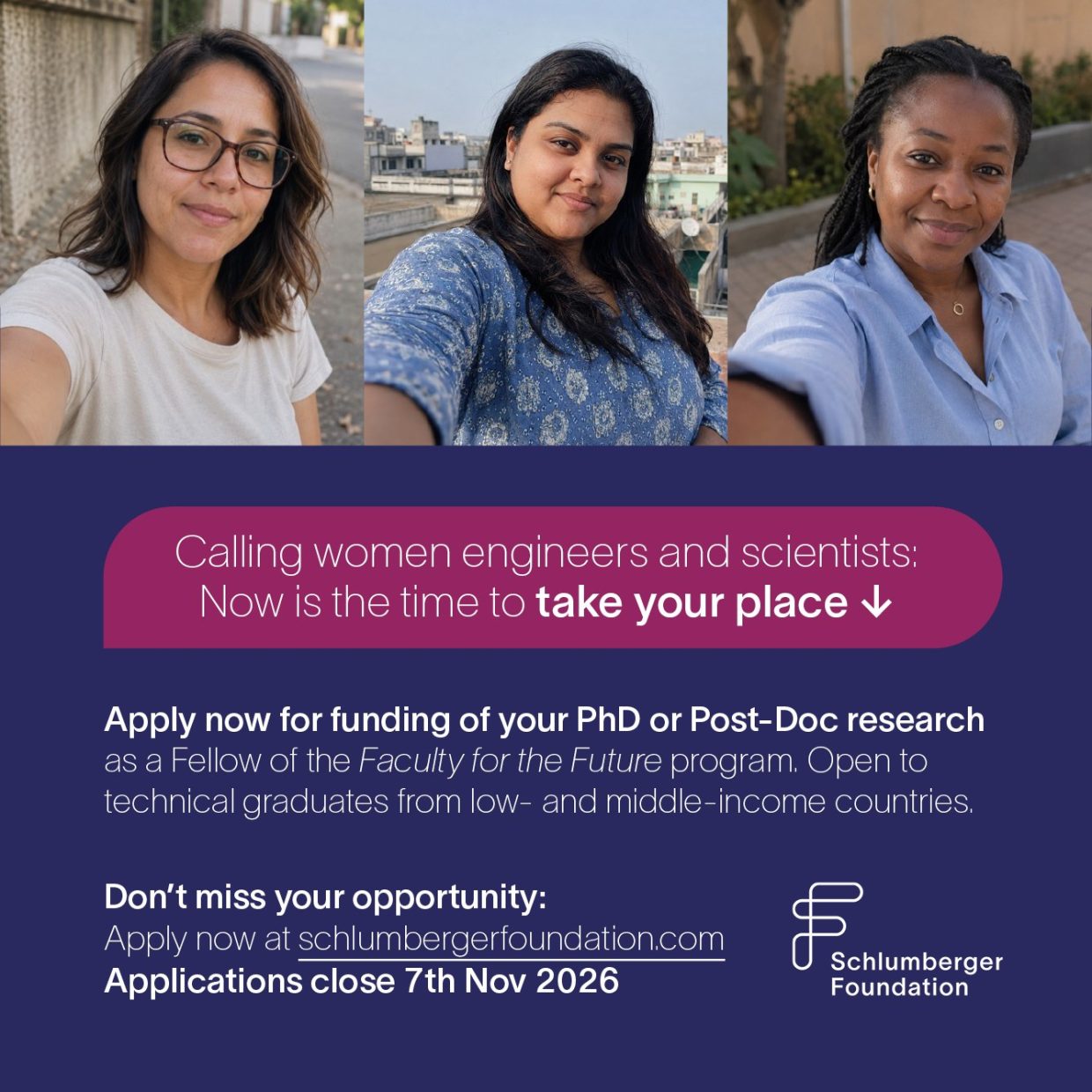
The Schlumberger Foundation Faculty for the Future program funds women from eligible low- and middle-income countries for PhD or post-doctoral research in STEM at a strong host university or research institute abroad, so they can return as change agents at home. It is a return-and-lead fellowship, not a generic study-abroad pot. It is not a Masters scholarship. Do not assume the published maximum is a guaranteed flat payment or that every family expense is covered.
If you already have the official apply page open, use this guide to decide go or no-go for the 2027 cycle, then follow a process order that matches how reviewers score files. Facts below were compiled by Scholarship Tally editors on 28 September 2026 from five official sources: the Foundation apply-now page, eligibility criteria, applications guidance, official FAQ, and the fftf.slb.com portal. Fit tests and process tips are Scholarship Tally guidance built on those rules. Deadlines and country lists can change. Re-open the live official pages the day you apply.
What this guide adds beyond the official handbook: a hard fit test before you invest weeks in essays, host-before-portal order, what the published grant maxima actually cover versus family costs, and failure modes the Foundation already names. It is not a substitute for the live portal or the eligible-country table.
What this fellowship is for (and what it is not)
(Programme rules from the official Schlumberger Foundation site and FAQ, checked 28 September 2026.)
Purpose: fund women engineers and scientists from eligible developing and emerging economies for PhD or post-doctoral research abroad so they can contribute to socio-economic development at home. Selection looks for academic strength, research quality, host quality, return commitment, teaching or related impact pathways, and work that inspires girls and women in STEM. The Foundation is particularly keen to see applications from Physical Sciences, Engineering, Computer Science, and Mathematics.
What it is not:
- Not a Masters scholarship. Official pages state that plainly.
- Not a family relocation package. Official FAQ: the grant is built on the student’s actual expenses; spouse and children may accompany you, but the Foundation does not cover a whole household and does not run family visas.
- Not an automatic multi-year cheque. Official FAQ: the initial award is one academic year; renewal is not automatic.
- Not a job offer or guaranteed faculty post at home. No faculty appointment letter is required, but weak return evidence hurts selection and renewal.
- Not a placement service. You find the host university and supervisor yourself.
Quick fit test before you open the portal
Answer these honestly. If any answer is no, do not force an application.
- Are you a woman and a citizen of a country on the Foundation’s current eligible list, without dual citizenship that includes a developed country? Check the 2026-2027 eligible countries table rather than an old blog list. Dual (or secondary) citizenship of a developed country makes you ineligible. If you later gain developed-country citizenship after an award, the Foundation states the grant ends from that date.
- Are you preparing a PhD or a post-doc in a STEM discipline? The FAQ also describes STEM and related fields or cross-disciplinary studies involving the major STEM fields. Masters applicants are not eligible. Schlumberger (SLB) employees are not eligible.
- Have you already applied to, been admitted to, or enrolled at a host university or research institute abroad that is well ranked and recognized for strong research in your field? Applications are not accepted if you have not yet applied to a university.
- Do you have a proven record of teaching experience in your home country? Official eligibility treats this as its own requirement, not optional colour on a return plan.
- Can you show a credible return pathway into a STEM faculty or research role, STEM entrepreneurship that addresses local challenges, and/or public-sector STEM policy leadership, together with leadership, community outreach, and a track record of encouraging girls and women into STEM?
- Can you live with the host university and research project you will submit? Official FAQ: you may update and save before submit; after submit you may not change project or host; after an award, changes need prior Foundation approval and there is no guarantee later changes will be accepted.
There is no official age limit. Remaining teaching years after the PhD or post-doc can still influence selection.
Who this is a strong match for
- You already have a host application in motion at a research-active university abroad, or you are already enrolled there.
- Your research question is useful to your home country or region, not only fashionable in the host lab.
- You can point to real classrooms, clubs, mentoring, curriculum work, or community STEM work, especially with girls, that existed before this application season.
- You can describe a plausible next role at home (faculty, lab, enterprise, or policy) and show some relationship with home institutions.
- You need a substantial contribution toward tuition, bench fees, housing, living costs, first travel, visa fees, and conference costs, and you can document other funding so the Foundation can assess the grant amount against your actual expenses.
Who should wait (or skip) this cycle
- Masters applicants hoping the committee will make an exception. Official pages say they will not.
- Anyone who has not applied to a host yet and plans to “find a university if I win.”
- Dual citizens with a developed-country passport, including a second passport you rarely use.
- Applicants with a strong lab offer but no proven home-country teaching record. Teaching is a separate eligibility screen.
- Applicants whose home-country story is only “I will come back someday,” with no outreach and no institutional tie.
- Thin files that rely on generic “women in STEM” language without dated evidence (Scholarship Tally practical filter, not Foundation wording).
- People treating this as a ranking play for every “women STEM scholarship 2027” keyword. That is the opposite of how this programme is judged.
2027 cycle dates
| Milestone | Official timing |
|---|---|
| Portal opens for new applications | 1 September 2026 |
| New application deadline | 7 November 2026, 12:00 noon Central Standard Time (UTC-6) |
| Reference letters | By 14 November 2026 (portal guidance) |
| Results | Apply-now page: early April 2027. FAQ: results are usually on the application site by the end of March; awardees then receive a personal email, others a formal letter. Watch the portal. |
Applications are accepted only through fftf.slb.com. The Foundation’s FAQ states that if you apply in this window and win (results around March 2027), the grant is described as valid until Spring 2028, by which time you must have begun studies at a host named in your application. The portal guidance names Firefox or Chrome. For questions not answered in the FAQ, the Foundation publishes [email protected].
Process order that matches how the file is read
Order matters. Do not write the Foundation essay before you have a real host application in motion.
- Confirm citizenship and the current eligible-country table. Dual-citizenship and Masters questions are not “explain in the essay” problems.
- Secure or advance the host application. You find the university and the supervisor. The Foundation does not place you.
- Write the research and return story as one piece: problem at home, method in the host lab, who uses the result when you go back.
- Inventory evidence of teaching, leadership, and girls-in-STEM work with dates, roles, and outcomes.
- Choose referees who can speak to research quality and to the return, teaching, and outreach record. Quality of references is an explicit selection criterion. For renewal later, a host supervisor reference is mandatory.
- List other fellowships, scholarships, and sponsorships. The applications page requires this. Award sizing uses other support and actual costs.
- Register on the portal only when the above exists. Complete the form carefully. Financial information unlocks only after the Study Program section is complete (per FAQ). Avoid symbols, dollar signs, hash marks, or accented letters in text boxes; the FAQ warns these can block saves.
- Submit before noon CST on 7 November 2026, then chase reference letters through 14 November 2026. You can save drafts before submit; after submit you cannot modify.
Official applications advice in plain language: if you miss the criteria, do not apply; a competitive file takes time; every section should form one integrated story; follow the portal instructions.
What reviewers weigh
Two official pages describe selection slightly differently. Use both; do not flatten them into one invented process.
Applications page (four rounds; seven focus areas): academic performance; quality of references; quality of the host university; level of commitment to return to home country; commitment to teaching, STEM entrepreneurship or policy making; relevance of research to home country; commitment to inspiring girls and women into STEM.
FAQ (five named stages): (1) eligibility and overall quality screen; (2) scored shortlist that includes academic performance, quality of references, scientific interest of the research proposal, commitment to teaching, relevance of research to home country, commitment to inspiring young women to pursue studies in the sciences, and quality of host university; (3) scientific committee review focused on research quality, scientific interest, and home-country relevance; (4) telephone interview of the final shortlist by members of the Schlumberger Foundation Board of Directors and Executive Management; (5) final selection by the Board of Directors.
In practical terms, a strong research proposal does not compensate for weaknesses in other selection areas such as references, host quality, teaching, or return commitment.
Competition context the Foundation published for the 2026-2027 academic year: 597 applications and 54 new grants (FAQ also uses the wording “597 eligible applications” in one place). Treat that as intensity data, not a 2027 quota. Keep new awards separate from any combined new-plus-renewal figures you may see in news posts.
Sandwich programmes: sometimes accepted if only part of the year is abroad, but the final degree must come from the foreign host or jointly, not solely from the home university. Official FAQ wording also stresses a host in a developed country for sandwich cases. Read the live FAQ for edge cases rather than stretching this guide.
Host not in a developed country: official FAQ says a university of excellence can still qualify, but the host cannot be in your home country except under the sandwich rule above.
Money: official maxima, not a promised stipend
(Official FAQ and grantee handbook language, checked 28 September 2026.)
Faculty for the Future grants are calculated from expenses the student will incur. Typical categories named by the Foundation include university tuition and bench fees, accommodation, a living allowance (examples given: food, a small allowance for books and supplies, medical insurance, child care, transport), initial travel to the host country, visa charges, and conference expenses.
Published maxima:
- Up to USD 50,000 per year for PhD programmes
- Up to USD 40,000 per year for post-doctoral research
The final amount is individual. The Foundation considers other funding you already have and cost-of-living benchmarks for the host city. The disbursed amount remains at the Foundation’s discretion. That is why this guide does not headline a flat “$50,000 scholarship.” Treat the published figures as maxima against actual expenses, not a promised flat payment.
Child care: at Foundation discretion, an exceptional child care grant may be available when stated conditions are met (child age limits, living in the same host-country household, documented costs). Official maxima named on the FAQ: up to USD 3,000 per year per child under 6, up to USD 1,500 per year per child aged 6 to 15, and a total child care grant not above USD 10,000 per grantee per grant year. School tuition for children is not covered; a contribution toward pre-school day care and after-school care can be.
Common risks reflected in the official criteria
The Foundation’s FAQ names poor or incomplete applications and weak evidence of return or teaching among typical reasons files fail. The points below mix those official reasons with Scholarship Tally practical reading of the published criteria.
- No host application yet.
- Masters dressed up as “pre-PhD.”
- Dual citizenship with a developed country.
- Return plan that cannot survive a reviewer looking for ties to home universities and a post-degree role.
- Outreach that cannot be evidenced. Official criteria look for a track record encouraging girls and women into STEM; Scholarship Tally reads that as past work with dates and roles, not slogans invented for the form.
- Weak or late references. The letter window is only about one week after the form closes.
- Host university that is not well ranked and recognized for strong research in your field (host quality is an explicit criterion).
- Research that cannot be explained as relevant to home-country needs.
- Omitting other fellowships, scholarships, or sponsorships. Official applications guidance requires disclosing other funding; grant sizing considers it.
- Treating renewal as guaranteed. Official FAQ: progress, a host-supervisor reference, and Foundation discretion.
- Special characters in form fields that block saves (per FAQ).
Myths worth killing
| Myth | Official reality |
|---|---|
| “AI-polished generic STEM-women essays will carry a thin record.” | Published criteria emphasise evidence of teaching, leadership, outreach, and research relevant to home (Scholarship Tally reading of those criteria). |
| “Apply to Faculty for the Future first, then shop for a university.” | Host application comes first. |
| “Any STEM topic is equal.” | The Foundation is particularly keen on Physical Sciences, Engineering, Computer Science, and Mathematics. |
| “Age is a hidden cutoff.” | No official age limit; remaining teaching years are considered. |
| “Living in a developed country for study makes me ineligible.” | Citizenship and dual-citizenship rules govern; residence for study alone does not disqualify. |
| “Winning means the Foundation places me or handles family visas.” | It does neither. |
| “Last year’s country list is safe to reuse.” | Use the current table on the eligibility page. |
| “The published maximum is a guaranteed flat payment that covers every family expense.” | Grants are based on actual student expenses up to published annual maxima; final amount is discretionary and individual. Family costs are largely outside the grant. |
| “My family package is covered.” | Grant is for the student; limited discretionary child care only under stated rules. |
| “I can switch host later if I win.” | Not without prior Foundation approval; no guarantee. |
Make the girls-in-STEM and return-home sections specific
Name the school, club, ministry workshop, or lab you taught in, who the learners were, what you ran, and what changed. First-hand detail beats mission language.
For return home, name the department, enterprise problem, or policy gap you intend to walk back into. Official text does not require a signed faculty contract, but reviewers closely examine evidence of commitment to return and the level of relationship with home-country universities or institutions.
For research relevance, name one concrete home-country constraint and how the host project produces something usable there. If you use writing tools to outline, the finished file still needs your facts, your dates, and your referees’ real voices.
After you click submit
Check your email for referee notifications after submission. Results live on the application site; winners get email. If unsuccessful, official process allows a later new application (contact the program if the portal routes you to a renewal form by mistake). If successful, treat year one as a progress-reviewed grant, not a finished journey. Keep home-institution relationships warm while you are abroad; that evidence is reused at renewal.
FAQ
Does Faculty for the Future fund Masters degrees?
No. PhD and post-doc only.
Can I apply before I apply to a host university?
No. You must have applied to, been admitted to, or be enrolled at a qualifying host abroad.
I have dual citizenship with a developed country. Am I eligible?
No.
Is there an age limit?
No official age limit. Remaining teaching years after the degree can influence selection.
Must the host be in a developed country?
Not absolutely, per the FAQ, but it must be abroad (or sandwich with the foreign host awarding the degree) and strong in the field.
Are sandwich PhDs allowed?
Sometimes, if the final degree is awarded by the foreign host or jointly, not solely by the home university. Read the live FAQ for sandwich wording.
When do 2027 applications open and close?
1 September 2026 to 7 November 2026, 12:00 noon Central Standard Time (UTC-6). Reference letters by 14 November 2026.
When are results announced?
Early April 2027 on the apply-now page; the FAQ describes end of March as the usual portal posting, with awardees then receiving a personal email.
How many new grants were given last cycle?
Official FAQ: 597 applications and 54 new grants for 2026-2027. Use this as competition context, not as a 2027 quota.
What is the maximum grant?
Official FAQ: up to USD 50,000 per year (PhD) and USD 40,000 per year (post-doc), calculated on actual costs and other funding.
Does it pay for my children’s school fees?
No. Limited documented child care may be added at the Foundation’s discretion under published caps.
Who do I ask when the FAQ is silent?
After reading the official FAQ, contact [email protected].
Where do I apply?
Only through https://www.fftf.slb.com/. Start from the Applications for 2027 page for current dates.
Before you click Apply
- Confirm your country appears on the current official eligible-country list.
- Confirm you do not hold developed-country dual citizenship.
- Confirm PhD or post-doc (not Masters) and STEM fit.
- Confirm a real host university application, admission, or enrolment abroad.
- Assemble teaching, outreach, and return-home evidence before you write essays.
- Brief referees early for the 14 November 2026 reference deadline.
- Re-read the live official pages on apply day, then open only the official portal.
Official sources
- Applications for 2027 (Schlumberger Foundation)
- Eligibility criteria and eligible countries
- Applications guidance (facultyforthefuture.net)
- Official FAQ
- Application portal
- Schlumberger Foundation home
Scholarship Tally explainer checked 28 September 2026. Not a Schlumberger Foundation page. Always prefer the live official URLs for deadlines, eligibility, and grant rules.