
By Ochieng Derrick, Scholarship Tally. Checked against the official programme website on 9 October 2026.
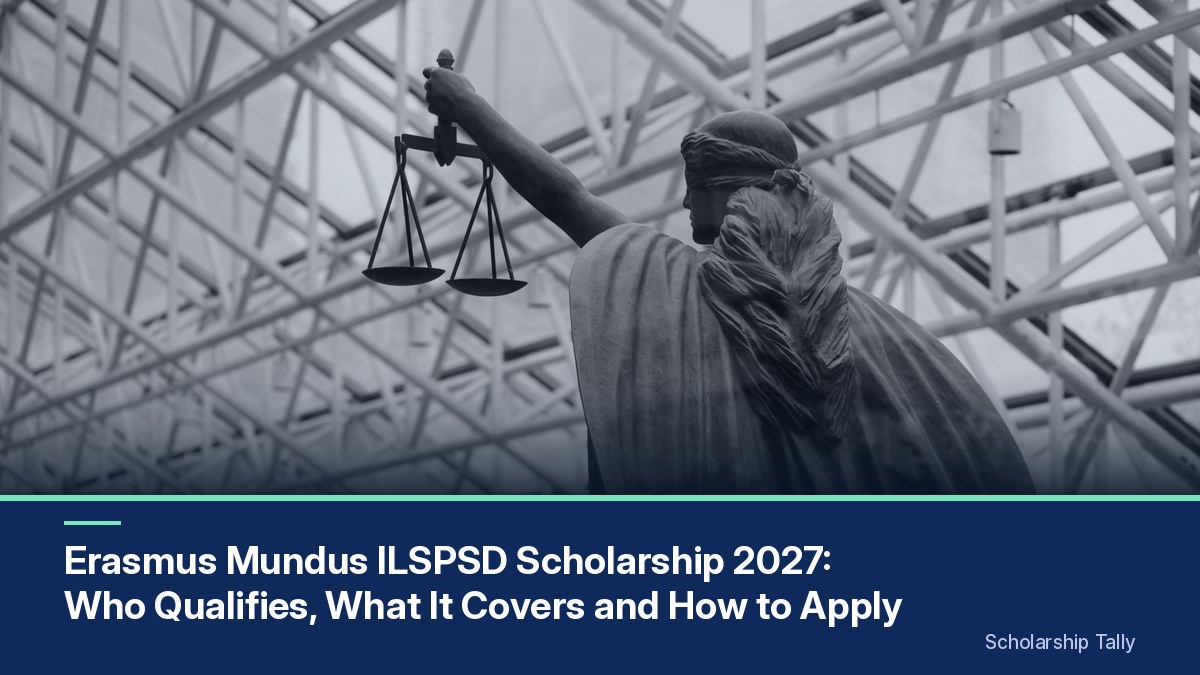
The Erasmus Mundus Joint Master (EMJM) in International Law of Security, Peace and Sustainable Development (ILSPSD) is a two-year master’s taught across several European universities, with Leuphana University of Lüneburg in Germany as the coordinating institution. For the second intake (2027 to 2029), the consortium offers Erasmus Mundus scholarships worth €1,400 per month for the full 24 months, plus an exemption from tuition fees. The scholarship deadline is 4 January 2027 at 23:59 Central European Time (CET).
This guide is for law, politics and international relations graduates who want to know, before they spend weeks on an application, whether they qualify, what the money really covers, and what the consortium will look at. Everything below comes from the official ILSPSD pages. Where those pages disagree with each other, we say so in Where the official pages differ.
ILSPSD scholarship at a glance
| Item | Scholarship applicants | Self-funded applicants |
|---|---|---|
| Deadline | 4 January 2027, 23:59 CET | 31 March 2027, 23:59 CEST |
| Monthly amount | €1,400 for 24 months | None |
| Tuition | Exempt | €24,000 for 2026 to 2028 only |
| Insurance | Package included | Package included |
| Selection weights | Merit 50, statement 40, references 10 | Merit 51, statement 49 |
| Results | April or May 2027 | April or May 2027 |
CEST means Central European Summer Time. The tuition figure is the published fee for the 2026 to 2028 cohort; the consortium says fees are set annually, so check the fees page for your intake.
What the programme is
The ILSPSD is a full-time, 24-month programme that combines international law with security studies and sustainability. The official programme structure puts every student on the same path for the first year and then lets you choose a specialisation:
- Semester 1 (October to January): Leuphana University of Lüneburg, Germany, on either a Master of Laws (LL.M.) track or a Master of Arts (M.A.) track in International Law of Security, Peace and Sustainable Development.
- Semester 2 (February to June): Institut Barcelona d’Estudis Internacionals (IBEI), Spain, studying Theories of International Security, followed by a summer thesis.
- Semester 3 (September to December): one study track chosen from the University of Glasgow (International Law and International Security), Université libre de Bruxelles (ULB) (Security and Conflict), Universidade NOVA de Lisboa (Globalization, Law and Security) or the University of Tartu (International Law and Human Rights).
- Semester 4: you stay at your Semester 3 university to write your dissertation.
Graduates receive joint, double or multiple degrees from Leuphana, IBEI and their Semester 3 university.
What the Erasmus Mundus scholarship covers
The scholarships page describes the award as a contribution to your costs, not as a full package. In the consortium’s words, it “shall cover travel, visa, installation and subsistence costs”. Here is what is published:
- €1,400 per month for the entire programme duration of 24 months, for full-time enrolment only.
- Exemption from tuition fees. Self-funded students pay €24,000 for the 2026 to 2028 cohort.
- Insurance. The fees page says an insurance package covering the minimum health and accident insurance requirements for EMJM students is included for scholarship holders and for self-funded students.
Two limits matter for your budget:
- The fees page says all students, funded and self-funded, must pay their own accommodation and their transport between partner universities. In practice, these costs come out of the monthly amount.
- The scholarships page says no subsistence contribution is paid for periods spent in your own country of residence.
The official pages do not describe this award as fully funded, and they publish no separate travel or installation lump sum. Rent, food and moves between the partner cities have to come out of the €1,400 a month.
How many scholarships there are
The consortium has 70 Erasmus Mundus scholarships across four intakes, with about 25% awarded to each intake. The number for the 2027 intake has not been published. The 70 are split into categories:
- 30 for nationals of European Union (EU) member states and third countries associated with the programme (Norway, Iceland, Liechtenstein, North Macedonia, Türkiye and Serbia).
- 20 for nationals of third countries not associated with the programme.
- 2 extra for students from Albania, Bosnia and Herzegovina, Kosovo and Montenegro, funded by the Instrument for Pre-Accession Assistance (IPA III).
- 18 extra for targeted regions (Regions 1, 3 and 5 to 11 in the Erasmus+ programme guide), funded by the Global Europe instrument.
The consortium says scholarships are open to students from any region of the world and that, as a rule, no more than 10% of all scholarships go to students of the same nationality, except for students from targeted regions.
If you miss the main list
There are two second chances. A reserve list replaces scholars who withdraw, following the same 10% rule. The consortium also offers one or more ILSPSD tuition-fee-only scholarships per intake to applicants on the waiting list. These are fee waivers: holders pay 50% of the tuition instalments and the €500 deposit, and receive no monthly amount.
Who qualifies
Rules for everyone
- Degree. You need a completed undergraduate degree of at least 180 European Credit Transfer and Accumulation System (ECTS) credits, or equivalent, from a fully accredited institution. The degree must give access to master’s study in the country that issued it.
- Subject background. The LL.M. track asks for 60 ECTS in law. The M.A. track asks for 60 ECTS in relevant subjects such as law, political science, international relations, European studies, war and security studies, sociology, political economics or human geography.
- English at level C1 of the Common European Framework of Reference for Languages (CEFR): International English Language Testing System (IELTS) Academic 7.0, Test of English as a Foreign Language (TOEFL) iBT 5 (or 95 for tests taken before 21 January 2026), Cambridge English Advanced or Cambridge English Proficiency. Results must be no more than two years old at submission.
- Language exemptions. No test is needed if English is your first language (signed declaration) or if your undergraduate degree, or a master’s of at least nine months, was taught entirely in English in a country on the consortium’s official list.
If your degree is not in ECTS credits, the entry requirements page asks you to convert your workload with its formula and upload a statement of course hours from your university.
Extra rules for scholarship applicants
- You must have finished your undergraduate studies by the time you apply. The FAQ accepts a transcript showing all degree requirements are complete, plus a university statement that the diploma will arrive before 31 August of the intake year.
- If you are still in your final year, the consortium says you can apply only as a self-funded student.
- You cannot hold this scholarship if you have already received an EMJM or earlier Erasmus Mundus master’s or doctoral scholarship.
- You cannot receive another EU grant while holding it.
- A master’s degree you already hold, or one you withdrew from, does not disqualify you. The FAQ asks you to explain your reasons in your motivation.
- You must first be offered a place (conditional or unconditional). An offer of a place is not a scholarship award. Only applicants with an offer and an on-time scholarship application enter the scholarship competition.
Extra rules for your Semester 3 track
- University of Glasgow: a 2.1 Honours degree (or non-UK equivalent) in law; Glasgow may consider international relations, politics or a relevant social sciences or humanities subject. English must be IELTS 7.0 with no sub-score below 6.5, or equivalent.
- ULB: a law degree or master’s of at least 240 ECTS (or four years of study) in law or a relevant subject, plus French at level B2 or a degree from a French-speaking institution.
- University of Tartu: at least 60 ECTS of law or law-related courses.
- Universidade NOVA de Lisboa: no additional requirements.
If you plan to choose Glasgow and need a UK student visa, the entry requirements page warns that your English test must be dated within two years and five months of the programme start date.
The consortium does not pre-check individual eligibility, and it says emails asking for language exemptions will not be answered.
Nationality and residence: which category you fall into
All nationalities can apply. Your category affects which pool of scholarships you compete in, and the scholarships page says scholarships “are dependent on both nationality and residency”. Its residence rule works like this:
- Nationals of EU member states and associated countries count in that group.
- Nationals of other countries count as non-associated, unless they have lived or carried out their main activity (study, training or work) for more than 12 months in total over the five years before the deadline in an EU member state or associated country.
- If you have dual nationality, you choose the nationality you apply under.
The consortium’s own example: a Serbian student who lived in Germany for 13 months, three years before the deadline, applies in the first group; a Mexican student who has lived in Spain for 11 months applies as a non-associated student. If you win, you will be asked for proof of residence: a residence certificate and a certificate from your place of work, study or training, both issued within 12 months before the deadline.
Note that the scholarships page still uses older Erasmus+ terms (Programme Country and Partner Country) for this rule, while its scholarship table uses the newer member state and associated country wording.
Key dates for the 2027 intake
Scholarship applicants:
- 1 October 2026: application form opens.
- 4 January 2027, 23:59 CET: scholarship deadline. That is 22:59 Coordinated Universal Time (UTC) on Monday 4 January 2027 (our conversion).
- February or March 2027: interviews with shortlisted candidates (dates to be confirmed).
- March or April 2027: preliminary results.
- April or May 2027: final results.
Self-funded applicants:
- 31 March 2027, 23:59 CEST: deadline.
- April or May 2027: results.
- 31 May 2027: €500 non-refundable deposit, deducted from the first tuition payment.
The deadline falls straight after the European winter holidays. Universities and referees are often closed in late December, so ask for transcripts and reference letters early.
How to apply
The steps, in order
- Check the general entry requirements and the requirements of the Semester 3 tracks you want.
- Choose your first, second and third track preferences. If you qualify for only one track, select it twice.
- Gather every document before opening the form (list below).
- Apply through Leuphana’s online application portal, using the scholarship form, which is linked from the official Step-by-Step Application Guide. Save the link to your application.
- Upload everything and submit well before the deadline. The consortium warns that technical problems near the deadline cannot be ruled out.
You apply once. The same application covers your study place and, if you ask for it, the Erasmus Mundus scholarship or a fee waiver.
Documents you need
- School-leaving certificate.
- Undergraduate diploma and transcript of records.
- Diplomas or transcripts from any other studies.
- Personal statement, ideally under 1,000 words.
- Two reference letters.
- A curriculum vitae (CV), for example in Europass format, with your photo on the first page (mandatory).
- Proof of English.
- Proof of French if you choose ULB.
The personal statement should cover your motivation for the programme, why you are a suitable candidate, your research interests, your placement or practice aims, and your preferred Semester 3 track with reasons.
The reference letters should be on official letterhead where possible, with contact details, dated within two years of submission. At least one must be academic; the second may be professional. Referees must say how they know you and why they can judge you. A referee may email the letter to [email protected] instead, with your full name, application ID and email address; you then upload a note with the referee’s name and email.
Documents must be in English or in Estonian, French, German, Portuguese or Spanish. Anything else needs a certified English translation, or an English version issued by your university. No apostille is needed. The personal statement, letters and CV must be in English. If you choose ULB, add proof of French.
How the consortium scores you
The selection criteria page gives the weights for scholarship applications:
- Academic merit: 50%.
- Personal statement, including relevant work and practical experience: 40%.
- Quality of references, especially academic ones: 10%.
Half the score is your academic record, which you cannot change now. The 40% statement share is where preparation pays off. The official tips ask you to link the programme to your previous studies and career goals, explain your track and partner choice, cite projects, dissertations or internships, show research and organisation skills, and mention conferences, non-governmental organisations, summer schools or awards.
After you apply
Shortlisted scholarship candidates may be interviewed in February or March 2027. Results come by email. If you are not selected, you can appeal within 14 days by emailing [email protected] with “ILSPSD scholarship appeal” in the subject line, but only on the grounds of a defective or unfair procedure.
The scholarships page says the ILSPSD Scholarship Student Agreement will be published “shortly”; it was not online when we checked.
Where the official pages differ
- Start month. The programme overview says the programme starts in September; the home page says “October Intake”; the entry requirements page gives the start date as 1 October at Leuphana; the student calendar puts welcome weeks in the second half of September. Because these differ, confirm your arrival date with the consortium before booking travel.
- Number of partners. The consortium page heading says nine European partner institutions, while the overview and home page say six. IBEI’s degree is awarded jointly by three Barcelona universities, which may explain the difference.
- Graduates in their final year. The current entry requirements page and the FAQ say scholarship applicants must have completed their undergraduate degree by the time they apply. Older Erasmus Mundus text lower on the scholarships page says final-year students may apply. We follow the newer pages.
- Results. The scholarships page says decisions come by the end of April; the timetable says final results come in April or May 2027.
- Costs. The scholarships page says the award covers travel, visa, installation and subsistence; the fees page says all students pay their own accommodation and transport between partners.
- Mobility. Older text on the scholarships page says at least two mobility periods; the programme structure page says at least three.
- Fees. The fees page lists the 2026 to 2028 fee. A separate 2027 to 2029 figure was not published when we checked.
Frequently asked questions
Is the Erasmus Mundus ILSPSD scholarship fully funded?
The official pages do not use that term. The scholarship gives €1,400 per month for 24 months, a tuition fee exemption and an insurance package. Accommodation and travel between universities come out of the monthly amount.
Can I apply from Africa, Asia or Latin America?
Yes. The FAQ says people of all nationalities can apply. Most non-European applicants compete in the non-associated group, and extra places exist for targeted regions.
When is the ILSPSD scholarship deadline for 2027?
4 January 2027 at 23:59 CET. Self-funded applicants have until 31 March 2027.
Can I apply in my final year of undergraduate study?
Not for the scholarship, in principle. Scholarship applicants must have finished their undergraduate studies by the time they apply, though the FAQ accepts a transcript showing all degree requirements are complete plus a university statement that the diploma will be issued before 31 August 2027. If you will only finish later in the 2026 to 2027 academic year and can hand in your certificate before 31 August 2027, you can apply as a self-funded student.
Do I need an IELTS or TOEFL score?
Yes, unless English is your first language or your degree was taught entirely in English in a listed country. The consortium accepts only IELTS Academic, TOEFL iBT (including the Home Edition) and Cambridge English, and it accepts the IELTS One Skill Retake.
Do I need a law degree?
Only for the LL.M. track and for some Semester 3 tracks. The M.A. track accepts 60 ECTS in subjects such as political science or international relations.
Can I apply if I already have a master’s degree?
Yes. The FAQ says a completed or withdrawn master’s does not stop you applying, as long as you have not held an earlier Erasmus Mundus scholarship.
Is there an information session?
The FAQ says the consortium plans at least one online information session per intake, with the date and link to be published on the programme website.
Official sources
- Erasmus Mundus Scholarships
- Application and Selection Timetable
- Step-by-Step Application Guide
- Entry Requirements
- Selection Criteria
- Tuition Fees
- FAQs
- Structure and Modules
Questions about your own case go to the programme coordinator at [email protected].