
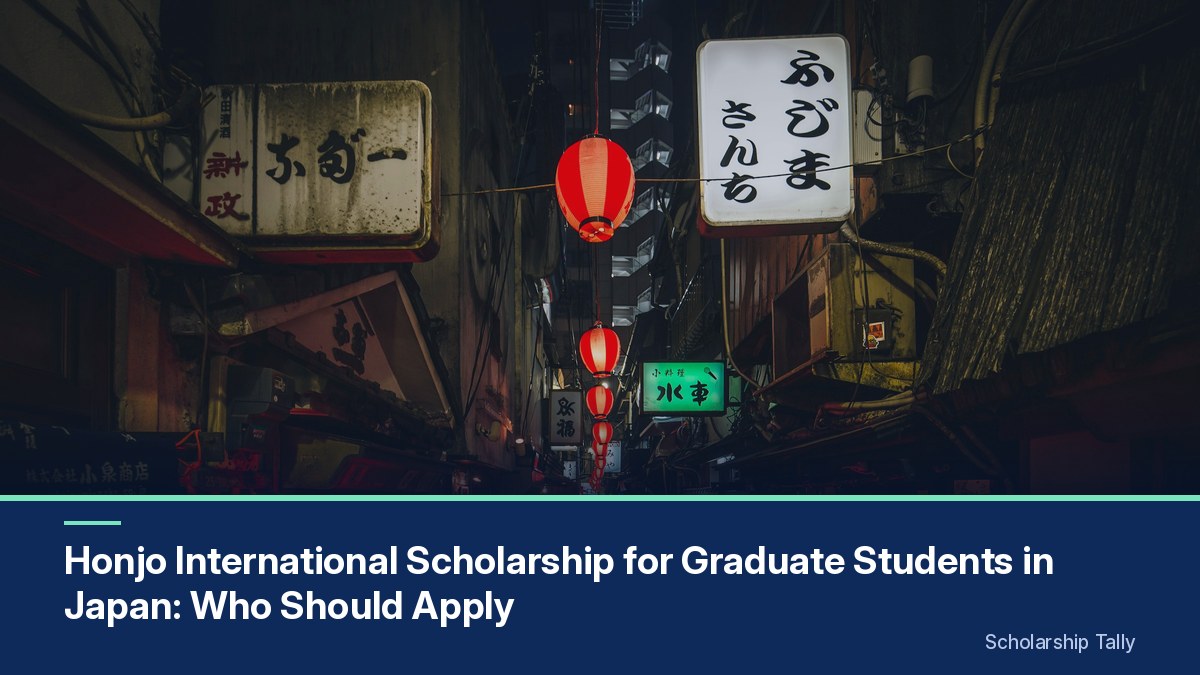
If you already have the Honjo International Scholarship Foundation page open, this guide is still useful. It helps you decide, before you spend weeks on a video and a research plan, whether the foundation’s scholarship for foreign graduate students in Japan actually fits you. The two checks that surprise people most are the age limit and the Japanese-language requirement.
Derrick Ochieng for Scholarship Tally read the official Scholarship for Foreign Students page and the 2027 application guideline (PDF) of the Honjo International Scholarship Foundation on 9 October 2026. We are not the foundation and cannot assess your application. Re-check the official pages before you submit, because dates and rules can change.
Who this scholarship is for
The foundation offers a monthly scholarship to foreign students who are studying, or about to study, for a master’s or doctoral degree at a graduate school in Japan. According to the official page, all nationalities and all research fields are welcome, and you can apply directly to the foundation without selection by your university. You can also apply from abroad if you have been accepted to a Japanese graduate school.
The official guideline says the money starts when graduate school begins in April 2027. It also says students who will enter graduate school in the fall of 2027 can apply, and that people who are currently employed are eligible if they will be enrolled in April 2027.
The programme at a glance
| Item | What the official pages say |
|---|---|
| Open to | Foreign students (no Japanese citizenship) planning to attend or currently attending a Japanese graduate school for a master’s or doctoral degree |
| Application period | 1 September 2026 to 31 October 2026 through the online application system |
| Places | Approximately ten students |
| Selection | Document screening, then interview |
| Document result | Announced by 31 January 2027 |
| Interview | Early February 2027 in Tokyo or by video call (the page lists 9 February 2027) |
| Final result | 31 March 2027 |
| Repayment | No obligation to repay the scholarship |
What the money is, and what it is not
The scholarship is paid monthly for the shortest period normally needed to complete your intended degree. The rate depends on how long that degree takes:
| Degree length | Monthly amount |
|---|---|
| 1 or 2 years | ¥230,000 |
| 3 years | ¥210,000 |
| 4 or 5 years | ¥180,000 |
The guideline adds that the payment period cannot be changed once it starts, and that students whose enrolment period is shorter than one year cannot apply. Recipients can also receive a travel grant for attending an international conference, based on the foundation’s scholarship provision rules. The pages we read do not publish the travel grant amount, so do not budget a specific figure for it.
The official pages do not describe this as a full scholarship that covers tuition, flights or accommodation separately. Treat it as a monthly living-and-study stipend and work out your tuition plan with your university before you rely on it.
Eligibility rules that decide most applications before they start
The guideline says you must meet all of the requirements. These are the ones worth checking first:
- You must not hold Japanese citizenship.
- You must be enrolled in a Japanese graduate school as of April 2027, or be applying for a course that starts in April 2027. The guideline also says fall 2027 entrants can apply.
- Students enrolling in a professional graduate school are not eligible in principle, although a student who can submit a research plan is eligible.
- Your enrolment until graduation must be longer than 12 months.
- Age: doctoral applicants must start the course by age 35, and master’s applicants must start by age 30. The guideline marks this with no exceptions.
- You need a strong commitment to serving your home country in your future career.
- You must be willing to attend foundation events and join the alumni network.
- You must be able to hold a basic conversation in Japanese. The interview is conducted in Japanese, and the guideline says there are no exceptions.
If you will be past those ages when your course starts, the guideline’s no-exceptions wording means this scholarship is not for you. If you cannot yet speak basic Japanese, the interview rule is the biggest obstacle, so be honest with yourself before you invest in the application.
Rules that affect your plans after you win
- Other scholarships: you cannot hold another scholarship alongside this one, except the ones the guideline lists: the Japanese Government (MEXT) Scholarship, the Monbukagakusho Honors Scholarship for Privately Financed International Students, a Japan Society for the Promotion of Science International Fellowship, a Japan Science and Technology Agency fellowship (only if approved for concurrent receipt), and a Japan International Cooperation Agency scholarship.
- Work: you cannot take employment other than part-time jobs related to your studies, such as teaching assistant, research assistant, or translator or interpreter roles in international exchange.
- Events: you are required to join the interview and the events the foundation organises, and to keep taking part in foundation events after you finish graduate school.
- Payments can be stopped, and the board can ask you to return money already paid, in situations the guideline lists, including false statements in your application and academic failure.
What to prepare and in what order
Applications are online only, and the guideline says documents cannot be accepted by post. The online system is at entry.hisf.or.jp. The data you enter can be rewritten until 31 October 2026. A sensible order, based on the guideline:
- Confirm you meet every requirement above, especially age and Japanese.
- Secure or confirm your admission to a Japanese graduate school, and ask your supervisor or a previous supervisor for a recommendation letter early. The letter needs a signature or seal and must be emailed by the recommender to [email protected] by the deadline, with your name and application number in the file name.
- Write the research plan on the designated Word template. The guideline asks for it in Japanese and covers your research content and schedule, how you will contribute to your home country, and what you have already achieved. If you are not confident in Japanese, you may add an English version.
- Record the required video: up to two minutes, in Japanese or English, .mp4 or .mov, maximum 1 GB, with your face visible. A 30-second self-promotion video is optional.
- Prepare the undergraduate transcript as a PDF (and the graduate transcript only if you have one), plus a face photo in .jpg or .gif of up to 500 kB.
- Submit, then save the application number and the PDF of your form. The foundation announces results by application number.
If your admission letter is not available by 31 October 2026, the guideline says to enter the probable date in the system and email the letter to the foundation as soon as you have it. It also says you cannot log in to the system after 1 November 2026.
Common mistakes to avoid
- Waiting for the last day: the official pages do not state a closing time zone for 31 October, so submit well before the deadline.
- Assuming English is enough: the research plan is expected in Japanese, and the interview is in Japanese.
- Counting on tuition support: the pages describe a monthly amount, not tuition coverage.
- Leaving the recommender until the end: the letter must reach the foundation by the deadline and then be uploaded by you.
- Ignoring the rule on other scholarships: confirm any award you hold is on the permitted list before you accept this one.
Frequently asked questions
When is the application deadline?
The application period runs from 1 September 2026 to 31 October 2026, according to the official page and the 2027 guideline.
How much is the Honjo International Scholarship?
It is ¥230,000 per month for a 1 or 2 year degree, ¥210,000 per month for a 3 year degree, and ¥180,000 per month for a 4 or 5 year degree.
Can I apply from outside Japan?
Yes. The official page says applications can be submitted from abroad if you are accepted to a Japanese graduate school.
Do I need to speak Japanese?
The guideline says you must be able to carry out a basic conversation in Japanese and that interviews are conducted in Japanese with no exceptions.
Is there an age limit?
Yes. Doctoral applicants must start by age 35 and master’s applicants by age 30.
Do I need my university to nominate me?
No. The official page says you may apply directly to the foundation without pre-selection by your university.
Who can I ask questions?
The guideline says inquiries are accepted by email at [email protected]. The foundation’s website also has an inquiry form and an FAQ page.
Official sources
- Honjo International Scholarship Foundation: Scholarship for Foreign Students
- 2027 application guideline for foreign students (PDF)
- Online application system
Dates, amounts and rules above were checked on the linked official pages on 9 October 2026. Prefer the live official pages if anything differs.