
Durham University is offering up to eleven PhD Studentships in Transformative Humanities for outstanding candidates starting a Doctor of Philosophy (PhD) programme in October 2027. The deadline is noon UK time on 15 January 2027. Up to nine awards are open to home students and up to two to overseas students, and every applicant needs a supervisory team that spans at least two departments.
Derrick Ochieng for Scholarship Tally reviewed the official PhD Studentships in Transformative Humanities page on 11 October 2026, 96 days before the deadline. This guide was drafted with AI assistance from an outline and checked against the official scheme page. Scholarship Tally is independent of Durham University and cannot assess individual applications. Where the official page does not publish a detail, this guide identifies the gap rather than supplying an estimate.
The studentships at a glance
| Item | What the official page says |
|---|---|
| Awards | Up to eleven: up to nine for home students, up to two for overseas students |
| Start | PhD programmes beginning in October 2027 |
| Funded by | Durham’s Arts and Humanities Research Council (AHRC) Doctoral Landscape Award and the Faculties of Arts and Humanities and Social Sciences |
| Covers | Tuition fee waiver, stipend at the UK Research and Innovation (UKRI) level, additional funding opportunities, training and placement resources |
| Length | 3.5 years full time or 7 years part time |
| Deadline | Noon UK time, 15 January 2027 |
| Info session | 10 November 2026, 11am UK time, online via Teams |
| Results | Successful applicants notified in March 2027 |
| Contact | [email protected] |
Who this fits (and who it does not)
Your project must relate to the Transformative Humanities framework
Durham says the awards are for projects “related to the themes of our Transformative Humanities framework”. The scheme page links to the framework page rather than restating the themes, so read it before you shape your research questions. If you cannot explain in a sentence or two how your project connects to that framework, this is probably not the right scheme for it.
Your team must be led by Arts and Humanities or Social Sciences, across at least two departments
Only PhD students accepted to Durham “with a supervisory team lead by Arts & Humanities or Social Sciences” will be considered, and supervision “must include collaboration across at least two departments”. This is the rule most likely to catch out projects that only make sense inside one discipline.
There is one gap to watch. Social Sciences-led teams are eligible, but the scheme page only lists Arts and Humanities departments to apply through. If your lead supervisor would be in a Social Sciences department, ask [email protected] which programme to apply to rather than guessing.
You must be accepted to a Durham PhD programme under that team
The official Durham scheme page says only PhD students accepted to Durham University with the required supervisory team will be considered. It does not specify whether an admission offer must be in place by 15 January 2027 or whether admission and funding applications are assessed together. Contact [email protected] to clarify the timing before relying on an assumption.
60-second eligibility check
Answer each question yes, no or not sure:
- Will you start a Durham PhD programme in October 2027?
- Is your supervisory team led by Arts and Humanities or Social Sciences?
- Does your supervision include collaboration across at least two departments?
- Does your project relate to the Transformative Humanities framework?
- Do you know whether you would count as a home or overseas student?
A “no” on any of the first four questions signals a potential eligibility problem to resolve before applying. If you are unsure about your project’s fit or the proposed supervisory team, contact [email protected] rather than guessing. The official Durham scheme page does not publish how home or overseas status is determined. Scholarship Tally’s view: resolve these questions as early as possible, ideally before the information session on 10 November 2026.
What the award covers and what is not published
What Durham lists
- A tuition fee waiver: at home level for the up to nine home awards, and at overseas level for the up to two overseas awards.
- A stipend for 3.5 years full time or 7 years part time, at the level set by UKRI. Durham links to UKRI but does not print a figure, so check the current UKRI rate yourself rather than relying on a number from another site.
- Additional funding opportunities, which the page does not itemise.
- Access to training and placement resources.
What is not published
- The stipend amount.
- What the additional funding opportunities are.
- Flights, visa costs, the Immigration Health Surcharge or family allowances.
- The overseas fee amount.
- How home or overseas status is decided.
- English language requirements.
- Whether there is an interview stage.
- Selection criteria beyond what the research proposal must cover.
The official Durham page does not describe the award as fully funded. It does not specify whether flights, visa costs, the Immigration Health Surcharge or family allowances are covered. Scholarship Tally’s view: overseas applicants should ask Durham what support, if any, is available for these costs before relying on the studentship to meet them. Contact [email protected].
Home versus overseas places
The official Durham page says up to nine awards are open to home students and cover tuition fees at home level, while up to two are open to overseas students and cover tuition fees at overseas level. Durham does not publish application numbers or success rates, so the available information cannot establish an applicant’s chances of success. The official page also says applicants can list other funding schemes in the Funding section under Scholarship details. Scholarship Tally’s view: check which other schemes you may qualify for, but do not assume that listing them changes your chances of receiving this studentship.
How to approach supervisors and build a two-department team
The official Durham scheme page recommends contacting potential supervisors to discuss your project before applying. It also says applicants should apply to the PhD programme of their lead supervisor’s department, so identifying the lead supervisor is an important first step.
Scholarship Tally’s view: use this sequence to organise your preparation.
- Read Durham’s Transformative Humanities framework and write a short project note explaining your research question and the disciplines involved.
- Identify a potential lead supervisor in Arts and Humanities or Social Sciences whose research fits your project.
- Contact that supervisor to discuss the project and ask whether collaboration with a second department is appropriate.
- If the project proceeds, contact a potential co-supervisor in the second department and clarify whether the proposed team can meet Durham’s cross-departmental requirement.
- Confirm the appropriate PhD application route before submitting.
The official Durham scheme page lists Classics and Ancient History, English Studies, History, Modern Languages and Cultures, Music, Philosophy, and Theology and Religion as departments for the application route. Because the page does not list Social Sciences departments there, applicants with Social Sciences-led teams should ask [email protected] for clarification. Start these conversations early enough to resolve unanswered questions before the deadline.
How to write the 1,000-word research proposal
The official Durham scheme page requires a research proposal of no more than 1,000 words, including footnotes and excluding the bibliography, covering four areas. Scholarship Tally’s view: using these four areas as working headings can help you check that your proposal answers every published requirement. The suggestions below are practical drafting advice, not a published Durham scoring rubric.
Research questions and context
State the questions you will answer and the scholarship or debate they respond to. Keep it focused: with footnotes counted, a long literature review will eat your word limit.
Approach and methods
Explain how you will answer the questions: sources, archives, methods or fieldwork. This is also where a two-department team should be visible, because each supervisor’s expertise should map onto part of the method.
Relevance to transformative humanities
Scholarship Tally’s view: explain how your research questions connect to the themes of Durham’s Transformative Humanities framework. Read the framework itself rather than assuming that a general statement about the importance or impact of your topic establishes this connection.
Fit with Durham University
Durham requires the proposal to explain its fit with the university. Scholarship Tally’s view: make this explanation specific to your project and proposed supervisory team, and describe how the research environment and the expertise of the supervisors you have contacted relate to your research needs. Durham’s published page does not provide a broader selection rubric, so do not treat this advice as a confirmed scoring criterion.
Supporting documents
The official Durham scheme page lists these application requirements:
- Research proposal: maximum 1,000 words, including footnotes and excluding the bibliography.
- Curriculum vitae (CV): maximum two pages.
- Equal opportunities monitoring form: complete the form linked from the official page and keep the code you receive as proof of submission.
- Two referees: provide their contact details. Consult Durham’s online application system for instructions about reference letters.
How to apply
- Apply to the PhD programme of your lead supervisor’s department through Durham’s online application system.
- In the Funding section, under Scholarship details, type Transformative Humanities and list any other schemes you want to be considered for.
- Upload the research proposal and CV, add your two referees and complete the equal opportunities form.
- Submit before noon UK time on 15 January 2027.
The official Durham scheme page says that applications can be submitted through an application link that will be available on that page in October. On 11 October 2026, no separate application link was visible to us, so check the official page again before starting your application.
A timeline from now to the deadline
- Now to early November 2026: confirm your project fits the framework, find a lead supervisor and a second department, and send your emails.
- 10 November 2026, 11am UK time: Durham’s information and question-and-answer session takes place online via Teams. Check the official page for the event link. Scholarship Tally’s view: prepare questions about the application route, the timing of PhD admission, and any funding details the page does not publish.
- Mid-November to December 2026: write the proposal against the four areas, trim the CV to two pages, ask your referees and complete the monitoring form.
- Early January 2027: submit a few days before the deadline so a technical problem or a missing document can still be fixed.
- 15 January 2027, noon UK time: deadline.
What happens after you submit
The official Durham scheme page says successful applicants will be notified in March 2027. Nothing else is published about the process between submission and notification, including whether there are interviews. Programmes begin in October 2027.
Frequently asked questions
Can overseas applicants apply?
Yes. The official Durham scheme page says up to two awards are open to overseas students and cover tuition fees at overseas level. Durham does not publish application numbers or success rates.
Does the award cover all my costs?
The official Durham scheme page lists a tuition fee waiver, a stipend at the level set by UKRI, additional funding opportunities, and access to training and placement resources. It does not publish a stipend figure or specify whether flights, visa costs, the Immigration Health Surcharge or family allowances are covered. Contact [email protected] about anything the page leaves unanswered.
Must my supervisory team include two departments?
Yes. The official Durham scheme page requires collaboration across at least two departments, with the team led by Arts and Humanities or Social Sciences.
Do I need a Durham admission offer before the funding deadline?
The official Durham scheme page says applicants must be accepted to Durham University, but it does not specify whether an admission offer must be in place by 15 January 2027. Contact [email protected] to clarify the timing.
What must my research proposal cover?
The official Durham scheme page requires a proposal of no more than 1,000 words, including footnotes and excluding the bibliography. It must cover research questions and context, approach and methods, relevance to Transformative Humanities, and fit with Durham.
When will applicants hear the outcome?
In March 2027, when Durham says successful applicants will be notified.
Official sources
- Durham University: PhD Studentships in Transformative Humanities
- Durham University: Transformative Humanities framework
- Contact: [email protected]
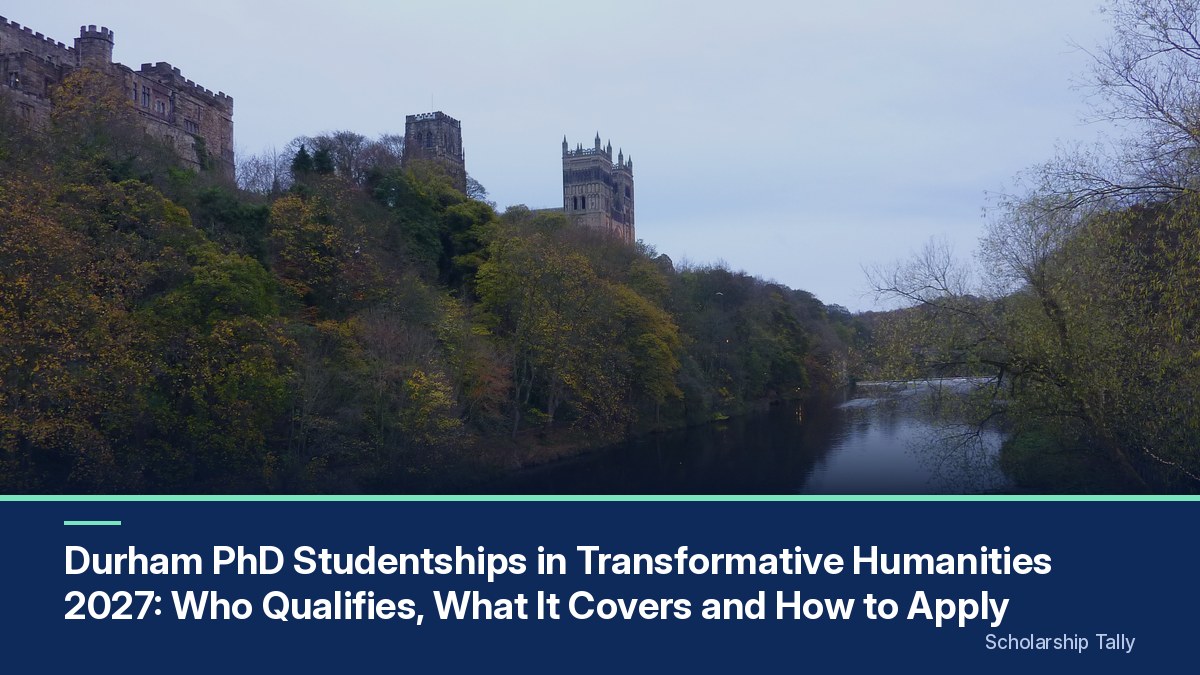
Dates and rules above were checked on the official page on 11 October 2026. Prefer the live official page if anything differs. Featured image: Durham Cathedral above the River Wear, photo by Richard Cooke, CC BY-SA 2.0, via Wikimedia Commons.