
The Eric Bleumink Fellowship at the University of Groningen supports a small number of Master’s students from least-developed and related developing countries. It is nomination-only: you cannot send a separate scholarship form. What you can control is completing a Master’s application early enough for admission to land before February, meeting the published excellence and nationality criteria, and understanding what the grant actually covers.
Derrick Ochieng for Scholarship Tally reviewed the official Eric Bleumink Fellowship page, the applying for a grant page, and the linked Rules and Regulations PDF (updated November 2024) on 12 October 2026. This guide was drafted with AI assistance from an outline and checked against those official sources. Scholarship Tally is independent of the University of Groningen and cannot assess individual applications. Where official pages disagree or leave a gap, this guide flags the difference rather than inventing a reconciled figure.
The fellowship at a glance
| Item | Detail |
|---|---|
| Award | Eric Bleumink Fellowship (also EBF Talent Grant) |
| Host | University of Groningen, Netherlands |
| Level | 1-year or 2-year Master (MSc, MA, or LL.M.), September start only |
| Covers | Tuition fee, international travel, subsistence, books, and health insurance (RUG page wording) |
| PDF amounts | Living €1,250 per month; settling €275; study materials €310 per year (Rules PDF, Nov 2024) |
| Application | No direct fellowship form; Admissions Office nominates |
| Master gate | Complete Master’s application before 1 December (timing for EBF consideration; not a separate fellowship form deadline) |
| Admission gate | Provisional or unconditional admission before February |
| Nomination notice | If nominated, informed before 1 February (applying page); final selection outcome before 1 March (Rules PDF) |
| Nationality | Live fellowship page Countries of Origin list (check live); Rules PDF Appendix 1 is a separate tiered DAC ODA-style list |
| Awards | Limited / few (live web pages); “only four” in Rules PDF, Nov 2024 (not a separately confirmed current-year quota) |
Who this is for (and who it is not)
Who it fits
This grant is aimed at promising Master’s candidates who:
- Want a 1-year or 2-year Master programme at the University of Groningen that starts in September (not a February intake).
- Hold the nationality of a country listed on the University of Groningen’s live Eric Bleumink Fellowship page. Check that page directly before applying. The live page publishes a flat Countries of Origin list; the November 2024 Rules PDF Appendix 1 is a tiered DAC ODA-style list. They are not presented the same way, so do not treat a static PDF reprint as identical to the live list. Kenya appears on the live page list as of Scholarship Tally’s 12 October 2026 check; still verify both live sources for your own nationality.
- Can show excellent bachelor grades and academic performance, preferably with strong recommendation letters, and English proficiency that matches the chosen programme.
- Have no other means of financing that Master study.
- Are available for the whole programme and in good health so Dutch health insurance can be arranged.
- Can finish a complete Master application before 1 December so a provisional or unconditional admission can arrive before February.
The applying page and Rules PDF also frame the intent clearly: training should help increase academic capability in the home country. That purpose shows up again in selection criteria.
Who may not meet the published requirements
This fellowship may not fit your plans if:
- Your intended programme does not start in September.
- You need funding for a Bachelor, PhD, exchange, or short course. Official pages describe Master’s only.
- You already have other funding for the same study, or you expect to take paid employment in the Netherlands while holding the grant (the Rules PDF says recipients must not enter paid employment in the Netherlands).
- You need family relocation or support costs covered. The Rules PDF (November 2024) states that the allowance is considered to be sufficient for one person’s subsistence and that the fellowship does not provide for the cost of bringing or supporting family members.
- You need a public scholarship application portal with status updates. There is none; nomination is internal, and further correspondence about the procedure is not possible once the February nomination window closes.
You cannot apply for the fellowship itself
Official wording on both the fellowship page and the applying page is blunt: you cannot directly apply for an Eric Bleumink Fellowship / EBF Talent Grant. Suitable candidates are nominated by the University of Groningen Admission Office, in consultation with faculty Admission Boards, based on (1) the candidate’s Master application and (2) the EBF nomination criteria. The applying page also asks you not to contact the university with scholarship applications.
The key practical point is that your Master’s programme application is the basis for nomination consideration. There is no separate public fellowship application to submit later. Make sure you understand the Master’s application requirements and the time needed for an admission decision.
Process order that actually matters
Scholarship Tally’s view: think in hard gates, not in “scholarship open / scholarship close” calendar language. The university does not publish a separate public fellowship application deadline because there is no public fellowship application.
Gate 1: Master’s application complete before 1 December
For EBF consideration, the University of Groningen says that the Master’s application should be completed before 1 December. This allows the Admission Office time to process the application so that provisional or unconditional admission can be received before February. Official pages state this as an annual calendar rule (not a year-stamped open/close window). This is the published timing requirement for the Master’s application, not a separate public EBF application deadline.
Gate 2: Provisional or unconditional admission before February
Candidates are considered only if they have received provisional or unconditional admission for a Master programme before February. Incomplete documents, missing English proof, or a delayed faculty decision can mean admission arrives too late for that cycle’s consideration, even with strong grades.
Gate 3: Nomination contact before 1 February
If you are nominated, you are informed before 1 February. If you hear nothing by then, you were not selected as a nominee. Official applying-page and Rules wording: further correspondence about the procedure is not possible.
Why the timing matters
The University of Groningen states that applicants must have provisional or unconditional admission before February to be considered. The Master’s application should therefore be complete before 1 December to allow the university time to process it. Strong academic performance alone does not replace these published requirements.
What happens after you apply for the Master’s
Once your Master application is in, the process is internal. The Rules and Regulations PDF (updated November 2024) spells out more steps than the short web pages:
- In the first week of January, the Admission Office selects nominees together with the faculty admission board.
- Selected nominees are informed and asked to send an EBF motivation letter to the Admission Office within one week.
- Nomination files go to the EBF committee before 1 February.
- The committee selects fellows and informs nominees of the outcome before 1 March.
The November 2024 Rules and Regulations PDF describes a two-stage process: nomination by the university, then selection by the EBF committee. Under the PDF’s procedure, selected nominees are asked to submit an EBF motivation letter within one week. Nomination files go to the committee before 1 February, and the final selection outcome is communicated to nominees before 1 March. The public applying page separately states that applicants who are not contacted about a nomination by 1 February were not selected as nominees, and that further correspondence about the procedure is not possible. If you are nominated, watch your email carefully in January; that one-week letter window is short.
Coverage: what the main RUG page says versus the Rules PDF
Summary wording versus PDF detail
The University of Groningen fellowship page states that the grant covers tuition fee, costs of international travel, subsistence, books, and health insurance. It is awarded for a 1-year or 2-year Master programme starting in September only.
For a concise summary, use that main fellowship page wording. For individual allowance amounts and detailed conditions, consult the November 2024 Rules and Regulations PDF. The figures below are attributed to that PDF and should not be added together into an unofficial total for the full degree. The primary page does not market a flat euro total and does not use a slogan such as “fully funded.”
Rules PDF component amounts (November 2024)
The Rules and Regulations PDF linked from the applying page (updated November 2024) breaks components down as follows. Attribute these figures to that PDF, not to a third-party summary:
- Living / subsistence: living allowance of €1,250.00 per month for food and accommodation.
- Settling-in: settling allowance of €275 for extra expenses on arrival.
- Study materials: study allowance of €310 per year for books and other study material.
- Tuition: tuition fees for the Master’s programme paid by the Eric Bleumink Fellowship.
- Travel: journeys to the Netherlands and back; economy-class flights between Amsterdam and the airport nearest the recipient’s residence; travel insurance and airport taxes; Mobility and Scholarship Desk (MSD) arranges flights and reimburses train tickets (Schiphol to Groningen, second class). Excess baggage is not covered.
- Insurance: private insurance premium paid by EBF; covers medical treatment, personal accidents, emergency extra flight home, and legal liability for private persons, valid in the Netherlands from arrival to departure. The November 2024 Rules PDF states that fellows are insured through a private insurance company (named as AON at the time the PDF was written).
The November 2024 Rules PDF also states that the allowance is considered to be sufficient for one person’s subsistence, paid from arrival (not more than one week before programme start) until departure (no later than five days after programme end). Clothing allowance is not included. The fellowship does not provide for bringing or supporting family. Recipients must not enter paid employment in the Netherlands.
Secondary €15,000 figure: do not reconcile
A Ubbo Emmius Foundation (UEF) fundraising page associated with the fellowship has referred to individual grants of €15,000. That figure conflicts with the RUG primary page (no flat total) and with the PDF component schedule for a full 1- or 2-year Master. Scholarship Tally’s view: treat €15,000 as a secondary fundraising-page conflict, not as the official award total. Do not average or invent a reconciled number. Prefer the RUG coverage wording and, when amounts are needed, the PDF components with an explicit November 2024 attribution.
How many awards and how competitive it is
Official sources use different levels of precision. Attribute carefully:
| Source | Wording |
|---|---|
| Main fellowship page | A considerable number of students apply; the university can issue only a limited number of grants |
| Applying page | Hundreds of applications; only a few of them can be awarded |
| Rules PDF (Nov 2024) | Hundreds of applications each year and only four of them will be awarded with a scholarship |
The official pages describe the number of grants as limited or few. The November 2024 Rules and Regulations PDF states that four scholarships will be awarded. Because the public pages use broader wording, this guide attributes the figure of four to the dated PDF rather than presenting it as a separately confirmed current-year quota. The university does not publish individual applicants’ odds of selection in these sources. Board decisions are described as final with no appeal.
Eligible nationalities and other hard criteria
Nationality: live page list versus Rules PDF Appendix 1
You must hold an eligible nationality as published by the University of Groningen. Treat these as two live sources, not one interchangeable list:
- The live fellowship page publishes a flat Countries of Origin list.
- The November 2024 Rules PDF Appendix 1 is a tiered DAC ODA-style list (least-developed countries first, then other low-income, then lower-middle-income groupings as listed).
Do not assume a blog reprint or a PDF excerpt matches the live page. Kenya appears on the live page list as of Scholarship Tally’s 12 October 2026 check; still verify the live page and the current Rules PDF Appendix 1 for your own nationality.
The Rules PDF also notes partner universities in Appendix 2; talented prospective students from those institutions are preferred. That preference does not replace the nationality gate on the live sources above.
Other published must-haves
Alongside nationality, candidates should:
- Hold provisional or unconditional Master admission before February.
- Show excellent academic performance, preferably confirmed by letters of recommendation.
- Have excellent undergraduate grades.
- Meet the English requirements of the chosen programme.
- Be available for the entire programme.
- Be in good health so insurance can be arranged.
- Have no other means of financing the study.
What the selection committee also looks at
Beyond the nomination checklist on the short fellowship page, the Rules PDF lists additional criteria used by the selection committee / Board:
- Contribution of the candidate’s education to strengthening scientific capacity in the home country.
- Perspectives for longer-term links between a university in the developing country and the University of Groningen (preferable).
- Balance between male and female candidates.
- Spread across disciplines (faculties).
- Regional variety across continents.
- Motivation, including clarity about other funding requests submitted (copies of those applications).
- Any other University of Groningen scholarship offered simultaneously with the EBF Talent Grant is not allowed.
Scholarship Tally’s view: a strong academic file is necessary but not sufficient. The Board is also balancing gender, fields, and regions, and weighing home-country capacity impact. That is why nomination is not automatic for every excellent admitted applicant from an eligible country.
Practical constraints and obligations
These Rules PDF points matter once you are deciding whether a Groningen Master under EBF is realistic:
- Arrival is tied to programme start (not more than one week early); departure is expected soon after the programme ends.
- Per the Rules PDF (November 2024), the allowance is considered sufficient for one person’s subsistence; family costs are out of scope.
- Paid work in the Netherlands is not allowed under the Rules wording.
- Clothing allowance is not included.
- Financial arrangements are handled by the Mobility and Scholarship Desk on behalf of EBF (contact given in the November 2024 Rules PDF). That is an administration contact for selected fellows, not an application channel. The applying page still says not to contact the university with scholarship applications.
If any of those constraints would break your plan (for example, you need family relocation support), this grant may not match your circumstances even if your grades are excellent.
Frequently asked questions
Can I apply directly for the Eric Bleumink Fellowship?
No. Official RUG pages state that you cannot directly or actively apply. The Admission Office nominates candidates after you apply for a Master’s programme.
What happens if I am not contacted by 1 February?
You were not selected as a nominee. Official applying-page and Rules wording say further correspondence about the procedure is not possible.
Does Kenya (or my country) appear on the eligible list?
Kenya appears on the University of Groningen’s live Eric Bleumink Fellowship page Countries of Origin list as of Scholarship Tally’s 12 October 2026 check. The November 2024 Rules PDF Appendix 1 is presented differently (tiered DAC ODA-style). Check both the live fellowship page and the current Rules PDF for your own nationality rather than relying on a copied list.
Is the Master application deadline the same as a fellowship deadline?
There is no separate public fellowship application deadline. For EBF consideration, complete the Master’s application before 1 December (official annual wording) so the Admission Office has time to process your file and admission can be issued before February.
What does “covers subsistence” mean versus the PDF amounts?
The main fellowship page uses the broader wording: tuition, international travel, subsistence, books, and health insurance. The November 2024 Rules PDF specifies a living allowance of €1,250 per month, a settling allowance of €275, and a study allowance of €310 per year, plus tuition, travel, and insurance details. Prefer the page wording for a short summary; attribute euro components to the PDF.
How many grants are awarded each year?
The main page says a limited number; the applying page says only a few of hundreds of applications; the November 2024 Rules PDF says only four will be awarded. Attribute the source you cite, and treat “four” as the dated PDF figure rather than a confirmed current-year quota. Scholarship Tally does not invent a single reconciled headcount.
Do I need a separate motivation letter before I am nominated?
Not as a public pre-application step. The Rules PDF says selected nominees are informed and then asked to send an EBF motivation letter within one week. You do not submit that letter as a substitute for the Master application.
What if I receive admission after February?
Official criteria say only candidates with provisional or unconditional admission before February are considered. Late admission is a hard failure mode for that cycle.
Are there preferences for certain universities or fields?
Yes, in the Rules PDF: Appendix 2 partner institutions are preferred for talented prospect students; selection also seeks balance across gender, disciplines, and regions, plus contribution to scientific capacity in the home country. The nationality gate remains Appendix 1.
What should I do if the official pages and Rules PDF differ on a detail?
Prefer the live University of Groningen fellowship and applying pages for process headlines, and the linked Rules PDF for detailed allowances and nomination steps. Flag conflicts (for example award count language, or a secondary €15,000 fundraising figure) rather than inventing a compromise. Always verify the live pages before you act.
Official sources
- University of Groningen: Eric Bleumink Fellowship
- University of Groningen: Applying for a grant (Eric Bleumink Fund / EBF Talent Grant) (links the updated Rules and Regulations PDF, November 2024)
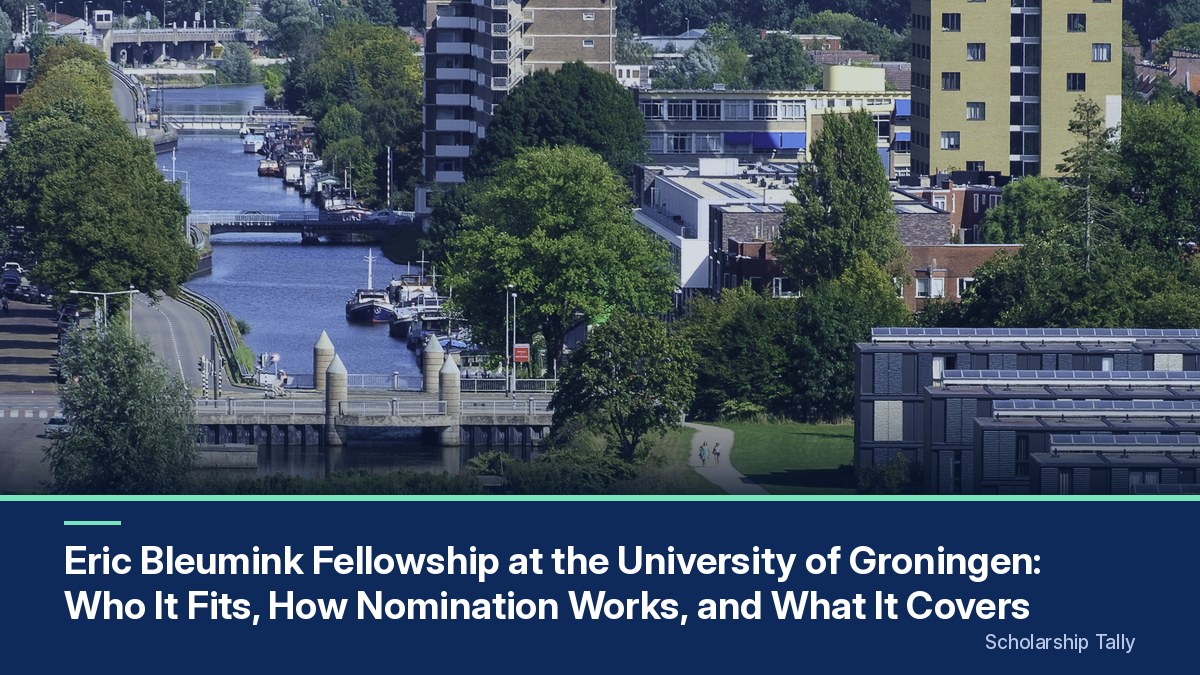
Dates and rules above were checked on the official pages on 12 October 2026. Prefer the live official pages and the current Rules PDF if anything differs. Featured image: Groningen canal (Oosterhamrikkanaal), photo by Hardscarf, CC BY-SA 4.0, via Wikimedia Commons. Scholarship Tally is not affiliated with the University of Groningen.