The John S. Knight Journalism Fellowships at Stanford, usually called the JSK Fellowships, give people who work in journalism, or at organizations that support or collaborate directly with journalists, nine months at Stanford University, from September through May, to explore one question about journalism they cannot stop thinking about. Fellows receive a $135,000 stipend, Stanford tuition and Stanford health insurance. Applications for the 2027-28 fellowships are open now, and the deadline is Dec. 2, 2026 at 1:00 p.m. Pacific time. JSK says it does not offer extensions or accept late applications.
This is not a degree, a book grant or a startup accelerator. JSK is looking for people who work in or for journalism, with at least five years of professional experience, who want time to rethink a problem with a small cohort and a personal coach. You do not need a college degree, and you do not need to arrive with a project.
Use this guide to decide whether you fit, what the fellowship pays for and what it asks of you in return, which of the two tracks (U.S. or international) applies to you, how the visa rule works, and how to prepare the application. Facts were checked on 23 October 2026 against JSK’s Become a fellow page, its Application FAQ and its fellowship experience page.
Quick facts
| Item | Details | Source |
|---|---|---|
| Length | Nine months, September through May, in residence at Stanford | Become a fellow |
| Stipend | $135,000 for the nine months | Become a fellow |
| Also covered | Stanford tuition and health insurance, plus a health supplement for dependents enrolled in Stanford coverage | Become a fellow |
| Experience | At least five years of professional experience | Become a fellow |
| Degree | Not required; no grades and no academic credit are awarded | Application FAQ |
| Tracks | U.S. fellowship or international fellowship | Application FAQ |
| Apply on | SurveyMonkey Apply (jsk.smapply.org) | Become a fellow |
| Deadline | Dec. 2, 2026 at 1:00 p.m. Pacific time | Application FAQ |
| Interviews | March, on Zoom | Application FAQ |
Who it fits, and who it does not
Likely a good fit
- You are directly involved in producing journalistic content in any capacity. JSK’s own examples include editors, producers, photographers, audience and community builders, and publishers.
- You work in operations or strategy at a news organization, or at an organization that supports or collaborates directly with journalists.
- You have at least five years of professional experience. Student work and internships do not count toward the five years.
- You freelance, and most of your work is within journalism. JSK says it does not matter whether you work as an employee or as an independent contractor.
- You have a question or problem about journalism that keeps coming back in your work, and you want to spend real time on it, with the openness to have your thinking challenged.
- You can work respectfully with people from different ideological backgrounds. JSK calls this central to how the cohort works.
- Your written and spoken English is proficient. The application must be in English.
Probably not for you
- You want a degree. JSK is not an academic programme: fellows can sit in on classes, but they get no grades and no academic credit.
- You work in public information, public relations, or in-house or industry communications.
- You are a government employee or a full-time academic.
- You work for or with an organization that is not editorially independent, such as government operated media.
- You need funding for a book or a reporting project. JSK says it does not support either.
- You are looking for a startup accelerator.
What the fellowship pays for, and what it asks of you
What you receive
- A $135,000 stipend for the nine months.
- Stanford tuition and Stanford health insurance. The Become a fellow page adds a health supplement for dependents enrolled in Stanford coverage, and the FAQ says health insurance is covered for spouses and children who come to Stanford.
- Advice on finding rental housing and settling into the Stanford area, for you and your family. This is advice, not accommodation.
- Individual coaching and customized workshops from JSK directors, programme partners and advisers. Every fellow is paired with one of the directors as a personal coach for the year.
- Access to Stanford classes, talks and its academic and creative life, plus the global JSK alumni network.
JSK’s pages do not mention a separate travel or relocation allowance.
What JSK asks in return
- Live at Stanford from September through May and treat the fellowship as a full-time commitment.
- Join weekly cohort meetings and one-on-one coaching sessions every two weeks.
- Attend occasional JSK and Stanford events.
- Share your insights and reflections publicly during the year.
- Collaborate respectfully with people from diverse backgrounds and perspectives.
The full-time residence rule matters most. If you cannot step away from your job, your newsroom or your freelance clients for the academic year, this fellowship will not work, however strong your application is.
Bringing your family
JSK welcomes spouses, partners and children. Its FAQ says fellows’ children can attend area public schools and that spouses and partners can sit in on some Stanford classes. Partners, whom JSK calls affiliates, are welcome at most JSK gatherings. Check the visa section below before you plan around an unmarried partner or non-dependent children.
U.S. or international: which fellowship you apply for
JSK runs two tracks. The FAQ gives a simple test: if the community you serve with your journalism is mainly in the United States, you would typically apply as a U.S. applicant; if not, you would apply as an international applicant. You do not choose freely. After you create your account on SurveyMonkey Apply, a few profile questions decide which fellowship you can apply for.
The tracks differ in selection. For U.S. fellowships, the JSK Selection Committee of journalism and Stanford leaders joins the selection team, and U.S. finalists hear in April with offers in May. International offers go out in April. See the timeline below.
Visas and the country restriction
International fellows and their eligible dependents come to Stanford on J-1 and J-2 visas tied to the fellowship. You do not need a visa before you apply. JSK’s FAQ notes that under U.S. law this is the only type of visa allowed for the fellowship, and that Stanford and JSK cannot help you obtain any other visa type for yourself, an unmarried partner or non-dependent children. Questions about the J-1 process go to Stanford’s Bechtel International Center.
There is one hard brake. If you are a citizen of a country where the United States has suspended issuance of nonimmigrant visas (specifically J visas), JSK says it would be unable to offer you a fellowship, and it recommends waiting to apply until the restrictions are lifted. JSK links to the U.S. State Department’s visa suspension page for the current list. If you also hold citizenship and a passport from a country without a visa restriction, you can apply with that citizenship.
Check that page before you spend weeks on an application.
How to apply, step by step
- Check the basics. Five years of professional experience (no internships or student work), journalism or journalism support work, an editorially independent employer, and no J visa suspension for your citizenship.
- Watch or join a webinar. JSK directors and fellowship alumni host live webinars on the fellowship and the application. This year’s dates are October 21, November 5, November 6 and November 12, 2026, so as of 23 October the remaining live sessions are November 5, 6 and 12. JSK posts recordings in the Become a fellow section.
- Create an account on SurveyMonkey Apply at jsk.smapply.org.
- Answer the profile questions. They decide whether you apply for the U.S. or the international fellowship.
- Complete the online form. It asks about your professional background and goals.
- Upload your resume and one work example. If your work sample is not in English, you may submit the original with a brief English summary.
- Add three professional references. You give names and contact details only. JSK does not ask for reference letters.
- Submit well before 1:00 p.m. Pacific time on Dec. 2, 2026. JSK’s FAQ advises not waiting until the last hour, because your Internet connection could go out or be too slow to upload the application in time. There are no extensions and no late applications, with no exceptions.
Writing a strong application
JSK’s own advice, plus what it says it looks for, points to a few practical choices:
- Lead with your question, not a project plan. JSK says it is not asking you to arrive with a project. It wants people with a question about journalism they cannot let go of, the drive to pursue it and the openness to have their thinking challenged. Show where the question comes from in your work.
- Show restlessness and openness. On its Become a fellow page, JSK describes the people it wants as “intellectually and creatively restless” and willing to “poke holes in their own thinking”. Concrete examples of changing your mind or testing an idea are more convincing than adjectives.
- Show you can work across differences. Collaboration with people from different ideological backgrounds is a stated requirement, so give an example.
- Pick references who know your work. They should be able to speak to your experience and the qualities that would make you a successful fellow.
- Choose a work example that fits your role. If you are an editor, producer, photographer, audience or community builder, or publisher, choose a sample that shows your own contribution.
- Know what JSK stands for, and stay true to your own values. JSK suggests learning about its mission, values and priorities through its website, social media and webinars, and its FAQ tells applicants to be true to their own values, priorities and life experiences.
- Get feedback early. JSK suggests drafting answers early, asking a friend or mentor to review them, having someone proofread, and talking to a JSK alum about their year.
Selection timeline for 2027-28
| When | What happens |
|---|---|
| Oct. 14, 2026 | Applications opened (1 p.m. Pacific time) |
| Dec. 2, 2026 | Deadline, 1:00 p.m. Pacific time |
| Early March 2027 | Initial evaluations completed; applicants not moving forward are told by email |
| March 2027 | Zoom interviews |
| April 2027 | International offers extended; U.S. finalists notified |
| May 2027 | U.S. offers extended; JSK International Fellows announced |
| August 2027 | Fellows move to the Stanford area |
| Early September 2027 | Fellowship orientation |
JSK describes the review as multi-layered and says it takes a few months to narrow the pool to a small number of Zoom interviews. The selection team includes JSK directors and several fellowship alumni, plus the Selection Committee for U.S. fellowships.
Mistakes to avoid
- Counting internships or student work toward the five years. JSK excludes both.
- Applying from a communications or PR role, or from an outlet that is not editorially independent. In-house communications, industry communications and public information work are outside the fellowship, and so is working for or with organizations that are not editorially independent, such as government operated media.
- Pitching a book or reporting project. JSK does not fund them. Frame your application around a question, not a deliverable.
- Ignoring the visa rule. If your only citizenship is from a country under a J visa suspension, JSK cannot offer you a place this round. And do not count on help with any visa other than the J-1 and J-2.
- Assuming housing or moving costs are covered. JSK offers advice on finding rental housing, not housing itself, and its pages do not mention a travel or relocation allowance.
- Reusing an old application. If you applied before, you can apply again, but you must submit a new application. JSK does not carry previous ones over.
Contacts
- Email: [email protected]
- Phone: +1 650-723-4937
- Address: JSK Journalism Fellowships at Stanford, 450 Jane Stanford Way, Stanford, CA 94305-2050, United States
JSK suggests checking its Application FAQ first, then emailing if your question is still open.
FAQ
How much does the JSK Fellowship pay?
A $135,000 stipend for the nine months, plus Stanford tuition and Stanford health insurance. Health insurance also covers spouses and children who come to Stanford, through a health supplement for dependents enrolled in Stanford coverage.
Does the stipend come with housing or travel money?
JSK’s pages list a $135,000 stipend for the nine months and advice on finding rental housing and settling in, but they do not mention a separate housing, travel or relocation allowance. If this affects your plans, email [email protected] before you commit.
Do I need a project?
No. JSK says it is not asking you to arrive with a project already in mind. It looks for people with a question about journalism they cannot let go of.
When is the 2027-28 deadline?
1:00 p.m. Pacific time on Dec. 2, 2026. JSK does not offer extensions or accept late applications.
Do I need a college degree?
No. JSK says it is not an academic programme, and you do not need experience in a traditional newsroom either.
Do I get a degree at the end?
No. Fellows can sit in on many Stanford classes informally, but they get no grades and no academic credit.
Do I need reference letters?
No. You give the names and contact details of three professional references who can speak about your experience.
Do I need TOEFL scores?
No. JSK expects you to be proficient in written and spoken English, and your application must be in English, but it does not ask for TOEFL scores. If your work sample is in another language, add a brief English summary.
Can freelancers apply?
Yes. Most of your work needs to be within the journalism sector.
Can I bring my family?
Yes. Spouses, partners and children are welcome. Dependents come on J-2 visas tied to the fellowship, and Stanford and JSK cannot help with other visa types, for example for an unmarried partner or non-dependent children.
I applied before and was not selected. Can I try again?
Yes, with a new application. JSK does not carry over previous applications. If you were a journalism fellow at another university, JSK’s FAQ says you may also apply.
Official sources
- Become a fellow (JSK Journalism Fellowships)
- Application FAQ
- The fellowship experience
- JSK Selection Committee
- JSK application platform (SurveyMonkey Apply)
- U.S. State Department: suspension of visa issuance (linked by JSK)
- Bechtel International Center, Stanford
Facts were checked on 23 October 2026. If anything differs, follow JSK’s live pages. Scholarship Tally is not affiliated with Stanford University or the JSK Journalism Fellowships.
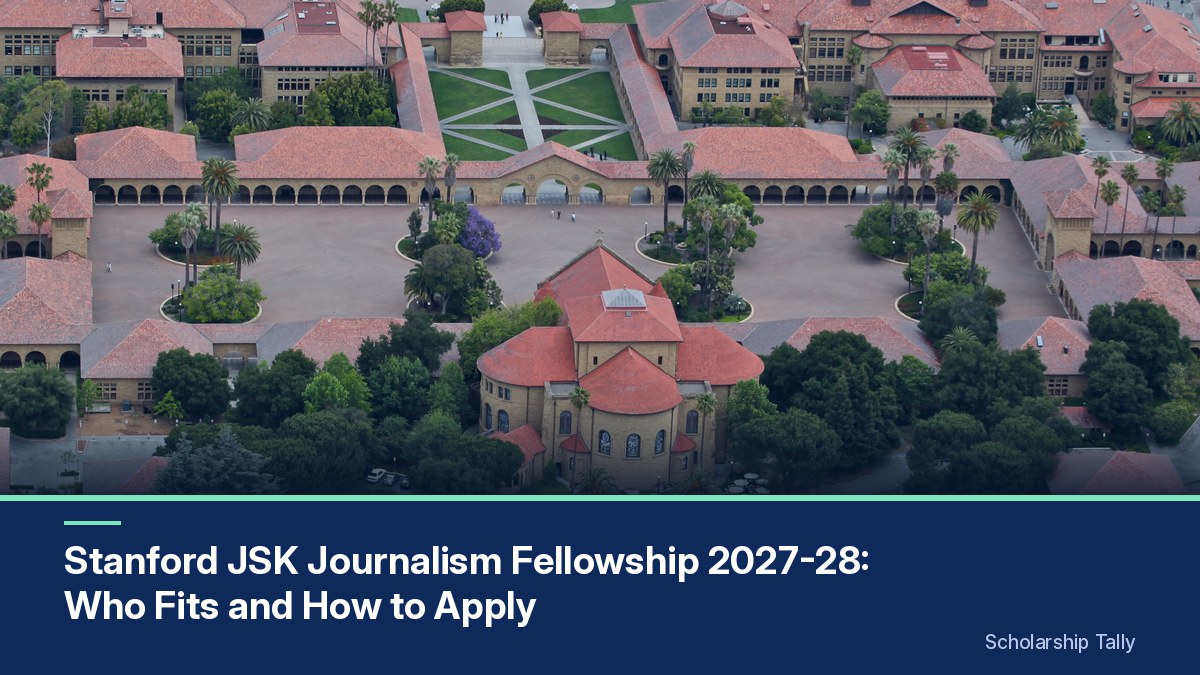
Photo by Steve Jurvetson via Wikimedia Commons, CC BY 2.0; cropped, tinted and title bar added.