The FASPE Fellowship is a two-week study programme in professional ethics for graduate students and early-career professionals in six fields: law, business, design and technology, medicine, journalism, and clergy and religious leadership. FASPE stands for Fellowships at Auschwitz for the Study of Professional Ethics. Fellows travel to Berlin, Krakow and Oswiecim (the location of the former Auschwitz camp) and examine the roles and behaviour of professionals in Germany and elsewhere between 1933 and 1945 as a framework for discussing the ethical pressures they face in their own work today. The 2027 application is open until 11:59 PM ET on 3 January 2027.
FASPE describes its fellowships as fully funded, and in practice that means FASPE pays for the trip itself: flights, hotels, group travel, group meals, admission fees, materials and pocket money for other meals. FASPE does not specify a salary or stipend. Its published funding information lists programme costs and related travel expenses, including pocket money for non-group meals. The real questions are whether you match one of the six programme profiles, whether you can be away for the full two weeks, and whether you can write honestly about your own ethical blind spots.
This guide explains who each programme is for, what FASPE covers and what it does not mention, what the two weeks ask of you, how the application works and how to approach the essays and references. Facts were checked on 27 October 2026 against FASPE’s Fellowships, How to Apply and FAQ pages and its 2027 eligibility and essay documents.
Quick facts
| Item | Details | Source |
|---|---|---|
| Host | FASPE, a New York non-profit | About page |
| Length | Two weeks, in Germany and Poland | Fellowships page |
| Fields | Law, Business, Design and Technology, Medical, Journalism, Clergy and Religious Leaders | Fellowships page |
| Trip 1 | Law, Business, Design and Technology: 28 May to 11 June 2027 | How to Apply |
| Trip 2 | Medical, Clergy, Journalism: 18 June to 2 July 2027 | How to Apply |
| Places | 13 to 16 a year on five programme pages; Design and Technology page prints no number; 85 fellowships in 2025 | Programme pages and About |
| Costs | Flights, hotels, group travel and meals, fees, materials, pocket money | FAQ |
| Who | Graduate students and early-career professionals | Fellowships page |
| Deadline | 11:59 PM ET on 3 January 2027 | How to Apply |
| Letters | Two letters, due 10 January 2027 | How to Apply |
| Decision | FASPE aims to tell fellows by early to mid March | FAQ |
Who it fits, and who it does not
Likely a good fit
- You are in graduate school or early in your career in one of the six fields, and you want structured time to think about the ethical side of your profession.
- You can describe a real ethical dilemma from your studies or work, and you are willing to look at where you yourself might go wrong.
- You are comfortable with intense, sometimes uncomfortable discussions in a small group of people whose politics and beliefs differ from yours.
- You are applying from outside the United States. FASPE welcomes eligible candidates regardless of citizenship or residency and says it covers travel to Berlin from other points of origin. You must arrange your own visa.
- You want a longer-term connection. FASPE maintains an alumni community with an annual reunion, regional events and professional development.
Probably not for you
- You cannot be there from the first day to the last. FASPE requires every fellow to attend the full programme.
- You do not meet the eligibility profile for your chosen programme. Business, Design and Technology, and Journalism generally look for experience not exceeding 10 years. Law and Clergy look for a degree received in May 2020 or later for applicants who are already working. Review the relevant 2027 eligibility guidelines before applying.
- You are looking for a stipend. FASPE describes its fellowships as fully funded for programme and travel costs; it does not state that it provides a stipend.
- You require a single room. Fellows share a room with one other fellow, and FASPE says it cannot provide or arrange for single accommodations.
- You are looking primarily for a Holocaust studies course. FASPE says the programme is neither a Holocaust studies course nor a genocide prevention programme; its historical framework is used to examine ethical issues in professions today.
Which programme is yours
Each programme has its own profile in FASPE’s 2027 eligibility guidelines. FASPE says applications that do not strictly match will still be considered, but preference may go to those that are more closely aligned.
| Programme | Who FASPE is looking for | Trip |
|---|---|---|
| Law | Juris Doctor (JD) students in their second or third year (2L or 3L); people working in law, including clerks, with a JD received no earlier than May 2020; or, where law is not a graduate degree, trainees or associates up to sixth-year level | 28 May to 11 June 2027 |
| Business | People pursuing a business career who are in an MBA or related graduate programme, or working as business professionals after an MBA, related graduate degree or undergraduate degree; generally up to 10 years of experience | 28 May to 11 June 2027 |
| Design and Technology | People who “build things”: graduate students in design, architecture, planning, computer science, artificial intelligence, statistics, engineering or related fields, or graduates working in those fields; generally up to 10 years of experience | 28 May to 11 June 2027 |
| Medical | Doctor of Medicine (MD) or Doctor of Osteopathic Medicine (DO) students, or equivalent, who expect to finish at least one clinical year before the trip, and residents | 18 June to 2 July 2027 |
| Clergy and Religious Leaders | Graduate students preparing to be religious leaders (seminary, divinity, rabbinical, Muslim chaplaincy or similar), or religious leaders with a relevant graduate degree from May 2020 or later; ordination not required | 18 June to 2 July 2027 |
| Journalism | Graduate students of any subject with some journalism experience who plan to work as journalists, or working journalists with an undergraduate or graduate degree; preference for work published or aired by a recognised news organisation; generally up to 10 years of experience | 18 June to 2 July 2027 |
The programmes that share a trip travel together and take part in joint seminars, so a law fellow spends the two weeks alongside business and design and technology fellows.
What FASPE pays for, and what it does not mention
FASPE describes its fellowships as fully funded “so that financial ability does not affect participation”. Its FAQ lists exactly what that covers.
| Cost | What FASPE says | Source |
|---|---|---|
| Flights | Round-trip economy airfare from the US to Europe; travel to Berlin from other points of origin and the return flight | FAQ |
| In-country travel | All group transport and activities in Germany and Poland | FAQ |
| Hotels | All hotel costs (three-star hotels, shared rooms) | FAQ |
| Meals | All group meals, plus pocket money for other meals | FAQ |
| Fees and materials | All admission fees and programme materials, including pre-trip reading | FAQ |
| Not stated | Any stipend or salary, the amount of pocket money, insurance, visa fees, lost wages | Not stated by FASPE |
If insurance, visa fees or time off work matter to your budget, ask FASPE at [email protected] before you commit. Do not assume they are covered.
What the two weeks involve
The programme includes daily seminars, site visits and interdisciplinary sessions. Sites include the House of the Wannsee Conference in Berlin and the Auschwitz Memorial Museum, where fellows spend two days walking through the museum. Each programme is led by two faculty members and a professional historian, with several FASPE staff members.
Expect real physical and emotional demands:
- Walking: FASPE says fellows walk at least one to two hours a day on average. Longer trips, such as Berlin to Krakow halfway through, are by bus.
- Rooms: three-star hotels in each city, shared with another fellow, with roommates rotated halfway.
- Health rule: FASPE’s FAQ says it requires all faculty, fellows and staff to be fully vaccinated against COVID-19.
- Language: everything is in English. You do not need German or Polish, but FASPE asks for a high level of written and spoken English. It does not name a test.
The work does not stop at the trip. Before you travel you receive a reading packet and must hand in one or two short writing assignments on time to be allowed to take part. Afterwards you complete a capstone project on an ethical question in your field, which might be a paper, news article, sermon, case study or blog post depending on the programme. Some are chosen for the annual FASPE Journal.
If the dates clash with exams, FASPE says it has worked with schools to adjust schedules, including letting fellows sit an exam during the programme. FASPE does not award academic credit itself, but some institutions do, and FASPE will provide documentation.
International applicants and visas
FASPE is based in the United States, but its FAQ is clear that you do not need to be American or live in the US: “All eligible candidates are welcome to apply regardless of citizenship or residency.” The Law programme even has a route for people from legal systems where law is an undergraduate degree.
Visas are your job. FASPE says fellows must make their own visa arrangements; it will provide documents to support a visa application but cannot arrange visas. The trip covers Germany and Poland, so check early what your passport needs and how long an appointment takes where you live. FASPE does not say whether it pays visa fees.
How to apply
- Pick your programme and read its 2027 eligibility guidelines on FASPE’s website. Each programme has a separate application form on Submittable.
- Sign up for FASPE’s 2027 updates through the form linked on the How to Apply page if you want reminders and information session notices.
- Ask two recommenders early. Letters come directly from them through Submittable and are due on 10 January 2027.
- Gather transcripts from every university where you spent significant time. Unofficial transcripts and scans are accepted; screenshots of online transcripts are not.
- Update your CV with your education, work history, honours, awards and publications.
- Write your answers to the six short essay questions as one PDF, staying within 1,800 words in total.
- Complete the online cover form with your contact details, the schools you attended and the names and contacts of your recommenders and references.
- Submit through FASPE’s Submittable portal by 11:59 PM ET on 3 January 2027. Submittable then emails your recommenders with upload instructions.
If you are in the first year of a programme and have no grades yet, FASPE asks for a letter from your dean confirming your degree programme, that you are in good standing and, ideally, your current classes. An admissions letter, or a registrar letter that does not name your degree programme, is not accepted.
Writing the essays
FASPE’s FAQ calls the essays “usually the most time-consuming part” of the application. The 2027 questions are the same across programmes, with the profession changed in the third question. In short, they ask:
- Why FASPE, what you hope to gain and what you would bring to discussions.
- What being a professional means to you and your responsibility in your profession.
- An ethical dilemma you have faced or expect to face, the issues for the individual professional and how to respond.
- Where you personally are most vulnerable to ethical violations.
- Why you will succeed in civil dialogue on difficult and controversial topics.
- A work of art (loosely defined) that shaped who you are, and why.
With 1,800 words across six answers, you have about 300 words each if you split them evenly. That is our arithmetic, not a FASPE rule; you can weight them as you like within the total. For the fourth question, consider a situation in which your judgement could be vulnerable to ethical pressure. For example, reflect on how a deadline, an employer’s expectations, a client relationship or personal ambition might affect a professional decision. Explain the potential ethical risk and how you would respond. This is practical writing advice, not a separate FASPE selection rule.
Choosing recommenders
FASPE wants two letters from academic faculty or professional references. Students should ideally ask faculty who taught them in their current or most recent graduate programme, but FASPE also accepts earlier graduate or undergraduate teachers. Early-career professionals can ask a supervisor or employer.
Pick people who can speak to what FASPE asks for, and share the list with them:
- Academic or work experience that would enrich a programme on professional ethics.
- How actively you take part in discussion, and how well you speak and write.
- How you handle emotionally and intellectually intense exchanges, especially with people who hold different world views and political views.
- How well you work and travel in small groups.
- Your potential to lead in your field compared with peers.
Because Submittable only emails recommenders after you submit, warn them in advance and give them time before 10 January 2027.
Timeline
| Date | What happens | Source |
|---|---|---|
| 27 October 2026 | Article facts checked against official FASPE sources; applications open on Submittable | Editorial verification |
| 3 January 2027 | Application deadline, 11:59 PM ET | How to Apply |
| 10 January 2027 | Letters of recommendation due | How to Apply |
| Early to mid March | FASPE aims to inform fellows of their acceptance | FAQ |
| Before the trip | Reading packet and one or two short writing assignments | FAQ |
| 28 May to 11 June 2027 | Law, Business, Design and Technology trip | How to Apply |
| 18 June to 2 July 2027 | Medical, Clergy, Journalism trip | How to Apply |
| After the trip | Capstone project | FAQ |
FASPE does not describe an interview stage on the official pages reviewed. Applicants should follow the published application requirements and any official updates.
Mistakes to avoid
- Applying to the wrong programme. Each programme has its own profile and its own Submittable form, so read the 2027 eligibility guidelines for your field first.
- Leaving the essays to the last week. FASPE itself warns they take the most time.
- Uploading screenshots of an online transcript. FASPE does not accept them.
- Forgetting your recommenders. They receive the upload link only after you submit, and their letters are due a week after your deadline.
- Reading FASPE’s “fully funded” label as a stipend. FASPE describes its fellowships as fully funded and lists covered programme and travel expenses, including pocket money for non-group meals. It does not specify a stipend or coverage for lost wages.
- Check your availability before applying. FASPE requires attendance from the start to the end of the programme.
- Waiting on your visa. FASPE will not arrange it for you.
Contacts
- Application questions: [email protected]
- General inquiries: [email protected] or 646-866-7734 (FASPE’s New York number, from its Contact page)
FAQ
Is FASPE fully funded?
FASPE describes its fellowships as fully funded. Its stated coverage includes flights, group transport, hotels, group meals, admission fees, programme materials and pocket money for non-group meals. A stipend, insurance coverage and visa-fee coverage are not specified.
Can I apply if I am not American?
Yes. FASPE says all eligible candidates are welcome regardless of citizenship or residency, and it covers travel to Berlin from other points of origin. You must arrange your own visa.
Do I need to be a student?
No. FASPE says all its programmes also accept early-career professionals (for Medical, that means residents), but each sets its own limits, such as a degree from May 2020 or later for Law and Clergy, or generally up to 10 years of experience for Business, Design and Technology and Journalism.
Is FASPE only for Jewish applicants?
No. FASPE says it has no religious, racial, ideological, political, gender or socioeconomic preferences, and the Clergy programme is multifaith.
How many people are selected?
Five programme pages state 13 to 16 fellowships a year. The Design and Technology page does not print a number. FASPE says it awarded 85 fellowships in 2025.
How long can my essays be?
All six answers together should not exceed 1,800 words, uploaded as one PDF.
Who should write my letters?
Two academic or professional referees. Former professors and work supervisors are accepted. Letters are due on 10 January 2027.
Can I join late or leave early?
No. FASPE requires fellows to attend from start to finish.
Do I need to speak German or Polish?
No. The programme is in English, and FASPE asks for a high level of written and spoken English.
Will I get academic credit?
FASPE does not grant credit, but some universities do. FASPE will provide documentation if your school needs it.
When will I hear back?
FASPE aims to inform fellows by early to mid March.
Official sources
- Fellowships overview, FASPE
- How to Apply, FASPE
- Frequently Asked Questions, FASPE
- 2027 Law Fellowship eligibility guidelines (PDF)
- 2027 Law Fellowship short essay questions (PDF)
- FASPE application portal on Submittable
- About FASPE
Facts were checked on 27 October 2026. If anything differs, follow the FASPE website. Scholarship Tally is not affiliated with FASPE.
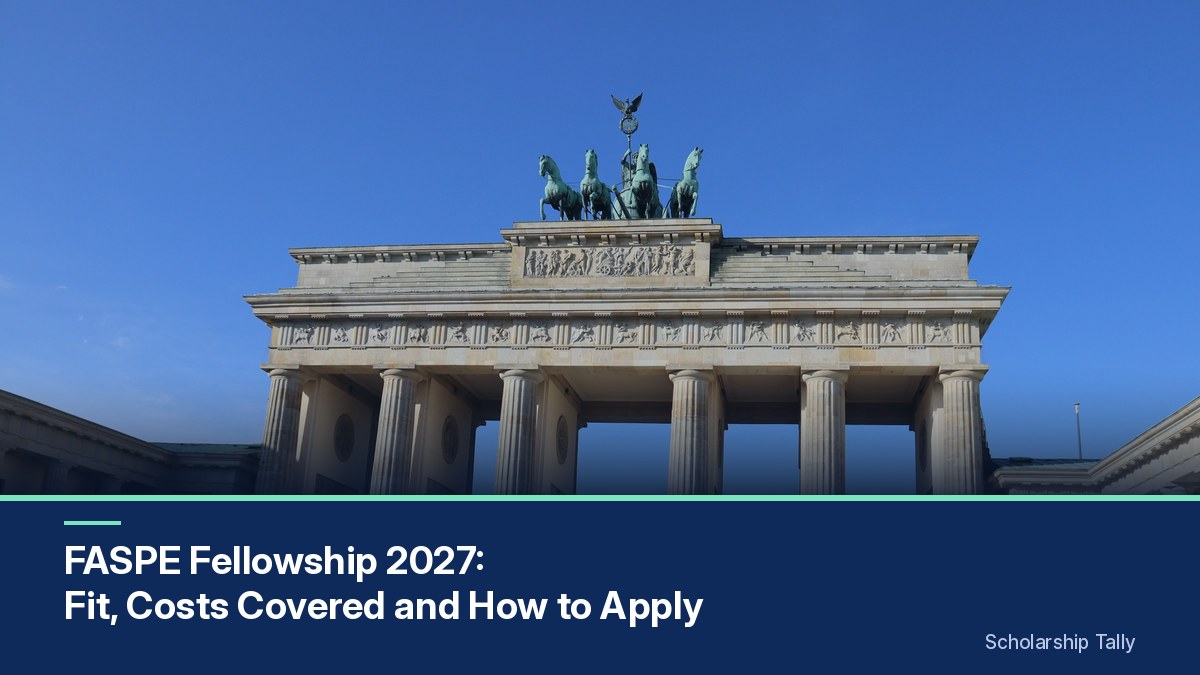
Photo by Shalev Cohen on Unsplash; cropped, tinted and title bar added.