The Hasselt ICP Connect Scholarship 2027 is a VLIR-UOS scholarship for one programme only: the two-year, on-campus Master of Transportation Sciences, specialisation Traffic Safety, at Hasselt University (UHasselt) in Belgium. UHasselt aims it at exceptional students from developing countries with a relevant academic bachelor’s degree. To be eligible you must be a national and resident of one of 30 listed countries in Africa, Asia and Latin America and be 35 or younger on 1 January 2027. Applications for the September 2027 intake run from 15 November 2026 and must be complete before 1 February 2027.
This guide is for applicants who want to know quickly whether they fit, what the award really pays for, and which steps matter. One is easy to miss: the ICP Scholarship Form must be uploaded for the application to be processed as an ICP scholarship application.
Quick facts
| Item | Detail | Source |
|---|---|---|
| Funder | VLIR-UOS (Flemish Interuniversity Council, University Development Cooperation), with DGD | UHasselt programme page |
| Programme | Master of Transportation Sciences, Traffic Safety track, on campus, 24 months | UHasselt programme page |
| Intake | September 2027 (academic year 2027-2028) | UHasselt application page |
| Who | Nationals and residents of 30 listed countries, age 35 or under on 1 January 2027 | UHasselt application page |
| Covers | Tuition fee, travel, insurance, board and lodging (full 24 months only, no partial award; ICP scholars pay the EEA fee) | UHasselt programme page |
| Places | Procedure section: top 7 ranked, waiting list ranks 8 to 14; another section mentions 10 scholarships | UHasselt programme page |
| Opens | 15 November 2026 | UHasselt programme page |
| Deadline | Complete application before 1 February 2027 | UHasselt programme page |
| Results | End of May to mid-June 2027 | UHasselt programme page |
Who it fits, and who it does not
Likely a good fit
- You hold an academic bachelor’s degree with at least a distinction grade in a listed field: behavioural sciences (psychology, sociology), political and social sciences, mathematical and statistical sciences, economy or transport economy, transport or traffic planning, urban planning or design, geography, (urban) architecture, or transport or civil engineering.
- You work, or plan to work, in higher education, government or civil society. This is a preference, not a rule: UHasselt says private-sector applicants and new graduates may also be considered with a strong motivation and profile.
- You can explain how you would use the degree to change road safety practice at home. UHasselt describes scholars as potential agents of change.
- You are a national and a resident of one of the eligible countries right now, at the time you apply.
Probably not for you
- You are older than 35 on 1 January 2027.
- You hold a Bachelor of Technology or an HND only. UHasselt says these are not sufficient for admission.
- You already received a Belgian government scholarship for a study programme, or you enrolled at a Belgian higher education institution before 1 January of the intake year.
- You want transport policy, online study or a programme other than Traffic Safety. The scholarship is attached only to the on-campus Traffic Safety track.
If you meet the academic rules but not the scholarship rules, UHasselt says you can still apply to the non-scholarship Master of Transportation Sciences.
Eligible countries
UHasselt’s application page lists 30 countries. You must be a national of one and a resident of one at the time of application; the two do not have to be the same country.
| Region | Countries |
|---|---|
| Africa | Benin, Burkina Faso, Burundi, Cameroon, DR Congo, Ethiopia, Guinea, Kenya, Madagascar, Mali, Morocco, Mozambique, Niger, Rwanda, Senegal, South Africa, Tanzania, Uganda, Zimbabwe |
| Asia | Cambodia, Philippines, Indonesia, Palestinian Territories, Vietnam |
| Latin America | Bolivia, Cuba, Ecuador, Haiti, Nicaragua, Peru |
One sentence on the programme page refers to “25 eligible countries”, while the application page lists the 30 countries above. UHasselt does not explain the difference, so treat the published 30-country list as the list the university currently shows.
What the scholarship covers
UHasselt states that VLIR-UOS scholarships cover the tuition fee, travel costs, insurance and livelihood, meaning board and lodging. The award runs for the full 24 months of the master’s. Partial scholarships are not offered.
Two details change your budget:
- ICP scholars are charged the EEA tuition fee instead of the higher non-EEA fee, whatever their nationality.
- UHasselt says it arranges accommodation for VLIR-ICP scholarship students.
UHasselt does not publish the monthly allowance on its own page. It points to the VLIR-UOS framework for scholarships in Belgium (study scholarships, pages 13 and 14) for the 2026-2027 guidelines and allowances. Read that document rather than relying on a figure from a third-party site.
If you are also weighing other funding for study in Belgium, our guide to the ARES International Training Scholarships in Belgium covers a separate programme with its own rules.
Road safety track: what you actually study
The scholarship is tied to one ICP track, “Road Safety in Low and Middle Income Countries”, within the 24-month, on-campus Master of Transportation Sciences, specialisation Traffic Safety.
The third semester is an 18-credit (ECTS) internship in your home country, and both the internship and the master thesis focus on topics relevant to the South. Our suggestion, not an official requirement: think early about an employer or agency at home that could host that internship, since it can also strengthen your motivation.
How many places, and how ranking works
The application section of the programme page says a ranking is made, the top 7 applicants receive a scholarship, and eligible candidates ranked 8 to 14 go on a waiting list. Another line on the same page mentions 10 scholarships for the programme, so treat the number as small and competitive rather than counting on a precise figure.
Selection criteria published by UHasselt:
- Motivation and professional goals that show you can transfer knowledge and contribute to sustainable development.
- Professional experience that makes it likely you will apply what you learn, in higher education, government, civil society or the private sector.
- Gender balance. VLIR-UOS strongly encourages female candidates to apply.
- Regional balance across countries and regions.
- Leave No One Behind: with equally qualified candidates, preference goes to people from vulnerable groups.
- Preference for candidates who have never had a scholarship to study in a higher income country.
Timeline for the September 2027 intake
| When | What happens |
|---|---|
| 15 November 2026 | Application period opens for academic year 2027-2028 |
| Before 1 February 2027 | Complete application, including document verification, must reach UHasselt |
| End of May to mid-June 2027 | VLIR-UOS emails winners; UHasselt informs other applicants |
| September 2027 | Programme starts in Hasselt |
| Third semester | Internship in your home country |
UHasselt gives the deadline as “before 1st Feb” without a clock time. As a suggestion, aim to submit by late January so that document verification is not still pending on the last day. That is our suggestion, not an official rule; the only stated rule is that the complete application must arrive before 1 February 2027.
Documents and steps that actually matter
- Create one application in the UHasselt Application Portal for the 2027-2028 academic year and choose the on-campus Master of Transportation Sciences, Traffic Safety.
- Fill in the ICP Scholarship Google Form linked inside the application. You receive your answers by email. Upload that document to the application. Without it, UHasselt says the file is not processed as a scholarship application.
- Upload two recent letters of recommendation from an academic staff member, scientist or superior who knows your work. As a practical step, ask each referee to state their name, title, workplace, contact details and relationship to you.
- Add your English test result: Cambridge C1 Advanced, IELTS Academic 6.5 overall, TOEFL iBT 89 or Duolingo 120, unless an exemption on the programme page applies.
- Complete document verification for every higher education diploma and transcript, by digital verification, direct email from your university, or certified hard copies. This step is mandatory.
If you forgot the scholarship form before submitting, UHasselt says you can still upload it later under Upload Documents as a “Scholarship Application” document.
Mistakes that waste a strong file
- Skipping the ICP Scholarship Form. UHasselt states that applications without this form are not processed as scholarship applications.
- Applying for more than one ICP Connect scholarship in the same year. VLIR-UOS allows only one ICP Connect application per year.
- Expecting conditional admission. UHasselt says ICP applicants cannot apply for conditional admission.
- Leaving verification to the end. Uploads, scans or photocopies without an official verification route are not accepted.
- Sending only one recommendation letter. UHasselt asks for two recent letters.
- Expecting a partial award. UHasselt offers the scholarship only for the full 24 months.
- Missing the national and resident rule or the age cut-off. Both are checked at the time you apply.
- Writing a generic motivation. The criteria reward a clear plan for using road safety skills at home.
Contact
- Administrative questions about the application: [email protected]
- Document verification: [email protected]
FAQ
What does the scholarship cover, and is an allowance amount given?
Tuition, travel, insurance and board and lodging for 24 months. UHasselt gives no allowance amount; the VLIR-UOS framework document has the figures.
Which master’s programme does it cover?
Only the on-campus Master of Transportation Sciences, specialisation Traffic Safety. It does not cover other specialisations or study formats of the master.
What is the age limit?
You must be 35 or younger on 1 January 2027.
Do my nationality and residence have to be the same country?
No. Both must be on the list, but they can be different countries.
Is Kenya on the list?
Yes. Kenya is on UHasselt’s list of 19 African countries.
When is the deadline?
Before 1 February 2027. Applications open on 15 November 2026.
How many scholarships are there?
The top 7 ranked applicants, with a waiting list of ranks 8 to 14. Another section mentions 10.
What English scores are accepted?
Cambridge C1 Advanced, IELTS Academic 6.5, TOEFL iBT 89 or Duolingo 120, unless an exemption applies.
What happens if I do not upload the ICP Scholarship Form?
It is not processed as a scholarship application. You can add the form later under Upload Documents.
Do I need work experience?
Not strictly. It is a preference; new graduates with a strong profile may be considered.
What happens if I am not selected?
If you are admissible, you can join the non-scholarship master instead.
Can I apply again next year?
Yes. Submit a new application in the portal and complete the scholarship Google Form again.
Official sources
- Master of Transportation Sciences, ICP Connect scholarship section – Hasselt University
- Application process for international students – Hasselt University
- Scholarships for incoming students – Hasselt University
Facts were checked on 6 November 2026. If anything differs, follow the official UHasselt pages. Scholarship Tally is not affiliated with Hasselt University or VLIR-UOS.
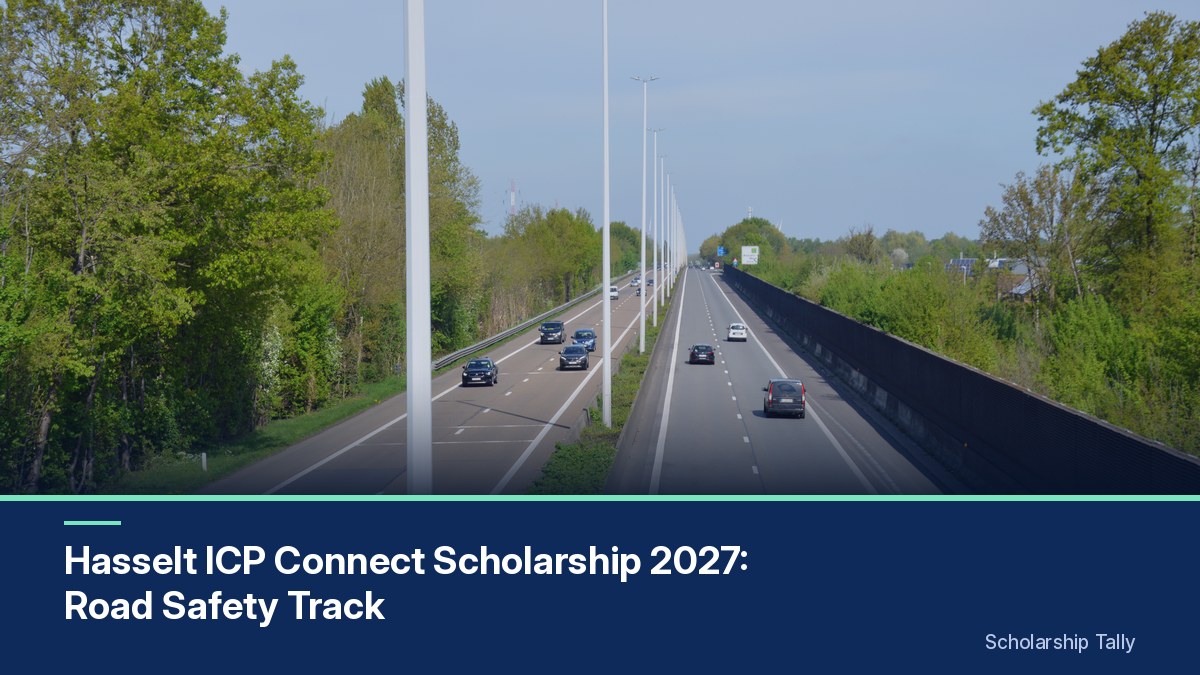
Photo: DimiTalen / Wikimedia Commons / CC0; cropped, tinted and title bar added.