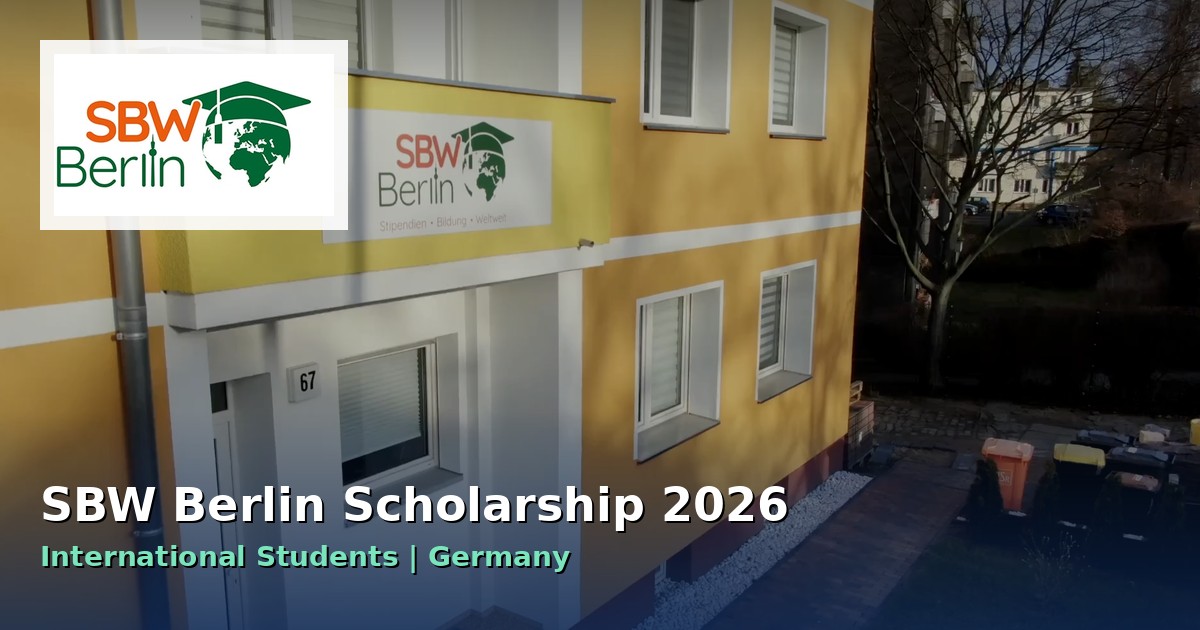
SBW Berlin gGmbH, a German non-profit limited liability company in Berlin founded in 2018 by Anika Maneva and Stefan Wienecke, runs the SBW Berlin Scholarship for International Students. It supports young people from abroad who already do social or non-profit work and want a bachelor’s or master’s degree at a university or university of applied sciences (Fachhochschule) in Berlin or Potsdam. The scholarship includes a furnished room in SBW Berlin’s shared student flats, a cost-of-living allowance currently in the amount of 480 Euro per month, and tuition fees. During your studies you work on a social project. After the funding or your studies end, you either return to your home country and develop and implement the project locally for at least 18 months with the local non-profit organisation or social institution, or repay the scholarship’s financial benefits under a notarized plan in 12 monthly instalments without interest, starting 3 months after your funding or standard study period ends.
This guide helps you check whether you meet SBW Berlin’s published requirements, understand what the scholarship covers and what it does not, weigh the return-or-repay obligation, and follow the application steps in the right order. There is no fixed deadline; SBW Berlin says applications are accepted all year round. Every rule below comes from SBW Berlin’s own website, its Guidelines and Criteria for international students (last updated 9 April 2025) and its project description guidance, all checked on 20 October 2026.
At a glance
| Item | Detail |
|---|---|
| Funder | SBW Berlin gGmbH, Rudower Str. 67, 12351 Berlin |
| Levels | Bachelor’s or master’s degree; vocational training only in special cases |
| Where | A university or university of applied sciences (Fachhochschule) in Berlin or Potsdam only |
| Fields | In principle, all scientific, social and artistic disciplines |
| Benefits | Furnished room in shared student flats, 480 Euro per month (current amount), tuition fees, possibly a travel contribution |
| Places | A total of 20 scholarship places, awarded each semester only as places become vacant |
| Age | Between 18 and 30 years old |
| Deadline | None; applications are accepted all year round |
| First step | A non-profit organisation or social institution emails a recommendation letter for you |
| Fees | SBW Berlin does not charge any application or processing fees |
| After studies | Return home and run your project for at least 18 months, or repay in 12 monthly instalments |
Who this scholarship fits, and who should skip it
SBW Berlin describes the scholarship as support for “young people from abroad who are already socially committed and will use the skills they acquire during their studies and thereafter to develop social or non-profit projects at non-profit organizations or social institutions in their home countries.” The guidelines call working with a non-profit or social organisation in your home country “an important prerequisite”, and SBW Berlin selects on “professional qualifications, personal suitability, and financial need”.
The strongest fit is someone aged 18 to 30 who already volunteers or works with a non-profit organisation or social institution at home, whose organisation will write and send a recommendation letter, who has a realistic project idea, who meets the financial need test, and who plans to go home after graduating. If that describes you, the room, the monthly allowance and the tuition fees are provided for at most the regular period of your study programme.
You should skip it, or check carefully first, if any of these apply:
- You have no working relationship with a non-profit organisation or social institution in your home country that will send a letter for you.
- You plan to stay in Germany after graduating. You would then repay the money under a notarized plan, and SBW Berlin itself warns this “can pose a major challenge and deep burden”.
- You want to study somewhere in Germany other than Berlin or Potsdam, or outside Germany.
- Your studies in Germany are already funded by another scholarship (assistance under the Federal Education Assistance Act (BAföG) is the only exception).
- You have already stayed in Germany for more than 18 months, a first-degree family member lives permanently in Germany, or your grades convert to worse than a German 2.0.
- You need family members or friends to live with you in SBW Berlin’s shared student flats, would need to use the scholarship to support family members or other third parties financially, or depend on a part-time job during your studies.
Places are limited. SBW Berlin says: “We have a total of 20 scholarship places. Each semester, only as many scholarships can be awarded as there are vacancies.” The 20 places are SBW Berlin’s total, not a yearly intake, and SBW Berlin does not publish how many are free at any given time.
Who can apply: the two target groups
Under “Who can apply?”, the guidelines list two groups:
- “Foreign nationals, whose home countries appear to have a particular need for development assistance”. SBW Berlin adds: “We believe that this applies particularly to many countries in Africa, Asia, Eastern Europe, and South America due to their current economic and/or social situation.” There is no fixed country list.
- “Holders of a student visa for Germany or a residence permit with the purpose of taking up or carrying out a course of study in Germany”.
SBW Berlin does not say whether you must belong to one group or both. It asks for a copy of a student visa or residence permit in the verification process after selection, not at the letter stage.
SBW Berlin also runs separate scholarships for study programmes in the social sector and for refugees.
One more rule sits in the same section: “Students whose studies in Germany are already being funded by another scholarship are not eligible to apply.” The exception is the Federal Education Assistance Act; if you receive BAföG, the amount of the SBW Berlin scholarship is adjusted.
The nine requirements (all must be met)
The guidelines say “Applications which do not meet all the requirements stated above cannot be considered.” You must meet all nine requirements:
- Be between 18 and 30 years old.
- Have professional or volunteer experience in the non-profit or social sector, proven by a social institution’s letter of recommendation.
- Be able to prove that you have not stayed in Germany for more than 18 months before the application. If you have spent time in Germany, SBW Berlin says your financial need and your cooperation with an organisation in your home country are “especially carefully reviewed”.
- Hold a qualification for university entrance.
- Intend to work in your country of origin for at least 18 months after graduation, or to engage in non-profit work until the repayment plan has been fulfilled.
- Be able to prove a relatively low net income: your total household income must not exceed the average income officially stated for your home country, and SBW Berlin counts the income of all household members from all sources (for example employment, business activities, property, child benefit or pensions).
- Have average grades corresponding to a German grade point average of at least 2.0, which means 2.0 or better: on the German scale a lower number is better, and SBW Berlin’s conversion formula below gives 1.0 for the highest possible foreign grade.
- Have no first-degree family members who reside permanently in Germany.
- Apply before you start university, or while fully enrolled in the first, second or at most third semester at a state-recognised university (in Germany or abroad), or apply for a master’s degree shortly before or after obtaining your bachelor’s degree.
To convert your grades, SBW Berlin gives this rule: “Subtract your received grade from the highest possible grade of the foreign grading scale and divide this by the difference of highest possible grade minus the minimum grade to pass multiplied by 3 and add 1; or mostly B+ and higher; Upper Second Class; 80% or higher.” After selection it asks for an evaluation report from Uni-Assist or other evidence converting your grades to the German system, so a borderline result will be checked formally.
Where you can study, and what is not funded
The scholarship pays only for a bachelor’s or master’s degree at a university or university of applied sciences in Berlin or Potsdam; vocational training in Berlin or Potsdam is supported only “in special cases”. The guidelines say “The scholarship does not cover any funding in other German federal states or abroad”, and that funding after the regular study period has ended “is unattainable”.
Getting a university place is your job. SBW Berlin’s programme page says an application to a university or university of applied sciences in Berlin or Potsdam “is done separately to the scholarship application, i.e. applicants are responsible for this themselves.” An admission letter is an “if available” document in the scholarship application, so you can apply for the scholarship before you have one. SBW Berlin points applicants to its “Good to Know” video series on its YouTube channel for an introduction to German and Berlin universities.
SBW Berlin’s FAQ adds that, as a rule, the costs of language courses or a preparatory year are not covered, and that financial support “only begins at the start of the semester and after their arrival in Berlin. A deposit for a study place or any tuition fees can therefore only be paid at this point.” If your deposit or tuition fees are higher than the national average, you contribute personally to the difference.
What the scholarship includes
The guidelines say that for the duration of the scholarship (at most the regular period of your study programme), “SBW Berlin covers the necessary living expenses of the scholarship recipients.” The list is:
| Benefit | What SBW Berlin says |
|---|---|
| Housing | A furnished room in shared student flats at Rudower Str. 67, 12351 Berlin, assigned by gender |
| Allowance | A cost-of-living allowance currently in the amount of 480 Euro per month; the amount could be different if BAföG was granted |
| Tuition | Tuition fees; if they exceed the national average, a deductible can be expected |
| Travel | Possibly a travel contribution for the journey to Berlin before your studies and the journey home afterwards: max. 500 Euro for trips within Europe, max. 1,000 Euro for travel outside Europe |
| Return flight | SBW Berlin covers the costs of the return flight home after graduation |
SBW Berlin publishes the allowance as a monthly amount and gives no yearly total, so this guide does not calculate one. It also says the individual amount of funding depends on each applicant’s personal circumstances, and that any additional money to implement your project is decided case by case.
The money rules that matter most for planning:
- First payment. “First payments can only be made after the scholarship recipient has moved into the shared student apartment.” Plan how you will pay anything due before then.
- Part-time work. “Part-time jobs are generally not approved by SBW Berlin.”
- Family. Family reunification through the programme is not possible, family members or friends may not live with you, and the scholarship cannot be used to support family members or third parties. SBW Berlin’s FAQ says this will result in an extraordinary termination of the scholarship contract.
- BAföG recipients. You can receive only benefits that are not counted as income under BAföG rules, the value of the room is taken into account, and “As a rule, these applicants only receive a ‘flat rate’ or book allowance in the amount of maximum 100 Euro per month.”
- After graduation. “Scholarship recipients will not receive any financial support after their graduation.”
SBW Berlin does not describe the scholarship as fully funded, so this guide does not either; it covers the items in the table above.
Duration, obligations and semester reviews
Funding lasts “at least 30 days up to a maximum of 48 months”, and the standard period of your study programme is decisive. It is granted in periods, usually for the upcoming semester. Before the end of each semester SBW Berlin decides whether further funding is justified, looking at whether you still meet the selection criteria, whether you passed most courses in the last semester, and whether your social project is moving forward (for example, shown in a project report).
While you hold the scholarship, SBW Berlin expects you to:
- Work 2 to 8 hours per week on your social project, and be able to prove your progress at any time.
- Attend workshops and regular project meetings at SBW Berlin.
- Write project reports and give talks or presentations on your project.
- Keep a German grade point average of at least 2.0 each semester.
- Send your current transcript or performance records after each semester without being asked.
- Tell SBW Berlin immediately if the circumstances your funding was based on change, and send a copy of your diploma when you graduate.
SBW Berlin can end funding after two failed compulsory examinations or two postponed examinations (a repeat exam must be taken in the next possible examination period, confirmed by your university), if you miss the target agreements for your project, or if the funds are not used as intended. In those cases you sign a notarized repayment agreement and repay the money received in 12 monthly instalments without interest, starting 3 months after the end of the funding period or the standard period of study. The guidelines add that the details are set in each scholarship contract, and that contracts “may differ slightly from one another”.
Return home or repay: decide this before you apply
This is the rule to weigh most carefully. After your studies or funding end, the guidelines give two options:
- Return home. You go back to your home country no later than the end of the month following your graduation (SBW Berlin pays the return flight), then develop and implement your project locally for at least 18 months with the local non-profit organisation or social institution. In this case there is no obligation to repay. SBW Berlin says it continues to support you in an advisory capacity, and the guidelines expect you to keep taking part in regular meetings with SBW Berlin about your project and job.
- Stay in Germany. You repay the financial benefits under a previously notarized repayment plan: 12 monthly instalments without interest, starting 3 months after the end of your study or funding period.
SBW Berlin explains that the notarized acknowledgement “allows any debt collection starting from the first due installment payment without taking further legal action.” Its own advice is blunt: “This can pose a major challenge and deep burden. It is therefore important to note that there could be cheaper alternatives if applicants and scholarship recipients intend to stay in Germany from the start.” If you already know you want to build a career in Germany, look at other funding first.
How to apply, step by step
There is no public application form and no fee. The order below follows the guidelines and SBW Berlin’s application process graphic.
- Read the guidelines for international students and the project description guidance, both linked under Official sources.
- Apply to a university or university of applied sciences in Berlin or Potsdam yourself. This is separate from the scholarship, and SBW Berlin does not do it for you.
- Ask your organisation to send the recommendation letter. The non-profit organisation or social institution (or one of SBW Berlin’s partner organisations) emails it for you in Portable Document Format (PDF); in the guidelines’ words, it “submits the letter on behalf of the applicant as a PDF to [email protected]”. The letter should explain the reasons for your chosen course of study, the connection between the organisation’s objectives and your social project, and your responsibilities in the organisation before and after graduation.
- Wait for the first review. SBW Berlin reviews the letter and decides whether to give you access to the online application portal. The link is shared by email with outstanding applicants only.
- Complete the online application form and upload your documents. Only complete applications are considered; the document list is in the next section.
- Second review. SBW Berlin reviews your application form, grades and financial situation.
- Interview. Suitable candidates have “an interview or video conference”, which “may include a practical task and discussion of the details of the planned community/social project, including objectives and timetable for the first six months.” The final selection follows.
- Verification. If selected, you send the verification documents, the final details of your project are agreed, and your project description becomes part of the scholarship contract.
SBW Berlin’s FAQ, which covers all three of its scholarships, and its application process graphic mention a letter of recommendation or a letter of motivation. For international students, the guidelines ask for a recommendation letter from a non-profit organisation or social institution, sent by that organisation, so follow the guidelines.
SBW Berlin offers no on-site consultation appointments. Questions go through its contact form, to [email protected], or by phone on +49 30 66 70 36 36. Recommendation letters go to [email protected] and should come from your organisation, not from you.
Documents: what is required and what helps
All documents must be in German or English; if an original is in another language, add a translation into German or English. “Non-certified copies and simple translations are sufficient for the application.” Certified copies are sometimes required later, in the verification process.
| Stage | Documents |
|---|---|
| Required | Recommendation letter (sent by email by the organisation); online application form; project description (two to five pages); qualification for university entrance; net household income information (entered in the form) |
| Required grades | Copy of your last school or university certificate and of your highest academic degree, each showing the grade point average and a grade overview |
| If available | Admission to a university or university of applied sciences in Berlin or Potsdam; an internationally recognised language certificate for your teaching language; all university certificates and records; work, training, apprenticeship and internship certificates and references |
| Recommended | One or two letters of recommendation from professors, schoolteachers or employers; evidence of net household income such as pay slips, pension notices or bank statements |
| After selection: identity and money | Passport copy with a current photo; student visa or residence permit copy; evidence of net household income |
| After selection: qualifications | Uni-Assist evaluation report or other grade conversion; latest certificate if a new one was issued; all university records; study-specific work, training and internship certificates; legalization of your highest foreign qualification; language certificate |
If you leave out the language certificate or the income evidence at the application stage, you must send it by the verification process at the latest. Master’s applicants must also provide certified copies of all bachelor’s certificates and records.
Writing the project description
The project description matters at every stage: SBW Berlin evaluates your project during selection, the interview may discuss it, and it becomes part of your scholarship contract. Its guidance (updated 27 January 2023) says:
- Area. Choose a project in one of these areas: education, social work, medical care, and ecology. It should support people or animals who are disadvantaged compared to others and have a benefit for society.
- Ownership. The idea can be your own, or an existing idea you want to advance with another organisation.
- Length and order. Write between 2 and 5 pages. Describe the problem or situation in your home country first, then your solution. Define your target group and the service your project offers it. The United Nations’ 17 Sustainable Development Goals can serve as inspiration or a framework, and any external sources should be cited.
- Goals and timeline. Set short-term goals (after 6 months) and long-term goals (after 2 years), prioritise the tasks, and lay out your first steps for the first 6 months.
- Resources. Name what you need: tangible resources such as money or equipment, and intangible ones such as organisational, technological or human resources.
- Scope. Keep it realistic. SBW Berlin warns that goals which are too big and too complex can be judged unrealistic.
Prepare to talk through your six-month plan in detail, since the interview may include a discussion of exactly that.
Common myths and mistakes
| Myth | Reality |
|---|---|
| “It is a German Academic Exchange Service (Deutscher Akademischer Austauschdienst, DAAD) scholarship.” | It is awarded by SBW Berlin gGmbH. The SBW Berlin pages and guidelines we checked do not mention the DAAD. |
| “I can download the application form and apply directly.” | There is no public form. Your organisation sends a recommendation letter first, and SBW Berlin emails the portal link only to outstanding applicants. |
| “There is a closing date I must meet.” | There is no fixed deadline. Places are filled each semester only as some of the total of 20 become vacant. |
| “The scholarship gets me a university place.” | You apply to the university separately and are responsible for it yourself. |
| “I can study anywhere in Germany.” | Funding is for Berlin or Potsdam only, never other German states or abroad. |
| “I can stay in Germany afterwards at no cost.” | Staying means repaying in 12 monthly instalments under a notarized plan. |
| “It pays for my language course first.” | As a rule, language courses and a preparatory year are not covered, and support starts only at the start of the semester after you arrive in Berlin. |
FAQ
Is there a deadline or intake date?
No. SBW Berlin accepts applications all year round and awards places each semester as they become free. It publishes no intake dates.
How many places are there?
SBW Berlin has a total of 20 scholarship places. It does not publish how many are vacant at a given time.
Do I need a university place before I apply?
No, but you must apply for one yourself in Berlin or Potsdam. An admission letter is listed as a document to include if available.
Who writes and sends the recommendation letter?
A non-profit organisation or social institution you have worked with (or one of SBW Berlin’s partner organisations) writes it and emails it as a PDF to [email protected] on your behalf.
What does the 480 Euro allowance cover?
It is a cost-of-living allowance on top of the furnished room and tuition fees. SBW Berlin gives it as a monthly amount, currently 480 Euro, and it can differ for BAföG recipients.
What happens if I want to stay in Germany after graduation?
You repay the financial benefits in 12 monthly instalments without interest, starting 3 months after your studies or funding end, under a notarized plan. If you return home and run your project for at least 18 months, you repay nothing.
Can I hold another scholarship at the same time?
No. Students whose studies in Germany are already funded by another scholarship are not eligible. BAföG is the only exception, and the SBW Berlin amount is then adjusted according to the BAföG allowance.
Can I work part-time during my studies?
SBW Berlin says part-time jobs are generally not approved.
Can candidates from Africa apply?
Yes. SBW Berlin names many countries in Africa, Asia, Eastern Europe and South America as examples of countries in particular need of development assistance. There is no fixed list, and every other requirement still applies.
Are there any fees?
No. SBW Berlin does not charge any application or processing fees.
Official sources
All pages checked 20 October 2026.
- SBW Berlin: Scholarship for International Students
- SBW Berlin: Guidelines and Criteria for International Students (last updated 9 April 2025)
- SBW Berlin: Project description guidance (27 January 2023)
- SBW Berlin: Application process graphic
- SBW Berlin: frequently asked questions
- SBW Berlin: scholarships overview
- SBW Berlin: contact
- SBW Berlin: imprint