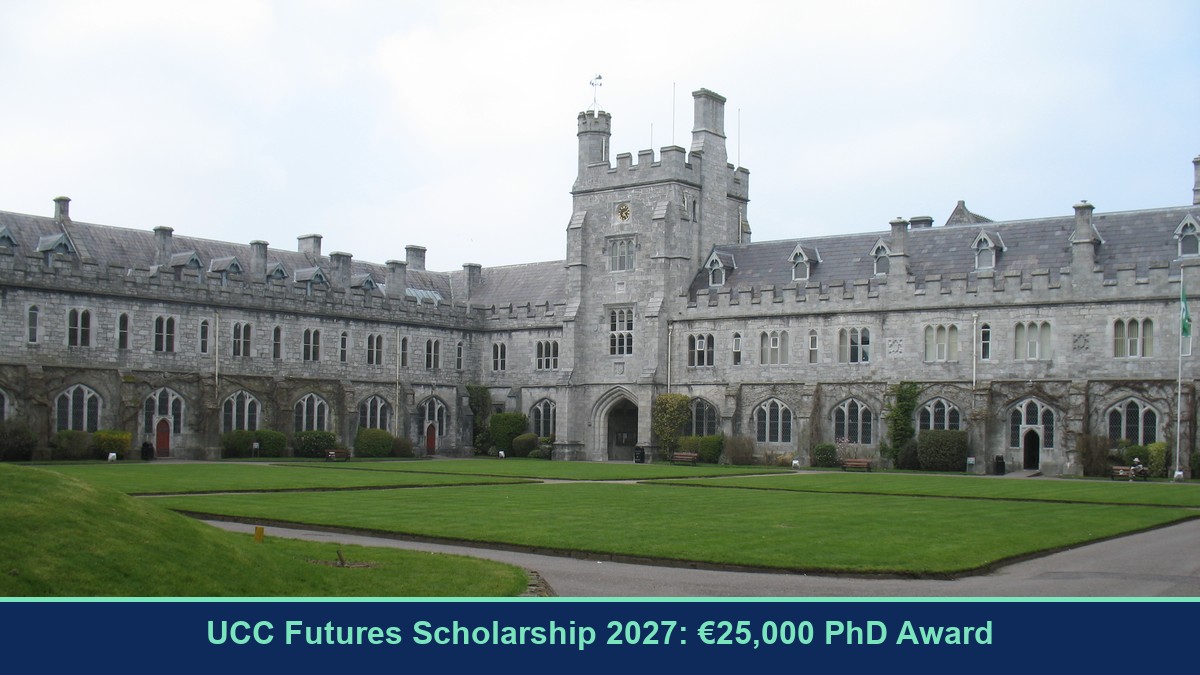
The UCC Futures Scholars Programme (GoI) is a full-time doctoral scholarship at University College Cork. UCC runs it through the Research Ireland Empower programme. People who are funded are recognised as Government of Ireland Postgraduate Scholarship holders. It is UCC’s own 2027 call. You do not file it yourself. An eligible UCC lead supervisor submits one form in Pure. The call says applicants do not have access to Pure.
Facts were checked on 12 November 2026 against UCC’s Futures Scholars page, the 2027 call document and the capitation fee schedules. If anything differs, follow the official pages.
The programme page and the 2027 call document both put the application deadline at 11 December 2026. The page says 5pm. The call document says 17:00 Irish time. Those are the same moment.
The scholarship has three parts, and you have to take all three. The call lists an annual stipend of €25,000, a contribution towards tuition fees of up to €5,750 a year, and at least €5,000 a year towards eligible direct research costs. UCC says it will waive any non-EU fee component that the €5,750 does not cover. The call also says you still pay the annual postgraduate research student capitation fee.
Derrick Ochieng for Scholarship Tally checked this guide against UCC’s Futures Scholars page, the 2027 call document and UCC’s capitation schedules on 12 November 2026. It was drafted with AI assistance from that reading.
Scholarship Tally is independent of University College Cork and Research Ireland and cannot assess your application.
At a glance
| Item | What the official pages say |
|---|---|
| Award | UCC Futures Scholars Programme (GoI). A doctoral scholarship. Funded holders are recognised as Government of Ireland Postgraduate Scholarship holders |
| Where | University College Cork. You must be registered full-time and primarily based at UCC |
| Who | All nationalities. No age limit. A 1.1 or 2.1 honours degree, or a master’s, or the international equivalent UCC accepts |
| What you cannot already have | A doctoral degree, a Research Ireland doctoral scholarship, or any other doctoral scholarship. Permanent staff of a higher education institution or a research-performing organisation cannot apply |
| Stipend | €25,000 a year |
| Fees | Up to €5,750 a year towards tuition. UCC waives any non-EU fee component the award does not cover. You still pay the research-student capitation fee |
| Research costs | At least €5,000 a year for eligible direct research costs. Extra costs can be requested later. They are not guaranteed |
| Length | Up to four years if you have not started the PhD. Up to three years if you are already in the first year, on the pilot rule below |
| Deadline | 11 December 2026. The programme page says 5pm. The call says 17:00 Irish time |
| Start | The call says 1 October 2027. The programme page says student registration in October 2027 |
| How you apply | Your UCC lead supervisor submits one form in Pure. You cannot email it or post a hard copy |
Who can apply
Applicants of all nationalities can apply. The call states there is no age limit.
You need the entry requirements of the UCC doctoral programme you want:
- A first class honours degree (1.1) or an upper second class honours degree (2.1), or a master’s degree, or an international equivalent in line with UCC’s guidelines. In Ireland, a 2.1 is the band above a 2.2. UCC does not print a percentage conversion for every country in this call.
- The minimum English language level in UCC’s postgraduate English language entry requirements. The call does not print an IELTS, TOEFL, or Duolingo score on these pages. If you are not sure you meet that policy, ask the Doctoral Institute before your supervisor spends a submission on you.
- If you are still finishing a degree, every requirement for that qualification must be done by 30 September 2027, so you can register from 1 October 2027.
- An eligible UCC lead supervisor who agrees to support the application and submit it for you.
The programme is for full-time PhD research in any discipline. It is not a taught master’s award. New students must be starting an eligible structured doctoral programme at UCC. The pilot 2027 call also allows people who have completed no more than the first year of an eligible doctoral programme, on the dates in the next section.
You are not eligible if any of these is true:
- You hold, or have previously held, a Research Ireland doctoral scholarship or any other doctoral scholarship.
- You already hold a doctoral degree.
- You submit more than one application to this call.
- You are a permanent staff member of a higher education institution or a research-performing organisation.
The project must not already have funding from Research Ireland or another funding agency. You must tell UCC about other applications you have sent, or plan to send, to Research Ireland or any other funder for the same project or a substantially similar one.
If you win, you cannot hold this scholarship at the same time as another major doctoral scholarship that pays an equivalent stipend or fee support for the same period. Smaller extras can be allowed. The call names travel bursaries, equipment grants, and other minor awards, if UCC approves them and, where it applies, Research Ireland approves them. They must not copy what this scholarship already pays. You declare them to the Doctoral Institute.
You also cannot be employed full-time, by UCC or by anyone else, while you hold the scholarship. You must keep residency in the Republic of Ireland, keep a physical presence at UCC, and live within a reasonable travelling distance so you can take part in the doctoral programme, training, and cohort work. Research travel, placements, and mobility are allowed when UCC approves them.
How long the money lasts
The length depends on where you are on 1 October 2027.
If you have not started the doctoral programme, you can be considered for up to four years. That still depends on registering and on progressing under UCC’s rules.
If you have already started, the pilot rule is narrower. You must have first registered for the first year of the doctoral programme on or after 1 September 2026, and between 1 September 2026 and 31 August 2027. People in that group can receive up to three years. If your first registration was before 1 September 2026, you are not eligible unless an approved leave of absence applies.
Leave only helps if, after the leave is counted, you are still in the first year of doctoral registration on the award start date of 1 October 2027. The call points to UCC’s policy on leave of absence for postgraduate research students. It names medical leave, family illness or bereavement, maternity, paternity or adoptive leave, and other approved exceptional circumstances. Do not put medical records or personal health information in the application. UCC checks approved leave through its own records.
Everyone who is awarded is required to start on 1 October 2027. The programme page’s date table says “Student Registration: October 2027” and does not print the day. If you cannot start on 1 October 2027, the call says the award may be withdrawn and given to someone on the reserve list. The UCC Futures Scholarship Board looks at each case before the start date. It can keep the award, withdraw it, or reallocate it. You and your lead supervisor are told in writing.
What the scholarship pays
Take the three headings together. The call says you may not apply for, or accept, only one or two of them. Partial acceptance is not allowed.
The stipend is €25,000 a year.
The fee line is a contribution of up to €5,750 a year towards tuition. UCC will waive any non-EU fee component that this contribution does not cover.
You remain liable for the annual postgraduate research student capitation fee. The call points to UCC’s 2026/27 capitation schedule. That page lists €70 for EU research students and €70 for international research students in 2026/27. UCC’s 2027/28 capitation schedule also lists €70 for EU research students and €70 for international research students. Taught postgraduate capitation on those pages is higher, and it is not the research line. The fee is paid at registration. The 2027/28 page says the Higher Education Grant Scheme (SUSI) does not cover capitation. Read the schedule for the year you actually register. This guide is not saying the scholarship pays the €70.
Eligible direct research costs are at least €5,000 a year. The call gives examples: research consumables, specialist training, conference attendance, fieldwork, travel, and other approved research expenses. They have to fit Research Ireland’s grant conditions and UCC’s post-award rules. If the project needs more than the annual amount, you may apply for extra eligible costs. The UCC Futures Scholars Board considers those requests. The call says this is subject to funding availability. It is not an automatic top-up.
The call also says awards depend on the funding Research Ireland gives UCC under Empower. A place on a ranked list, a reserve place, or a message that you have been selected does not by itself admit you to a PhD, and it does not guarantee the money.
How to apply
You prepare the application. Your lead supervisor sends it.
The lead supervisor is a UCC academic, research, or affiliated clinical staff member who is allowed to supervise doctoral students under UCC’s supervision policy. The call says their contract must extend beyond the expected completion date of your doctoral programme, and it says that date will extend to 30 September 2031. That line is about the supervisor’s contract. It is not a promise that a three-year award runs to the same day. They must use their UCC email. They need a working Pure profile before they submit. If they do not have one, the call tells them to write to [email protected] early. That address is for the supervisor’s Pure profile. It is not where you send an application.
Each lead supervisor may endorse only one application as lead supervisor. If they endorse more than one, every application in their name is ineligible. They can be a co-supervisor on other applications. There is no cap on co-supervision in the call.
The form can be in English or in Irish. The written proposal is up to 2,700 words, plus the other information the form asks for so reviewers can judge you, the project, and the research setting. The call says a guide for applicants will be on the Futures Scholars page. Use the application form linked from that page. Do not add material the form does not ask for. Extra material can make the application ineligible. Do not put hyperlinks in the form to websites, profiles, or publication lists. Reviewers score only what is in the submitted form.
The proposal has to be your own work, developed with the supervisory team. The call says the intellectual content, the research rationale, and the scholarly judgement must not be outsourced or substantially written by a generative AI system or by someone else. Plagiarism, or a proposal that is not clearly your own, makes the application ineligible. The supervisor confirms that declaration in the form.
Pick one assessment stream. The STEM-leaning panel covers science, technology, engineering, mathematics, health sciences, and related fields. The AHSS-leaning panel covers arts, humanities, social sciences, business, law, education, and related fields. Both panels use the same weights: 45 percent for your profile and your researcher development and training plan, 45 percent for the quality of the research project, and 10 percent for the research environment, the research ecosystem, or interdisciplinarity.
Do not email the form. Do not post a hard copy. The call says neither will be accepted. The supervisor submits in Pure by the deadline. The call warns that the server can slow down on the day. Do not leave the upload until 11 December.
Questions about eligibility or the process go to the Doctoral Institute at [email protected]. On the programme page that address appears in the contact lines. In the call document it appears once, in the enquiries section, with the same spelling. This guide did not find a second, misspelled version of that address. Use [email protected].
What the reviewers do
The Doctoral Institute and the Office of the Vice President for Research and Innovation check eligibility first. Only eligible, complete applications go forward. Passing that check is not a final promise. UCC can check eligibility again later and withdraw an offer.
Each application that is reviewed gets three reviews against the published criteria. The panel then agrees a shortlist for interview. The call says that, as a guide, about three applicants may be interviewed for each scholarship available under the baseline funding. It does not print how many scholarships that baseline is. Do not treat “about three” as a number of awards.
After shortlisting, everyone gets their numerical scores. Written feedback is not provided at that stage, whether or not you are shortlisted. The call expects the shortlisting meetings in mid-January 2027.
Interviews are online. The programme page lists them as 9 to 12 February 2027. The call document splits that window: the AHSS-leaning panel on 9 and 10 February 2027, and the STEM-leaning panel on 11 and 12 February 2027. By applying, you and your supervisor accept those provisional dates. If you cannot attend in your panel’s window, you can be ruled out, unless the UCC Futures Scholars Board approves an exceptional reason.
The interview includes a presentation on the project of no more than 3 minutes. Templates are promised in advance. The three reviewers who scored your form lead the interview. Only those three have their cameras on. Other panel members may watch with cameras off. You should be ready to talk about aims, method, whether the plan can be done, ethics, data, how you will share the work, interdisciplinarity if you claimed it, fit with UCC Futures, your academic record, and how you will develop as a researcher.
The same three weights are used again after the interview. People who reach the interview get written feedback and their final interview-stage score, whether the result is awarded, reserve, or not awarded.
The Board then makes the funding recommendation. For this pilot year it also looks at how awards sit across UCC’s research areas, including the pattern of earlier Government of Ireland postgraduate scholarships at UCC. The call says that strategic look does not replace excellence. The Board does not re-mark your application. Final recommendations are provisionally set for the end of February 2027.
Outcomes are awarded, reserve, or not awarded. A reserve place is not a promise. It is used if someone declines, fails the conditions, more funding appears, or UCC reallocates money. Once the available funding is used, no further awards are made.
Documents to prepare
Before the Pure deadline, the call requires:
- The application form from the Futures Scholars page, filled in with your lead supervisor, in English or Irish, with the proposal inside the word limits.
- Accurate, checkable information on your qualifications. You must be able to produce official academic transcripts.
- Evidence of English language proficiency where that applies to you.
- If you are using the leave-of-absence rule, UCC verifies the approved leave from its records. Do not upload medical records.
- A declaration of other funding applications for the same or a substantially similar project.
If you are awarded, admission documents go through UCC Apply, not through Pure. The call uses two wordings for that date. In the award section it says you must submit the documents needed for a structured PhD at UCC before 1 April 2027. In the post-award section, and earlier in the eligibility section, it says all required documentation must be submitted in UCC Apply no later than 1 April 2027. The call does not print a clock time for 1 April. Missing that documentation, or sending something that cannot be checked, can make you ineligible, pull the offer, or end the award.
The award is confirmed only if you are admitted to an eligible doctoral programme, you finish UCC’s admission and enrolment steps, and you are registered as a full-time doctoral student no later than 1 October 2027.
Dates
| Date | What it is |
|---|---|
| 2 November 2026 | Call launch, on the programme page |
| 2 December 2026 | Pure platform information session. The programme page says the time is still to be confirmed |
| 11 December 2026 | Supervisor submits in Pure. The programme page says 5pm. The call says 17:00 Irish time |
| Mid-January 2027 | Shortlisting panel meetings, expected |
| 9 to 12 February 2027 | Interviews on the programme page. The call puts AHSS on 9 and 10 February and STEM on 11 and 12 February |
| End of February 2027 | Offers, on the programme page. The call says the Board’s final recommendation is provisionally the end of February 2027 |
| 1 April 2027 | UCC Apply documents. The call says both “before 1 April 2027” and “no later than 1 April 2027” |
| 30 September 2027 | If you are still finishing a degree, its requirements must be complete by this date |
| 1 October 2027 | Scholarship start in the call. The programme page says registration in October 2027 |
Application mistakes to avoid
- Asking a supervisor to submit two applications as lead supervisor. The call says all of those applications become ineligible.
- Sending a second application yourself. One application only.
- Emailing the form, or posting it. The call says those copies are not accepted.
- Adding a link, a writing sample the form did not ask for, or a page over the word limit.
- Putting medical records in the file because you had leave. The call tells you not to.
- Treating a generative-AI draft as your proposal. The call says the scholarly judgement must not be substantially generated that way.
- Assuming the fee line covers capitation. It does not. The research-student line on the 2026/27 and 2027/28 schedules is €70, and you pay it.
- Assuming a reserve email is an award. It is not.
- Missing the interview window for your panel. The page prints one block of dates. The call splits AHSS and STEM.
Appeals
The call’s own appeal rule is narrow. You may appeal only on procedural grounds. That means a procedural irregularity, an administrative or factual error, a conflict of interest, bias, or a failure to apply the published call rules or the assessment criteria. Disagreeing with comments, scores, rank, the interview, or the funding decision is not an appeal.
Send the appeal in writing to the Doctoral Institute within 10 working days of the day UCC tells you the outcome. State the grounds and include the evidence. Appeals that arrive later, or that do not name a procedural ground, are not considered. The UCC Futures Scholarship Board decides whether the grounds are enough. If it upholds the appeal, it chooses the correction, which can include re-running the affected stage. Upholding an appeal does not mean you get the scholarship. The Board’s decision on the appeal is final under this call. The call says no further appeal or review is permitted under this call.
Separately, the call tells applicants and supervisors to read Research Ireland’s policies, and it names an Appeals Process in that list. It does not set out the steps of that Research Ireland process in this document. The steps this call itself writes down are the 10-working-day written appeal to the Doctoral Institute. The How to Apply section of the call does not describe a second appeal route, and the Futures Scholars page does not print an appeal procedure of its own.
FAQ
Is this the same as applying to the old national Government of Ireland postgraduate scholarship by myself?
No. This call is UCC’s Futures Scholars Programme, supported through Research Ireland Empower. Funded students are recognised as Government of Ireland Postgraduate Scholarship holders. The application still has to be submitted by a UCC lead supervisor in Pure.
Can I apply if I live outside Ireland?
Yes, at the application stage. The call says all nationalities are eligible, and it sets no age limit. If you are awarded, you must reside in the Republic of Ireland, be primarily based at UCC, and register full-time. You also have to meet immigration and registration rules in time for 1 October 2027. The call says the Doctoral Institute will send successful applicants the guidance for those steps.
Does €5,750 mean my whole fee is paid?
The award contributes up to €5,750 a year towards tuition, and UCC says it will waive any non-EU fee component that contribution does not cover. You still pay the research-student capitation fee. Both the 2026/27 schedule, which the call links, and the 2027/28 schedule list that research line at €70. You must accept the stipend, the fee contribution, and the research-cost heading together.
I started a PhD before September 2026. Can I use this call?
Only if an approved leave of absence means that, once the leave is counted, you are still in your first year on 1 October 2027. Otherwise the call says a first registration before 1 September 2026 is not eligible. People who registered for the first year between 1 September 2026 and 31 August 2027 can be considered for up to three years, not four.
What if I cannot attend the interview that week?
The programme page groups interviews as 9 to 12 February 2027. The call puts AHSS on 9 and 10 February and STEM on 11 and 12 February. If you are not available in your panel’s window, the call says you may be deemed ineligible, unless the Board approves an exceptional circumstance. Plan as if you must be free for your panel’s two days.
Official sources
- UCC Futures Scholars Programme (GoI) page
- 2027 PhD call document
- Capitation fee 2026/27, the schedule the call links
- Capitation fee 2027/28, the later schedule for the year this scholarship starts
Checked 12 November 2026.