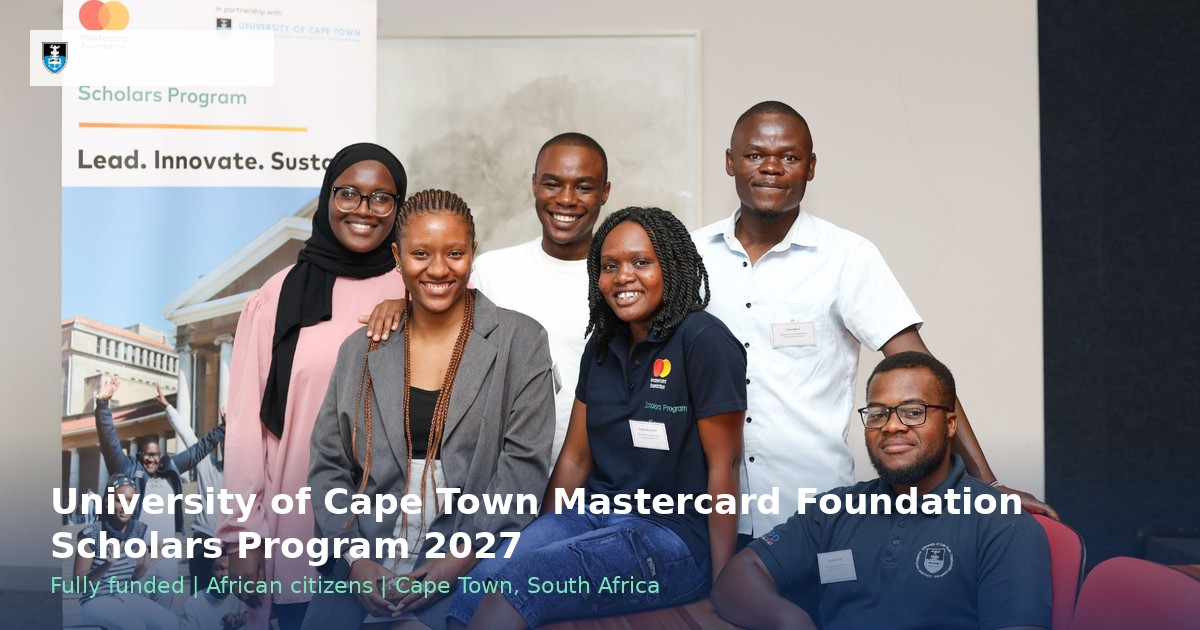
The 2027 round of the Mastercard Foundation Scholars Program at the University of Cape Town closed on 31 October 2026, the official postgraduate application deadline, and if this page and the official UCT page disagree, the official page wins.
Where the call stands on 6 October 2026: the bachelor's degree track closed on 30 September 2026, and the postgraduate Scholars Program application form is open until 31 October 2026. The University of Cape Town does not publish a time of day or a time zone for either deadline, so treat 31 October 2026 as a date to beat, not a target. If this guide and the official page ever disagree, the official page wins.
The Mastercard Foundation Scholars Program at the University of Cape Town (UCT) gives comprehensive support to academically talented young Africans who face significant social and economic barriers to higher education. It is a standing programme: UCT says it opens its call for applications every year, and the current call is for the 2027 academic year. Successful scholars study a first bachelor's degree or an eligible taught postgraduate programme at UCT in South Africa, with the award covering the full period of that programme.
This guide is for readers who already have the official UCT pages open and want help deciding whether to apply and how to get the order of steps right. It explains who the award fits and who it does not, why you need two separate applications, what the support covers and what UCT does not publish, the eligibility traps, how to prepare each document, and a realistic plan for the weeks left. Facts were checked on 6 October 2026 against the official UCT Mastercard Foundation Scholars Program pages. The fit and preparation advice is ours, not UCT rules.
Where the 2027 call stands
- Bachelor's degree track: closed. The Scholars Program deadline for applicants to a UCT bachelor's degree was 30 September 2026. The online form now says undergraduate applications are closed and will not be considered. UCT also says its own undergraduate academic applications for the 2027 intake are closed.
- Postgraduate track: open until 31 October 2026. This covers a postgraduate diploma in the Faculty of Health Sciences, an honours degree, or a coursework master's programme. No closing time is published.
- The academic application is separate. UCT says postgraduate academic applications remain open, but each faculty sets its own programme requirements and deadlines, and the Scholars Program pages do not list them. Check your faculty before you plan around 31 October 2026.
- Read the home page alongside the apply page. The Scholars Program home page uses broad wording that applications are open and shows both closing dates. The apply page and the form are more specific: undergraduate applications are closed, and only the postgraduate track remains open.
- Next call. UCT opens the call annually. No dates for the following cycle are published, so bachelor's applicants should prepare now and wait for the official apply page to announce the next window.
If you are a postgraduate applicant, three things decide whether your application can be considered at all. The route: a full-time taught programme at an eligible level, not a research degree. The order: your UCT academic application goes in before the Scholars Program form, and your faculty's own deadline may come before 31 October 2026. Completeness: the form requires every document type, including financial evidence that often depends on family members. The plan near the end of this guide turns these points into steps for the weeks left.
Who this award fits, and who it does not
Who it fits
According to the official apply page, applicants should be a citizen of an African country, including South Africa, and be applying for a first bachelor's degree or an eligible taught postgraduate programme at UCT. They should also demonstrate academic talent and a commitment to excellence, face significant social and economic barriers to accessing higher education, show potential for transformative and ethical leadership, and be committed to serving their communities and contributing to positive change.
UCT's selection criteria repeat these points: academic talent with a drive to complete your education, significant financial barriers to education, a commitment to investing in your community, and ethical leadership. UCT encourages applications from young women, people living with disabilities, refugees, forcibly displaced youth and all young people whose access to opportunity has been held back by social and economic barriers.
In our reading, the strongest applicants can show all four things at once: good results, real financial need backed by documents, a record of helping others, and a clear link between their chosen UCT programme and the community they want to serve. Strong grades alone are not enough, and neither is need alone.
Eligible study routes
- A first bachelor's degree (closed for the 2027 call).
- A postgraduate diploma offered by the Faculty of Health Sciences.
- An honours degree in any of UCT's six faculties: Commerce, Engineering and the Built Environment, Health Sciences, Humanities, Law, and Science.
- A coursework master's programme in any of those six faculties.
- The Integrated Master's Programme through the African Climate and Development Initiative (ACDI), for students admitted to it.
- Healthy Futures South Africa (HFSA) via the Africa Health Collaborative, for students admitted to it.
Who it does not fit
- Doctor of Philosophy (PhD) applicants. Research-only qualifications are excluded.
- Applicants to a master's by dissertation, which UCT also treats as research only.
- Part-time students.
- Applicants to a postgraduate diploma outside the Faculty of Health Sciences, which is not on the eligible list.
- Anyone who has not first applied for admission to a UCT programme. The form says such applications will not be considered.
- Anyone who does not receive an offer of admission to UCT. Only applicants with an admission offer are eligible for the award.
Check the nationality wording before you start
The apply page says applicants should be "a citizen of an African country, including South Africa", and it gives no country list. The About the Program page says the programme at UCT selects young leaders from Sub-Saharan Africa. The two pages use different wording, and UCT does not explain the difference. If you are unsure whether your citizenship is covered, ask the Scholars Program office to confirm your eligibility before you spend time on documents. The contact details are in the Frequently asked questions section below.
Two applications, in this order
UCT is clear that a Scholars Program application is not the same as an academic application to UCT. It advises applicants to apply to UCT first and then apply for the Scholars Program.
- Choose an eligible programme. Use UCT's applicants and students pages, the Postgraduate Hub programme list and the UCT faculty websites. Contact the faculty about entry requirements and its own deadline.
- Submit the UCT academic application online. Apply at applyonline.uct.ac.za. Once you submit it, you cannot change it yourself. Only the Admissions Office can change your programme choice or biographical details, or add documents. You can monitor your status online. The Scholars Program staff in UCT's International Academic Programmes Office do not process academic applications.
- Submit the Scholars Program form. Use the Scholars Program application form. It asks for your UCT Campus ID or applicant number, your full name as it appears on your birth certificate or passport, and the email address you used to apply to UCT. Choose "Postgraduate studies" and the level: honours, postgraduate diploma or master's.
- Wait for the academic outcome. Your eligibility for the award depends on receiving an offer of admission from UCT.
Two details in step 3 cause avoidable problems. Use the same email address and the same name as on your UCT application, so staff can match the two records. And keep your applicant number from step 2 to hand, because the form asks for your UCT Campus ID or applicant number.
You do not need to hold an admission offer when you submit the Scholars Program form. UCT says people who have already applied to UCT may apply for the Scholars Program if they meet the eligibility requirements, but only those who then receive an offer will be eligible.
Applying to other partner universities
UCT is one of several Mastercard Foundation Scholars Program partner universities. The form asks whether you have applied to the Scholars Program at any other partner university and, if so, which one. UCT explains that this helps allocate the available scholarships fairly across the network. Answer that question honestly.
What the support covers, and what is not published
The About the Program page describes "comprehensive financial support" covering:
- Tuition fees for your chosen programme of study.
- A laptop.
- Accommodation on UCT's campuses.
- Living expenses.
- Medical aid.
- A study visa, where applicable.
- Annual travel to and from UCT.
The award covers the full period of your UCT programme. It is renewable each year, subject to satisfactory academic performance and personal conduct, and to taking part in the programme's development activities.
Is it fully funded? UCT's own wording is "comprehensive financial support", not "fully funded". In our summary, the list above amounts to a fully funded award, because it covers tuition, housing, living costs, health cover, visa and travel. That is our description, not an official term.
No amounts are published. UCT does not state a stipend, a living allowance, a travel amount or any other figure. Do not plan around a number you have seen elsewhere. If you need to know how living expenses or travel are paid in practice, ask the Scholars Program office.
The support is not only financial. The programme provides academic and peer support and skills programmes for entrepreneurial and career readiness, ethical and transformative leadership, and continued community contribution. The Scholar Development page adds that all scholars are part of the mentorship programme. It also lists an annual leadership training camp, a two-day entrepreneurship bootcamp, and activities on career management and planning. The Mastercard Foundation Scholars Council runs an annual Service Day, and a pilot Scholars Entrepreneurship Fund lets scholars and alumni pitch for funding for social enterprise ideas. After graduating, you join the Mastercard Foundation Scholars Alumni Network.
These are expectations as well as benefits. UCT says scholars are expected to take part in community upliftment projects and in what UCT has to offer, and renewal depends on taking part in the development activities. If you are looking for a scholarship that only pays fees and carries no participation expectations, this programme may not be the right fit.
Eligibility traps that are easy to miss
Each of these can stop an otherwise strong postgraduate application before its merit is weighed.
- Financial need must be shown on paper. The form asks how many people live in your household and asks you to upload documents showing your family's income and financial status. A strong essay cannot replace this evidence.
- The form checks for your UCT application first. A Scholars Program form sent without a prior UCT academic application will not be considered.
- Faculty deadlines can come first. The 31 October 2026 date belongs to the Scholars Program form. Your faculty may close its programme earlier, and missing that closes the route to the award.
- Research degrees are out. A master's by dissertation or a PhD does not qualify, even in an eligible faculty.
- The current Scholars Program application pages do not publish an age limit or minimum scholarship mark. Your marks need to meet the admission requirements of your chosen UCT programme. The under-21 reference on UCT's pages is a study visa requirement, not a scholarship age rule: UCT appoints guardians for visa applicants under 21.
- Disclose other applications. If you applied to the Scholars Program at another partner university, say so on the form.
Documents to prepare before you open the form
The form says you must upload each type of required document for your application to be considered. Each upload has a 40 megabyte (MB) limit, and the allowed file types are txt, rtf, pdf, doc, docx, odt, ppt, pptx, odp, xls, xlsx and ods. Image files such as jpg and png are not on the list, so convert scanned documents to an allowed type, such as pdf, before you start.
Proof of address
UCT gives examples: an official bank statement, a utility bill or a bill from your local council or municipality, or a letter from your school to your parents or caregiver at their home address. You can upload more than one file.
Financial status documents
UCT gives examples: your parents' or guardian's bank statements, or details of social or government grants your family receives. You can upload more than one file. Gather these early, because they often depend on other people.
Curriculum vitae (CV)
One file, no more than 3 pages. UCT asks you to include your full educational background, your employment history if any, extra-curricular activities, community activities, and any leadership positions you have held. In our view, put dates and your specific role next to each community or leadership entry, because these are the parts the selection criteria focus on.
Essay
One file, no more than 2,000 words. The postgraduate prompt, which is the one that matters for the open track, asks you to reflect on the qualities that define leadership and on how the Scholars Program will empower you to contribute to the economic growth and social development of your home community, your country and the continent. It also asks you to include details of any community service, leadership or entrepreneurship initiatives you have undertaken.
The undergraduate prompts, for the next bachelor's call, ask five questions: why you are applying to the programme at UCT, which personal and professional goals it will help you achieve, what has inspired your educational path, what obstacles you have faced in pursuing education and how you overcame them, and how you have helped others.
Our advice: answer the prompt directly rather than writing a general life story. Use concrete examples that your CV and your referee can confirm. Link your chosen UCT programme to a specific need in your community. The 2,000 words are a limit, not a target, and a focused essay is easier to read than a padded one.
Recommendation letter
UCT asks for a letter of recommendation and accepts up to 2 files. It can come from a school teacher or lecturer, a pastor or other religious leader, or a previous employer. The letter must include your referee's full name and contact details. Ask early, tell your referee about the leadership and community focus of the programme, and check that the contact details are on the letter before you upload it.
Extra steps for South African applicants
A separate financial aid requirement, not a Scholars Program deadline. South African undergraduate applicants must also apply for UCT Student Financial Aid and National Student Financial Aid Scheme (NSFAS) assistance, in addition to the Scholars Program. UCT says only South African citizens and permanent residents are eligible for this funding, and only a first undergraduate qualification is considered. The cited UCT page says financial aid applications must be submitted no later than 30 October and that late applications will not be considered, but it does not state a year. Do not read 30 October as a Scholars Program date, and do not assume it applies to the 2027 cycle. If you are a South African who applied for the bachelor's track before it closed, confirm the current financial aid instructions with UCT directly.
UCT also says applications for a place in a UCT residence are managed by UCT Student Housing Admissions and Advocacy Services, are part of the online academic application, and must be received by 30 September. That page does not give a year either. If the date applies to this cycle, it has already passed. The award itself covers accommodation on UCT's campuses, and the visa list says Scholars Program staff arrange proof of accommodation for successful applicants. If you are unsure how the residence date applies to you, ask the Scholars Program office.
If you are applying from outside South Africa
International applicants who receive an offer must get a South African study visa before they leave home. UCT will not let you pre-register or register without a visa valid for studies at UCT. The official UCT page lists:
- A passport valid for at least 30 days after the end of your planned stay, with at least one unused page, and not endorsed or extended.
- The Department of Home Affairs application form BI-1738.
- An official letter from the relevant UCT faculty offering you a place for the duration of the course.
- For applicants under 21, guardians appointed by UCT, with proof of consent arranged with the parents.
- A police clearance certificate less than 6 months old.
- Medical and radiological reports less than 6 months old.
- A certificate showing your marital status, if you are married, widowed, divorced or separated.
- A yellow fever vaccination certificate, if you travel from or through a yellow fever endemic area.
- Proof of medical cover, which Scholars Program staff arrange for successful scholarship applicants.
- Proof of accommodation, which Scholars Program staff arrange for successful applicants.
- Proof of sufficient funds to cover tuition fees, maintenance and incidental costs, which is confirmed in the letter of award.
South African embassies and high commissions can ask for more documents, so check with the mission nearest to you. Police clearance and medical reports have a 6-month validity window, so in our view it makes sense to identify where you would get them now but to request them only once you hold an offer.
A realistic plan for the weeks before 31 October 2026
Postgraduate applicants, starting now
- Confirm that your programme is an eligible taught route: a Health Sciences postgraduate diploma, an honours degree or a coursework master's, studied full time.
- Check your faculty's academic deadline and requirements, and contact the faculty if anything is unclear.
- Submit the UCT academic application first, then note your applicant number and the email address you used.
- Ask your referee for the recommendation letter straight away.
- Collect proof of address and financial status documents, and convert any scans to an allowed file type.
- Write the CV and the postgraduate essay, then check that they tell the same story.
- Submit the Scholars Program form well before 31 October 2026, since no closing time is published.
Bachelor's applicants, for the next call
Do not submit now, because the form will not consider undergraduate entries. Use the gap to shortlist a first bachelor's programme at UCT, gather proof of address and financial documents, build a CV that records your community and leadership activity, draft answers to the five undergraduate essay questions, and line up a referee. Then watch the official apply page. UCT has not published dates for the next call, so do not rely on any date until the apply page shows it.
After you submit
UCT's current pages do not describe an interview, a shortlisting stage, a results date or the number of awards for 2027. If you are selected, expect the mentorship programme, the leadership camp, the entrepreneurship bootcamp, the Service Day and community engagement, with annual renewal tied to your results, conduct and participation.
Frequently asked questions
Can I still apply for a bachelor's degree for 2027?
No. The bachelor's Scholars Program deadline was 30 September 2026, and the form says undergraduate applications are closed and will not be considered. UCT opens the call annually, so prepare for the next one.
What is the postgraduate deadline?
31 October 2026 for a Faculty of Health Sciences postgraduate diploma, an honours degree or a master's programme. UCT does not publish a time of day, and your faculty may have an earlier academic deadline.
Can I apply for a PhD or a research master's?
No. UCT says the programme does not cover qualifications by research only, which include a master's by dissertation and a PhD. Part-time study is not covered either.
Do I need an admission offer before I submit the Scholars Program form?
No, but you must have applied to UCT first, and the form asks for your UCT Campus ID or applicant number. Only applicants who receive an offer of admission are eligible for the award.
What does the support cover, and is it fully funded?
UCT calls it comprehensive financial support covering tuition, a laptop, campus accommodation, living expenses, medical aid, a study visa where applicable, and annual travel to and from UCT. We summarise that as fully funded, but no amounts are published.
Is there an age limit or a minimum mark?
Not on the current Scholars Program application pages, which list no age limit and no minimum scholarship mark. You need to meet the admission requirements of your chosen UCT programme. The under-21 rule on UCT's pages is a study visa requirement: UCT appoints guardians for visa applicants under 21.
Which African countries are eligible?
The apply page says citizens of an African country, including South Africa, and gives no country list. The About the Program page refers to Sub-Saharan Africa. If you are unsure whether your citizenship is covered, ask the Scholars Program office to confirm before you apply.
Can I apply to the Scholars Program at other partner universities?
UCT's form does not address this directly. It asks whether you have applied to the Scholars Program at any other partner university and which one, so that scholarships can be allocated fairly across the network. Answer that question honestly, and ask the Scholars Program office if you are unsure how it affects you.
Is there an interview, and when are results announced?
UCT's current pages do not publish an interview stage or a results date.
Who do I contact with questions?
The Scholars Program contact page lists telephone +27 (0)21 650 2822 and email [email protected]. Questions about programme entry requirements go to the relevant UCT faculty, because Scholars Program staff do not process academic applications.
Official sources
- Apply to the Mastercard Foundation Scholars Program at UCT (eligibility and deadlines)
- Scholars Program application form (documents and essay prompts)
- About the Program (what the support covers)
- Apply hub (two applications, annual call)
- How to apply for academic study and placement at UCT (South African and international applicants)
- Contact the Scholars Program at UCT
Facts checked 6 October 2026. The Scholars Program frequently asked questions page on the UCT site still describes an earlier research master's call, so we did not use it for current rules, dates or benefits. Deadlines and open or closed status can change, so re-read the official pages before you apply.