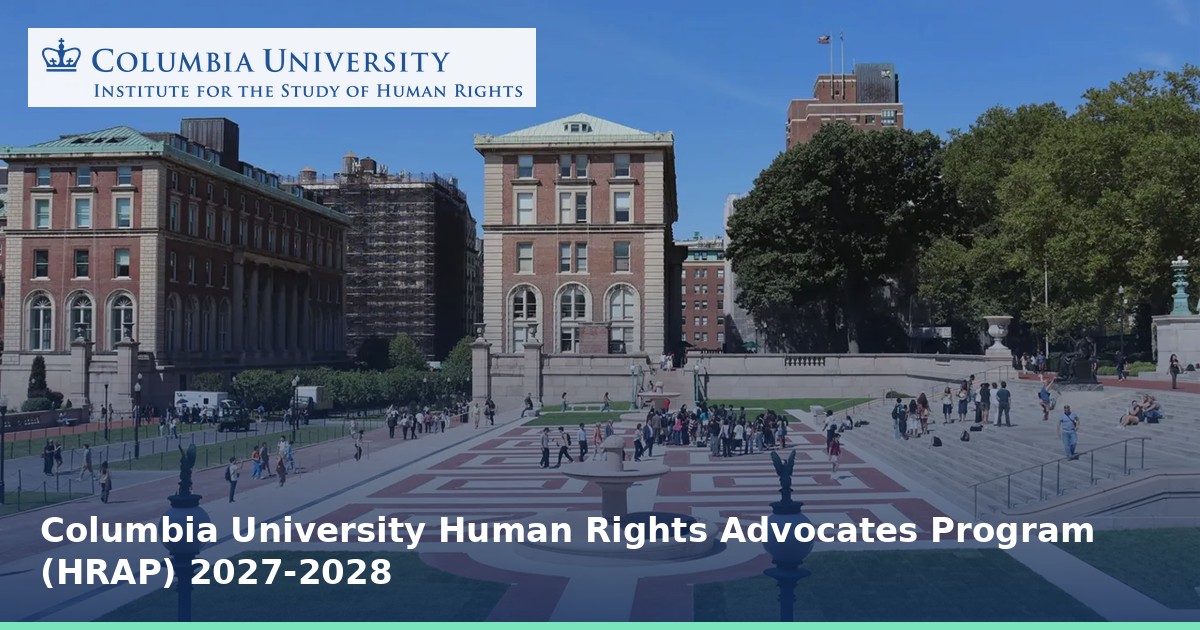
The Fall 2027 / Spring 2028 Columbia Human Rights Advocates Program (HRAP) application round closed on 15 October 2026 at 11:59 pm Eastern Time. If this page and the official source disagree, the official page wins.
Status checked 6 October 2026: the Fall 2027 and Spring 2028 call is open.
- Deadline: 15 October 2026 at 11:59 pm Eastern Time, one deadline for both programmes. Columbia publishes only the Eastern Time deadline.
- Late files: not accepted, even after technical problems on your side. The online system closes automatically at the deadline.
- Programme windows: September 2027 to mid-December 2027, or January 2028 to early May 2028, both subject to change.
- Funding: not fully funded for everyone admitted. Only a very limited number of full scholarships will be awarded, and no amounts are published.
- Results: all applicants are told their status by late February 2027.
The Human Rights Advocates Program (HRAP) is run by the Institute for the Study of Human Rights (ISHR) at Columbia University in New York City. Founded in 1989, it brings grassroots human rights leaders to Columbia for graduate-level coursework, skills-building workshops, networking and mentoring, so that they can strengthen the organizations they return to. ISHR says more than 350 advocates from nearly 100 countries have taken part.
It is not a degree and not a scholarship for students. It is a non-degree, on-campus programme for people who already work full time at a grassroots non-governmental organization (NGO) and who will go back to that organization afterwards. It is a standing programme, and the current call covers two separate programmes, one in fall 2027 and one in spring 2028.
This guide is for advocates who already have the official ISHR pages open and want to decide, before the deadline, whether this application is worth their time. It covers who the programme fits and who it does not, what you actually get, the funding reality, the eligibility traps that end applications, how to prepare each document, a realistic plan for the days left and what happens after you submit. Facts were checked on 6 October 2026 against the official Institute for the Study of Human Rights pages and the Portable Document Format (PDF) application form. The fit, planning and interpretation notes are ours, not ISHR rules. If this guide and the official pages ever disagree, the official pages win.
Who this programme fits, and who it does not
Who it fits
The admissions page says the programme is designed for human rights activists working with grassroots NGOs on issues including sexual and gender-based violence, minority rights, lesbian, gay, bisexual, transgender, queer and intersex (LGBTQI+) rights, labor rights, indigenous peoples' rights, migration, health, social exclusion, environmental justice, disability rights and corporate social accountability. The Frequently Asked Questions (FAQ) page adds lawyers, journalists, doctors, teachers, social workers and community organizers, as long as they work in that same grassroots NGO setting. Both lists are examples, not a closed menu.
Based on the admissions page and FAQ, a candidate who fits:
- Works full time in a paid position for a grassroots NGO now. ISHR prefers applicants who hold full-time jobs pursuing their advocacy.
- Can show work experience in human rights, commitment to the human rights field and the ability to pursue graduate-level studies. These are the three bases ISHR names for selection.
- Is fluent in English. No English test or score is named, and the form asks you to rate your own speaking, reading and writing.
- Has a signed endorsement from their organization and commits to returning to that organization when the programme ends.
- Ideally holds a bachelor's degree, which ISHR describes as preferred, not required.
ISHR also gives preference to applicants who have not previously had opportunities to travel and study internationally, and the FAQ confirms that advocates with a disability are eligible.
In our reading, the programme is aimed at someone doing human rights advocacy now, whose organization will provide institutional endorsement, who has had few opportunities to study internationally, and who can explain what they will take back to their organization. Current grassroots advocacy should be central to the application, because ISHR's published selection criteria emphasize human rights work experience, commitment to the field and demonstrated ability to pursue graduate-level studies.
Who it does not fit
- Full-time students, academics or government officials. The admissions page says they will not be considered. The FAQ uses softer wording for students and university professors ("not encouraged"), so plan around the stricter admissions sentence.
- Anyone planning to join an NGO later. The FAQ says ISHR can only consider advocates currently employed at NGOs.
- A second applicant from the same organization. Only one application per organization is allowed.
- Nationals of countries on the United States travel ban list that ISHR links to. If your country is on it, ISHR asks you not to apply.
- Applicants from high-income countries on the World Bank list, unless they represent marginalized communities.
- Anyone who needs a degree, academic credits or a certificate at the end. None is published for this programme.
What the programme offers, and what it does not
The programme overview page describes four pillars: graduate-level coursework, skills-building workshops, networking and mentoring.
- Coursework. Advocates attend Columbia University seminars chosen to suit their interests, in schools across the university, including the School of International and Public Affairs, Columbia Law School, Barnard College, the Mailman School of Public Health and Teachers College. In the 2025-26 annual report, a Columbia instructor describes two advocates as "technically auditing the class". No degree, credits or certificate is published, so do not plan around one.
- Skills workshops. ISHR says the workshops vary slightly each year. Standing examples on the overview page include fundraising and building sustainable organizations, a six-week human rights research, documentation and reporting course taught by Human Rights Watch senior researchers, editorial writing, effective presentations, stress management, human rights advocacy, video advocacy with WITNESS, media training, Maximizing Your Time in HRAP and oral history.
- Networking. Group meetings with New York organizations, individual meetings with organizations in the United States relevant to your work, an intensive networking and advocacy trip to Washington, D.C., public speaking at universities and community groups, and meetings with representatives of the United Nations, the United States government, the World Bank and others.
- Mentoring. Columbia faculty mentor advocates throughout the programme.
After the programme, ISHR says it keeps building the capacity of its alumni. It shares scholarship and fellowship opportunities, gives technical advice on request and supports collaboration among alumni. It reports that since 2010 its advice on alumni grant proposals has resulted in funding totaling $3 million. That is a programme-wide result, not money that any advocate receives on joining.
How long it lasts
The overview page still refers to "the intensive six-month program". The admissions page for the current call gives shorter windows: September 2027 to mid-December 2027, or January 2028 to early May 2028, and notes that these are subject to change. Use the admissions windows when you ask your organization for leave. Exact start and end days are not published.
On the form you choose one window or tick "Please consider me for either one." Our reading: tick "either" only if both windows genuinely work for your organization. ISHR does not say whether that choice affects your chances.
How many places
The Current Advocates page lists seven advocates in the 2025-26 group. ISHR does not publish the number of places for 2027-28, so treat the seven-person 2025-26 group as historical context, not as a quota or forecast for the current call.
The funding reality
This is the section to read twice. Do not treat the programme as fully funded. Selection and funding are separate steps, and full funding reaches only a few advocates.
- The admissions page says that after its stringent selection process, ISHR "makes every effort to secure funding for shortlisted Advocates to attend the program." Where it cannot, shortlisted advocates "may be asked to secure the funds needed for them to be admitted to the program."
- The FAQ says: "Only a very limited number of full scholarships will be awarded. Other admitted applicants will be asked to cover expenses such as living expenses and stipend."
- There is no separate funding form. All funding questions sit inside the main application, and no additional documentation is needed.
What Columbia does not publish
Columbia does not publish any funding amounts, a stipend figure, the cost of attending, a programme fee or an item list of what a full scholarship includes, such as housing, international airfare, health insurance, visa costs or the Washington, D.C. trip. The number of full scholarships for 2027-28 is not published. The pages do not mention an application fee, but they do not say that applying is free either.
The funding question on the form
The PDF application form asks you to pick one of two statements:
- "In the event that full funding is not available, I am able to provide full/partial funding from another source."
- "I would only like to be considered for full funding."
Our reading: the first option keeps you in the running if ISHR cannot fund you, but only choose it if you or your organization could realistically raise the money. The second limits you to the very limited pool of full scholarships. ISHR does not publish how the choice affects selection, so give the answer that is true for you.
Targeted support named for this call
The admissions page names several targeted funding commitments for this call:
- Funders will enable ISHR to admit qualified advocates working on lesbian, gay, bisexual and transgender (LGBT) rights and/or disability rights and/or sexual and reproductive health and rights (SRHR) in Latin America and/or Africa. The page itself writes "LGBT and/or disability and/or SRHR rights" and does not spell out SRHR.
- The Packard Foundation will allow ISHR to admit two advocates working on human rights abuses in the fisheries sector in Southeast Asia.
- The Harriman Institute at Columbia University will allow ISHR to admit one advocate from Russia, Eurasia and Eastern Europe.
These lines describe specific support, not the total number of places. If your work genuinely matches one of them, make that link clear in your essays and issue areas.
ISHR also strongly recommends that, if your organization has funding from an external source, you obtain at least one letter from one of your donors.
Plan the money before you apply
Our advice: before you choose a funding option, talk to your director about what would happen if you were offered a place without full funding. Could the organization or another funder cover the expenses you would need to meet during your HRAP programme period in New York? ISHR publishes no funding figures, so do not build a budget from guesses. Get honest answers to the question first, then choose the form option that matches them.
Eligibility traps to check before you start
- Travel ban first. The admissions page tells you to check whether your country is on the current United States travel ban list before you apply. ISHR links to a third-party list rather than publishing its own. The FAQ says people from those countries are ineligible at this time for a visa to attend. The list can change, so open it from the admissions page on the day you apply.
- High-income countries. The FAQ links the World Bank list of high-income countries. Applicants from those countries are not considered unless they represent marginalized communities. If you rely on that exception, our advice is to name the community and your work with it plainly.
- No pre-check. ISHR says it will not tell you whether you are eligible at this stage, and that it cannot assess eligibility without reviewing a completed application.
- One application per organization. More than one application means every application from that organization is disqualified. It is up to you to make sure you are the only applicant.
- Current employment and a current letter. You need a paid, full-time post at a grassroots NGO now, and a letter of institutional support that is current to this year's application. Without that letter your application cannot be considered.
- Signed letters only. Unsigned recommendation letters are not accepted, and the whole application is then removed from consideration. Electronic signatures are accepted.
- No double use. The institutional letter cannot also serve as one of your two recommendation letters.
- English throughout. The entire application, including attachments, must be in English.
- File limits. Uploads must be no larger than 2 megabytes, and PDF is highly preferred. The passport image must be JPG, PNG or TIFF.
- Editing the application. Before you submit, you can keep editing your application up to the deadline. Once you submit it, neither you nor HRAP can make further changes, so review everything carefully before you press submit.
Documents and form preparation
Required files
The admissions page lists the letters and the diploma, while the PDF form also marks the curriculum vitae, passport image and video statement as required. Prepare all of them.
- Two-page curriculum vitae (CV) or resume. PDF only, with dates and locations for all activities. Only the first two pages are read.
- Letter of institutional support. On letterhead and signed. The admissions page asks for your supervisor, and the PDF form allows the director, immediate supervisor or implementing organization. If you are the director, the FAQ says the chair of your board should sign. The form asks the letter to cover your title and length of employment, your responsibilities, why they support you, the expected benefits, how your work will be covered while you are away and the changes they expect after the programme. PDF only.
- Two signed recommendation letters in English. They should come from people who can attest to your work as a human rights advocate. Each recommender must give a phone number and email address, and ISHR highly recommends a work email. Letters can be addressed to ISHR, to HRAP or "To whom it may concern", and you may reuse letters from a previous year. References from your own organization are allowed, but ISHR advises seeking letters from others. ISHR says these letters weigh heavily and that most recommenders need at least a few weeks.
- University diploma and/or transcript. If you hold several degrees, upload the highest one.
- Passport image. JPG, PNG or TIFF.
- Video statement link. A short video, no longer than three minutes, introducing you and your work, with the exact hosted link.
- Donor letter. Strongly recommended if your organization has external funding.
Key form prompts, so you can draft offline
The form also contains other personal and administrative fields, such as gender identity, pronouns, date of birth and phone number. The points below are the main prompts worth preparing in advance.
- Personal details as they appear on your passport, plus citizenship, residence and contact details.
- Three short answers of up to 500 characters each: how you learned about HRAP, whether you know an HRAP alumnus, and any existing relationship with Columbia.
- "Why did you become an advocate?" (up to 5,000 characters) and "Why have you chosen to apply for HRAP?" (up to 2,500 characters).
- Your organization: founding year, address, mission, number of staff and volunteers, annual budget, and recent funding sources from the past five years with years, amounts and project titles.
- Your role: title, the country where you work, start date, type of employment and your top three issue areas.
- Six longer answers of up to 5,000 characters each: how you address the issues, the communities you serve, the problems with their causes and solutions, your organization's strategy with a current project example, your responsibilities and challenges, and your progression as an advocate with plans for the next 2 to 5 years.
- A checklist of organizational affiliations, including Amnesty International, Ford Foundation, Front Line Defenders, Human Rights Watch, Open Society Foundations, Oxfam and WITNESS, with explanations and contact names.
- English self-rating and how you learned English, your highest degree, the countries you have visited ("None" if applicable), the funding choice and up to 10 links about you.
Our tip: ISHR contacts the partners and donors you list during due diligence, so list only relationships that the other side will confirm.
Two ways to submit
- Google Form. Linked from the admissions page. To save progress and return later you must log in with a Google account (the FAQ also says Gmail). Drafts are saved for up to 30 days, and you receive a confirmation when you submit a completed application. If you do not log in, keep a copy of your answers in your own text file.
- PDF form by email. Fill in the PDF version and send it to [email protected], with each recommendation letter attached as a PDF in the same email.
Either way, our advice is to write every answer in a separate document first, check it against the character limits, and paste it in only when it is final.
A realistic plan before 15 October 2026
This is our planning advice, not an ISHR schedule. On 6 October 2026 about nine days remain, so start with the checks that could end your application.
- Check the travel ban list linked from the admissions page and, if relevant, the World Bank high-income list linked from the FAQ. If either rule excludes you, stop here.
- Confirm with your director that nobody else from your organization is applying.
- Ask your supervisor, or your board chair if you lead the organization, for the institutional letter, and ask both recommenders on the same day. Tell them the letters must be signed, in English and include their phone and email. ISHR says most recommenders need a few weeks, so be honest that the timeline is tight.
- Gather the passport image, your highest diploma or transcript, your organization's annual budget and its funding sources for the past five years.
- Write the two-page CV and save it as a PDF.
- Draft the essays offline within the character limits, using concrete examples you can back up.
- Record the three-minute video statement, host it and test the link from another device.
- Check that every upload is under 2 megabytes and in PDF where possible.
- Submit well before 11:59 pm Eastern Time on 15 October 2026 and keep the confirmation.
If your letters cannot be signed in time, do not send an incomplete application. ISHR allows you to apply again in a future call, although no date for the next call is published.
What happens after you submit
- Due diligence. ISHR describes a stringent and thorough process. It contacts your recommenders and any organizations you list as partners or donors.
- Your file is shared. The FAQ says your entire application will be shared with HRAP alumni who work in your country. Our note for advocates whose work carries personal risk: treat that as a privacy and safety fact when you decide what to write.
- Interviews. Shortlisted applicants interview with HRAP alumni from their own countries or regions. Finalists then interview with ISHR's Director of Capacity Building. Interview dates and format are not published.
- Funding and results. ISHR then seeks funding for shortlisted advocates. All applicants hear their status by late February 2027, and ISHR asks for patience because selection and funding take a long time.
- No deferral. If you are accepted but cannot attend, you cannot postpone to the following year. You would need to reapply for a future programme.
- Visa. ISHR describes itself as sponsoring advocates, but the visa type and process are not published.
Frequently asked questions
Is the Human Rights Advocates Program fully funded?
No, not for everyone. ISHR tries to secure funding for shortlisted advocates, but full scholarships are very limited, and other admitted applicants are asked to cover costs such as living expenses and stipend. No amounts are published.
Can I apply as a student, lecturer or government official?
The admissions page says full-time students, academics and government officials will not be considered. You need a current, paid, full-time job at a grassroots NGO.
Which countries are eligible?
ISHR welcomes applications from all regions but publishes no country list. Two rules exclude applicants: countries on the United States travel ban list that ISHR links to, and World Bank high-income countries unless you represent marginalized communities.
Will I receive a degree or certificate?
None is published. Advocates attend Columbia seminars as part of a capacity-building programme, and nothing on the official pages describes a qualification at the end.
Can two people from my organization apply?
No. If more than one person from the same organization applies, all of those applications are disqualified.
Can I apply by email instead of the Google Form?
Yes. Complete the PDF version of the form and email it to [email protected] with your recommendation letters as PDF attachments.
Is there an age limit or a minimum number of years of experience?
Neither is published. ISHR asks for work experience in human rights and a current full-time paid position at a grassroots NGO.
Do I need a bachelor's degree or an English test?
A bachelor's degree is preferred but not required. Fluency in English is required, but no test or minimum score is named.
Can I defer if I am accepted?
No. The FAQ says an accepted advocate cannot postpone to the following year. Taking part in a later year means submitting a new application for that programme.
When will I hear back?
ISHR says all applicants will be notified by late February 2027.
Who do I contact with questions?
Email [email protected] with questions that the application instructions and FAQ do not answer, because that is the address the admissions page and the FAQ page give for further questions. ISHR says it cannot answer individual application questions or tell you in advance whether you are eligible. The Contact the Institute page lists [email protected] as the Human Rights Advocates Program contact, and [email protected] with +1 212 854 2479 under General Inquiries.
Official sources
- Admissions information (current call, deadline, eligibility, funding, documents, selection)
- Frequently asked questions (employment rule, funding, one application per organization, uploads, letters, deferral)
- Programme overview (four pillars, workshops, Washington, D.C. trip, mentoring, alumni support)
- Human Rights Advocates Program home page (history and alumni numbers)
- PDF application form (questions, character limits, required files)
- Current Advocates (2025-26 group)
- HRAP 2025-26 annual report (context on workshops and funders, not rules)
- Contact the Institute (emails, phone and office)
The admissions page links a third-party list of countries covered by the United States travel ban, and the FAQ links the World Bank list of high-income countries. Open both from those official pages rather than relying on a copy. Facts checked 6 October 2026. Deadlines, programme windows and eligibility rules can change, so re-read the official pages before you apply.