The Santa Fe Institute’s Undergraduate Complexity Research programme offers a ten-week research experience in New Mexico from 30 May to 7 August 2027. Participants receive a $7,000 stipend, housing and meals, with travel support. Applications close on 13 January 2027 at 4 pm Mountain Standard Time (MST). You must be eligible to work in the United States and return to undergraduate study after the programme.
Derrick Ochieng for Scholarship Tally checked on 13 November 2026 against the Santa Fe Institute’s Undergraduate Complexity Research page, its applying and logistics pages. It was drafted with AI assistance from that reading. Scholarship Tally is independent of the Santa Fe Institute and cannot assess your application.
At a glance
| Item | Details |
|---|---|
| Programme | Ten-week in-person undergraduate research experience in complexity science |
| Dates | 30 May to 7 August 2027, Santa Fe, New Mexico |
| Support | $7,000 stipend, housing and meals, plus travel support |
| Deadline | 13 January 2027, 4 pm MST |
| Status updates | March 2027 by email for complete, on-time applications |
What participants do
Students work with one or more Santa Fe Institute researchers on an original research project. Complexity science studies systems with interacting parts, using approaches from mathematics, computation and other disciplines. At the start of the programme participants explore possible directions, meet researchers and develop a project with a mentor. Your application idea helps the selection committee understand how you think; it is not a commitment to carry out that exact project.
This is a full-time, in-person programme. Participants must arrive on 30 May and attend the entire period through 7 August. The Institute says late arrivals cannot be accommodated. If exams overlap with the opening weeks, its FAQ says arrangements such as proctored exams may be possible if discussed and approved in advance; you must still arrive and take part in required activities.
Who can apply
You must be actively enrolled part-time or full-time in an associate’s or bachelor’s degree and intend to return to undergraduate enrolment for at least one more academic term after the programme. Students at two- and four-year institutions and transfer students, including during the summer between institutions, may apply. An integrated bachelor’s and master’s student may be eligible if they remain in the undergraduate portion and return to it for another term.
You are not eligible if you finish your undergraduate degree before the programme ends, if you will not return to undergraduate study, or if you have graduated from high school but have not started college-level coursework. The Institute welcomes undergraduate students from physical, natural and social sciences and mathematics. Previous research experience is not required. The Institute typically gives priority to students entering the junior or senior year of a four-year course, and looks favourably on strong quantitative skills or programming experience.
Applicants need citizenship or residency that makes them eligible to work in the US. International students at US institutions typically arrange curricular practical training (CPT) under F-1 status with their institution. Eligible students enrolled outside the US may receive short-term J-1 visa sponsorship; the Institute does not sponsor H-1B visas. It provides individual guidance to final-round candidates after application review and interviews. Do not assume visa support is automatic.
What the programme pays and provides
Participants receive $7,000 over the programme, housing and meals at no cost during the residential stay, and travel support to and from Santa Fe. Students live at the Institute of American Indian Arts campus in a private room with a private bathroom. Group transport to the research campus is provided on workdays.
Travel reimbursement is subject to limits and rules on economy fares and carriers. Ground transportation to and from airports may be reimbursed, and students who drive may qualify for mileage reimbursement within the applicable limit. Meals and purchases during travel are not reimbursed, and neither is personal local travel. The Institute gives accepted applicants the relevant limits. If you arrive early or leave late for a personal trip, you must arrange and pay for your own accommodation and other costs outside the programme dates. Overnight guests are not allowed at the programme venues.
What to prepare
The Institute accepts applications through SurveyMonkey Apply. Its Applying page lists:
- Biographical information entered in the portal.
- A current academic CV or résumé.
- Written responses to two research prompts, including a one-page research statement and short project proposal.
- An unofficial transcript from each college or university attended, showing completed and ongoing courses and available grades. If it is not in English, include an English translation cover page. If fall grades are unavailable, provide an institutional list of the courses you enrolled in and will complete.
- One recommendation letter from a professor, mentor or adviser who knows your work.
The research statement should explain a clear question or target, a plausible way to approach it and why that approach fits. The Institute does not expect prior research experience or a fully specified dataset or algorithm. In the fields-of-study section, list disciplines you actually study; in the maths section, list eligible completed coursework as described on the Applying page.
How to apply
- Read the overview, Applying and Logistics pages, plus the programme FAQ. Check the work-eligibility and enrolment rules before preparing the form.
- Contact your recommender early. A missing letter can hold up an otherwise strong application.
- Prepare your CV, transcripts and research responses, then complete the online form through the Institute’s application link.
- Submit the complete application by 13 January 2027 at 4 pm MST. The Applying page says late or incomplete applications are not reviewed, and updated grades or documents cannot be added after the deadline.
Questions about the application go to [email protected]. That address appears on the Applying page for enquiries and again in its footer. The programme FAQ asks applicants not to contact Institute researchers or programme directors about their application; it directs questions to the education team instead.
What happens after submission
Selected finalists are invited to short individual Zoom interviews. The Applying page says all applicants receive a status update in March; the programme FAQ specifies an email update for complete, on-time applications and says late or incomplete applications receive no status notification. Read those statements together. The pages do not give an exact March date.
FAQ
Do I need previous research experience?
No. The Applying page says prior research experience is not required. Explain your question and a plausible approach in the research statement.
Can international students apply?
The Institute welcomes applicants whose citizenship or residency makes them eligible to work in the US. It describes possible F-1 CPT arrangements and J-1 assistance for eligible students, but does not sponsor H-1B visas.
Can I submit an updated transcript later?
The Applying page says updated grades and additional documents cannot be added or reviewed after the deadline. It explains what to provide if fall grades are not yet available.
Official sources
- Santa Fe Institute programme overview: dates, stipend and support.
- Applying: eligibility, documents and application process.
- Logistics: housing and travel rules.
- Programme FAQ: 2027 deadline, scheduling and status updates.
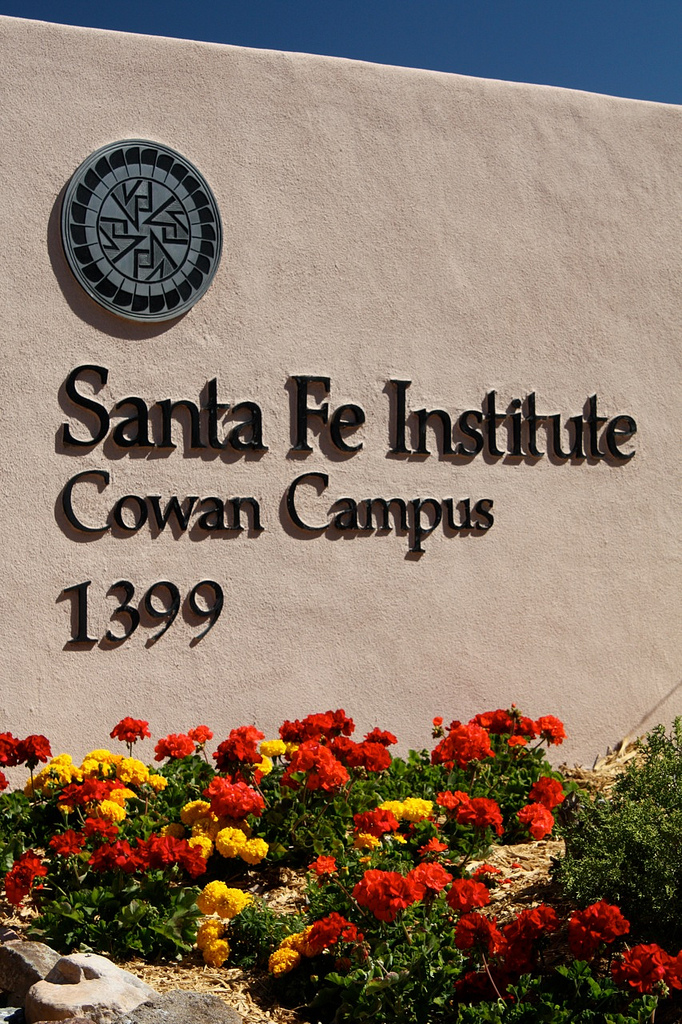
Featured photo: Santa Fe Institute entrance sign by Go2placitas, via Wikimedia Commons (https://commons.wikimedia.org/wiki/File:Santa_Fe_Institute.jpg), licensed under CC BY-SA 3.0 (https://creativecommons.org/licenses/by-sa/3.0/). Original image, unmodified.