
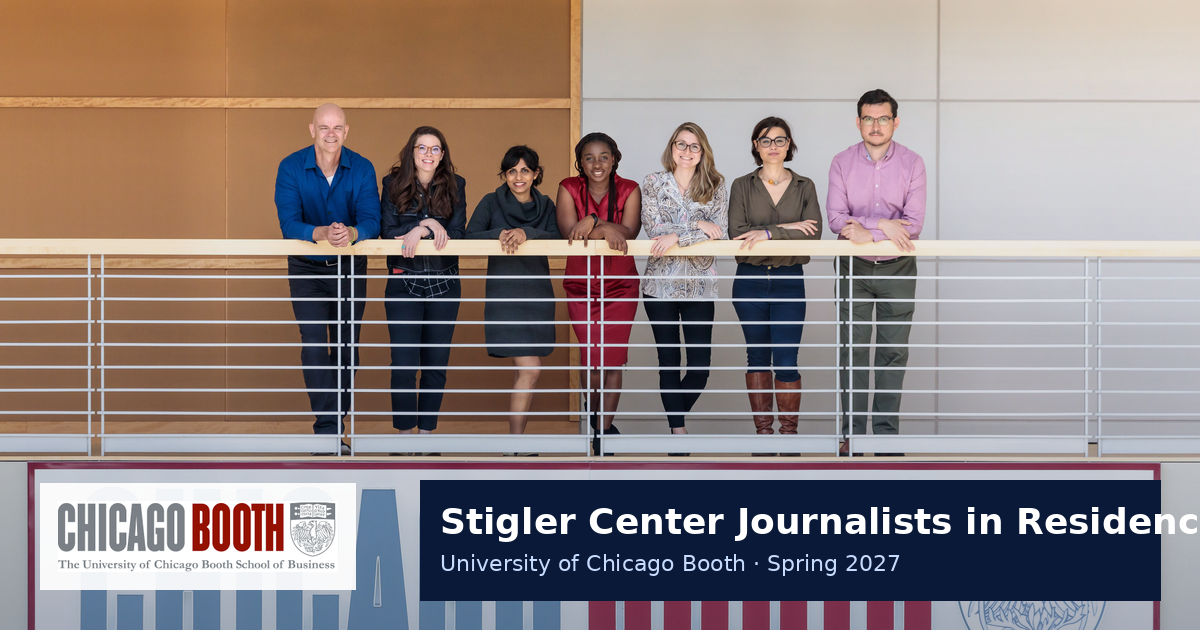
This is a standing explainer of the Stigler Center Journalists in Residence Program at the University of Chicago Booth School of Business. It is a roughly 12-week Hyde Park residency for journalists who want deeper tools for political economy and business reporting. It is not a Master of Business Administration (MBA) and not a University of Chicago degree.
According to the Stigler Center program and how-to-apply pages, the official Spring 2027 application deadline was 20 September 2026, 11:59 p.m. Central Time. That window is closed. As of 28 September 2026, official pages may still display that date, and no next-cycle deadline is published. If you already applied for Spring 2027, decisions are due by the end of December 2026, and the residency is listed as tentatively 15 March to 31 May 2027. If you did not apply, use this page to decide whether the standing program fits you, what the money actually covers, and which official pages to watch for the next call.
Published by Scholarship Tally. Editorial research desk covering scholarships and professional residencies from official sources.
Last checked: 28 September 2026 (Africa/Nairobi) against the Stigler Center program page, how-to-apply page, FAQ, and application portal link. Facts below are reported from those University of Chicago Booth School of Business pages. Editorial recommendations are practical guidance, not extra eligibility rules. If this article and the live official pages disagree, the official pages win.
What this guide adds: The official pages list features, expectations, and FAQs. This guide’s job is decision support before the next cycle opens: which published signals suggest fit, what the first-month cash-flow gap means in practice, how recommender timing interacts with a portal-only file, and how to read a closed Spring 2027 cycle without inventing a new deadline. Official requirements stay official; sequencing and “weaker practical fit” notes are editorial.
What this program is (and what it is not)
The Stigler Center launched the Journalists in Residence Program in 2017 to shape leaders in business reporting and to enrich public debate on the interaction between politics and the economy. Participants spend about 12 weeks on the Chicago Hyde Park campus. Journalists from around the world and from all forms of media are in scope.
Core activities on the official pages include auditing three Chicago Booth classes; attending Stigler Center seminars, lectures, conferences, and social events; working with the cohort; optional writing for ProMarket; and engaging Booth faculty and students. Successful completion brings a certificate of participation. The Center asks alumni to cite the experience as “The University of Chicago Booth School of Business – Stigler Center, Journalists in Residence Program (Program Year).” Participants also sign a letter of agreement on program and university guidelines.
What it is not
- Not an MBA, not a University of Chicago degree, and not a transcript you can present as either.
- Not a newsroom assignment desk and not a paid reporting contract.
- Not a housing package. The Center offers guidance and resources for short-term Chicago accommodation; you search and pay.
- Not a light seminar series. The official FAQ describes a heavy workload: class participation and assignments plus weekly Stigler events.
- Not automatic continuing-education credit. Your home institution decides whether to recognize it.
If your primary goal is an MBA or a university degree, note that this program does not provide either. Its structure is a 12-week Hyde Park residency focused on political economy and business reporting, with Booth classes you audit by permission and a global journalist cohort. That makes it more relevant to journalists seeking a short, intensive academic residency than to applicants looking primarily for a degree credential.
Who it fits, and who should wait
Official fit signals
- Interest in deepening knowledge of political economy and the interaction of politics and the economy.
- Proficient English.
- Journalists with at least some years of experience; strong applicants typically have a few years of post-degree work in the field.
- Editors and freelancers are explicitly welcome and are regularly hosted.
- All media forms, including television and radio (clips via links plus English transcriptions).
- Articles on political economy and Stigler-related topics are strongly preferred, even if not required. If your clips do not show that beat, the personal statement must make the connection.
Good-fit portraits (composites grounded in those criteria, not fake alumni bios)
- A mid-career business or investigations reporter who already covers firms, regulation, or public money and wants deeper political-economy tools. Basic economics and accounting help in class, but the Center does not require them.
- An editor who assigns political-economy stories and needs sharper frameworks, not a career reboot.
- A freelancer with a published record who can pause client work for 12 intense weeks and self-fund the first month.
- An international reporter who can handle a J-1 process and US tax withholding without treating the stipend as pure profit.
Situations that may make the program a weaker practical fit (editorial reading of published logistics and requirements, not an official eligibility screen)
- You have no published work, or only unpublished drafts.
- You have no English proficiency path (degree taught in English, or accepted proof listed on the apply page).
- Your primary goal is immigration, an MBA brand, or “study in Chicago” tourism.
- You cannot cover roughly the first month on personal funds (the official FAQ range is about USD 3,000 to 5,000 for housing, food, and transportation).
- You need the program to house, insure, or visa a partner or dependents. Companions may come; the program will not advise or pay.
- You cannot do a full-time academic load plus required Stigler events.
- You plan to email materials or upload your own recommendation letters. Those routes are rejected.
Basic knowledge of economics and accounting is useful but not required. Classes are harder without that background. Be honest in the statement rather than bluffing expertise.
What the 12 weeks on the Hyde Park campus actually involve
If you are already in the Spring 2027 pool, the residency is listed as tentatively 15 March to 31 May 2027. Treat those dates as tentative, matching the official wording.
Participants audit three Chicago Booth classes. You choose classes subject to instructor permission, seats, and sometimes prerequisites. The Center can suggest courses. Future schedules may not appear on the course search until closer to the academic year, and not every listed course is auditable. You participate in class and complete required readings and assignments. You also attend Stigler Center seminars, lectures, conferences, social events, and other recommended activities, and engage with the cohort and the wider university community. Writing for ProMarket is optional, not required. Networking among participants is an official goal.
Treat this as a term of study plus a required public-events calendar, not a fellowship with large unstructured reporting time. What this means for applicants: class choice is real but constrained by permission, seats, and prerequisites. Do not assume specific electives will be available. Use the official Chicago Booth course search only as a preview tool, with the FAQ caveat on availability.
You receive a certificate of participation. Your host newsroom or university decides whether it counts as continuing education. Do not claim an MBA or university degree from this program.
Money: stipend, first-month cash, tax, insurance, airfare, housing
This is a stipend residency, not a fully funded degree. Plan for the first-month cash-flow gap before you treat the stipend as day-one spending money.
What the Center pays or reimburses
- A stipend of USD 14,000 for living expenses over the 12-week program (Stigler Center program page).
- Reimbursement for economy-class airfare to and from Chicago.
- Reimbursement of Student and Exchange Visitor Information System (SEVIS) and visa application fees.
- Health insurance through the University of Chicago Student Health Insurance Plan (U-SHIP) unless you waive with proof of equivalent coverage. If you enroll in U-SHIP, the cost comes out of the stipend. Rates change yearly; use the official U-SHIP page rather than any price quoted elsewhere.
What the Center does not pay
- Rent. Housing guidance only.
- Partner or dependent travel, housing, or insurance.
- Business-class travel.
- A promised net-of-tax living surplus.
Cash-flow reality (official)
According to the Stigler Center FAQ, stipend disbursement can take up to one month after the program begins because of university payroll documentation. Plan personal funds of about USD 3,000 to 5,000 for housing, food, and transportation during that first period.
Tax reality (official)
For international participants, the stipend is subject to tax withholding of up to 14 percent, depending on the tax treaty between your country and the United States. Check your own treaty. This article does not compute a net stipend for you.
Money myths
- Myth: USD 14,000 is spendable cash on week one. Fact: processing lag, possible U-SHIP deduction, and possible 14 percent withholding all come first.
- Myth: housing is arranged and paid. Fact: you search and pay, with guidance.
- Myth: insurance is a free extra. Fact: mandatory; U-SHIP is deducted unless a valid waiver.
- Myth: the stipend is a salary for reporting. Fact: it is a living-expense stipend tied to a study residency.
Do not invent Chicago rent estimates or unofficial “true cost” totals. Price housing yourself against the first-month range the Center already published.
International logistics: J-1 visas, SEVIS, family
International participants are usually issued J-1 visas. SEVIS and visa application fees are reimbursed along with economy airfare. Partners or dependents may accompany you. The program supports the individual participant only and will not advise on or fund companion travel, housing, or insurance.
Build visa time into any future cycle plan. Do not invent processing weeks from this article. Practical implication: family travel and support are personal costs, not a program benefit. Planning note: English-language class work plus a heavy event load is often the harder practical filter for non-native speakers, not the visa category alone.
English proof (from the apply page)
Required for non-native English speakers unless the undergraduate or graduate degree was earned at a college or university where English is the primary language of instruction. Accepted examples include Test of English as a Foreign Language (TOEFL), International English Language Testing System (IELTS), SAT, ACT, Cambridge, Duolingo or similar certificates; an English equivalency diploma or certificate from an accredited national institution; work experience in an English-speaking office; or a letter from an employer or manager affirming language skills. The Center does not publish minimum scores on these pages. Do not invent them.
Application materials and the order that actually matters
All materials must go through the online portal. Materials sent by email, social media, or other channels are not considered.
Materials (official list)
- Curriculum vitae
- Personal statements describing interest and goals for the program
- Two recommendation letters, submitted directly by recommenders through a separate portal link you receive during the process. Letters uploaded by the applicant are not accepted.
- Three published news articles. Non-English pieces need the original plus a translation. Television or radio: links to audio or video in a PDF or Word file, plus English transcriptions.
- Proof of English proficiency if applicable
Process order that saves applications (editorial sequencing grounded in those rules, not a hidden official checklist)
- Confirm the cycle is actually open on the official apply page the week you plan to submit. Do not trust this article’s date stamp.
- Ask two recommenders first. Practical planning note: recommenders often take the longest because they must use the Center’s separate portal link.
- Choose three published pieces that show your best work. Prefer political economy or adjacent reporting. If the clips are not on-beat, use the personal statement to draw the line to Stigler Center themes.
- Write the statements around why this residency would change the reporting, not around wanting to “experience Booth.”
- Assemble CV, translations or transcriptions, and English proof.
- Submit in the official portal. Stop. Do not chase status updates.
The Center does not publish rubric weights, an interview stage, or an acceptance rate on these pages. The FAQ notes high volume and says the Center will not share updates or individual feedback before decision release.
Spring 2027 status, decisions, and how to watch the next cycle
What is published
- Application deadline for Spring 2027: 20 September 2026, 11:59 p.m. Central Time (Chicago).
- Decisions: by the end of December 2026. The FAQ adds that the Center will not share interim updates or specific feedback before that date.
- Program dates: tentatively 15 March to 31 May 2027.
What is true on 28 September 2026
That deadline has passed. Live pages may still display the Spring 2027 call. Treat the calendar, not leftover page copy, as the status. No official deadline for a later cohort is published on these pages. Do not guess autumn 2027 or spring 2028 from this article.
If you already applied
Wait for the December 2026 decision window. Do not email for a preview. If admitted, follow the official pages plus U-SHIP and visa instructions that come with the offer.
If you missed it
Keep the file warm: recommenders, three clips, and a statement draft tied to political economy. Recheck, in this order: the program page, the how-to-apply page, the FAQ, then the portal link. Questions go to [email protected]. When Chicago Booth posts a new deadline, update your plan from that page, not from memory of this article.
Frequently asked questions
Is the Spring 2027 application still open?
No. The official deadline was 20 September 2026, 11:59 p.m. Central Time. As of 28 September 2026 that window is closed. Watch the official Stigler Center pages for any future cycle.
I already applied. When will I hear, and can I ask for feedback sooner?
Decisions are announced by the end of December 2026. The FAQ says the Center cannot share updates or specific feedback before that date.
Who can apply: staff reporters only, or also editors and freelancers?
Editors and freelancers are welcome and are regularly hosted. Journalists in all forms of media may apply.
Do I need economics or accounting first?
Basic knowledge is useful but not required. Courses are likely to be more challenging without that background.
How many Chicago Booth classes do participants audit, and who picks them?
Participants audit three classes. You choose, subject to instructor permission, seats, and sometimes prerequisites. The Center can suggest courses.
Is the workload compatible with reporting full time during the term?
Yes. The official FAQ says you can continue working, but warns that the program has a heavy workload: class participation and assignments plus weekly Stigler-organized seminars, lunch workshops, events, and social activities, which make for a very full schedule.
What does the USD 14,000 stipend actually leave me to live on?
The published figure is USD 14,000 for living expenses over 12 weeks. International participants may face tax withholding of up to 14 percent. U-SHIP, if used, is paid from the stipend. This article does not invent a net take-home figure.
When does the stipend arrive, and how much cash should I bring?
Disbursement can take up to one month after the program begins. The FAQ advises planning about USD 3,000 to 5,000 in personal funds for housing, food, and transportation during that period.
Is health insurance extra, and can I use my own plan?
Health insurance is mandatory. You may enroll in U-SHIP (cost deducted from the stipend) or waive with proof of equivalent coverage. See the official U-SHIP page for rates and waiver rules.
Does the program pay rent?
No. It provides housing guidance and resources for short-term Chicago accommodation. You arrange and pay for housing.
Can my partner or children come?
They may accompany you, but the program supports individual participants only and will not advise on or fund companion travel, housing, or insurance.
What visa do international journalists usually get?
International participants are usually issued J-1 visas. SEVIS and visa application fees are reimbursed.
Is writing for ProMarket required?
No. You may write for ProMarket, but it is not required.
Do I get an MBA or a University of Chicago degree?
No. You receive a certificate of participation. Completion does not confer a university or MBA degree.
How should I list the program after I finish?
The Center recommends: “The University of Chicago Booth School of Business – Stigler Center, Journalists in Residence Program (Program Year).” Do not claim an MBA or university degree.
What if my best articles are not in English, or I work in television or radio?
Submit the original plus a translation for non-English articles. For television or radio, include links to audio or video in a PDF or Word document with English transcriptions.
Can I email my CV to the Center instead of using the portal?
No. All materials must be submitted through the online portal. Email and other channels are not considered.
How do I find out when the next cycle opens?
Recheck the program page, how-to-apply page, FAQ, and portal. Email [email protected] with questions. Do not rely on a guessed future deadline from this article.
Official sources
- Stigler Center Journalists in Residence Program: https://www.chicagobooth.edu/research/stigler/education/journalists-in-residence-program
- How to apply and dates: https://www.chicagobooth.edu/research/stigler/education/journalists-in-residence-program/jir-apply
- Program FAQ: https://www.chicagobooth.edu/research/stigler/education/journalists-in-residence-program/jir-faq
- Official application portal: https://apply.chicagobooth.edu/apply/?sr=b2a6549f-357d-4640-b3d7-90b532ccdc3f
- Program email: [email protected]
- University of Chicago Student Health Insurance Plan (U-SHIP): https://wellness.uchicago.edu/student-insurance/u-ship/
- Chicago Booth course search (preview only): https://intranet.chicagobooth.edu/pub/coursesearch/coursesearch
Figures and dates in this article follow those pages as retrieved on 28 September 2026. If a page and this article disagree later, the University of Chicago page wins.
Use the official University of Chicago Booth School of Business portal and confirm the current cycle on the Stigler Center program pages before you start a file.